

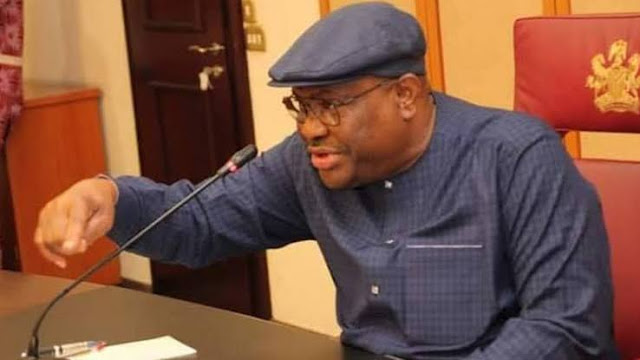
THE Minister of the Federal Capital Territory (FCT), Nyesom Wike, has accused former Minister of Transportation Rotimi Amaechi and other opposition figures of hypocrisy over their criticism of provisions in the newly signed Electoral Act 2026.
News Point Nigeria reports that speaking during a media chat in Abuja on Monday, Wike reacted to the opposition’s rejection of aspects of the amended law, particularly the clause permitting manual transmission of election results where electronic transmission fails due to poor network coverage.
Wike alleged that Amaechi and other members of the previous administration had opposed electronic transmission of results during the tenure of former President Muhammadu Buhari, arguing at the time that it could cost them elections.


“Remember under Buhari, the issue of electronic transmission came. People like Rotimi Amaechi were in government. They said ‘no, don’t sign, if you sign you lose election,’” Wike said.
He questioned why the same individuals are now advocating strongly for electronic transmission, describing their stance as politically convenient.
According to the minister, the Electoral Act 2026 does not abolish electronic transmission but introduces a safeguard to prevent voters from being disenfranchised in areas with weak or failed network connectivity.
“They did not say there should not be electronic transmission. All they said is in case, and which is likely, let us not disenfranchise people by not allowing their votes to be counted,” he explained.
Wike also defended the provision mandating direct primaries for political parties, arguing that the system would curb the influence of wealthy political elites.
He maintained that indirect primaries often empower governors, ministers, and moneybags to dominate party structures, sidelining grassroots members.

Describing Nigerians as “professional complainants,” Wike said critics had previously condemned indirect primaries for concentrating power among party elites, yet were now opposing reforms designed to democratise internal party processes.
Last week, opposition parties including the African Democratic Congress and the New Nigeria Peoples Party called on the National Assembly to immediately commence fresh amendments to remove what they described as “obnoxious” and “anti-democratic” provisions in the Electoral Act 2026.
They argued that certain clauses signed into law by President Bola Tinubu could undermine electoral transparency and weaken public trust in the voting process.


Beyond the Electoral Act debate, Wike also addressed criticism over his decision to impose a curfew ahead of the February 21 area council elections in the Federal Capital Territory.
The restriction, which limited human and vehicular movement from 8 p.m. on Friday to 6 p.m. on Saturday, drew backlash from opposition figures and residents.
Wike insisted he had the authority as the FCT minister — whom he described as the “governor” of the territory — to declare a curfew in the interest of security. He added that the measure was approved by President Tinubu.
“As the Chief Security Officer, I have a right to have a view of what is going on. I am not a candidate in the election,” he said.
Responding to criticism of his movement across polling units during the elections, Wike argued that visiting a handful of polling units could not influence results across more than 3,000 voting centres.
However, Senator Ireti Kingibe, who represents the FCT, described the curfew as autocratic.
Kingibe argued that imposing sweeping movement restrictions without broad consultation was a direct affront to democratic governance and constitutional rights.
“Any sweeping restriction on movement and livelihoods must be justified by compelling evidence, subjected to scrutiny, and carried out with transparency,” she stated.
Wike further blamed opposition parties for what he described as poor preparation for the council elections, insisting that the victories recorded by the All Progressives Congress reflected public approval of the Tinubu-led Federal Government.
The developments have intensified political debate over the Electoral Act 2026 and the balance between electoral integrity, security measures, and democratic freedoms in Nigeria’s evolving political landscape.