

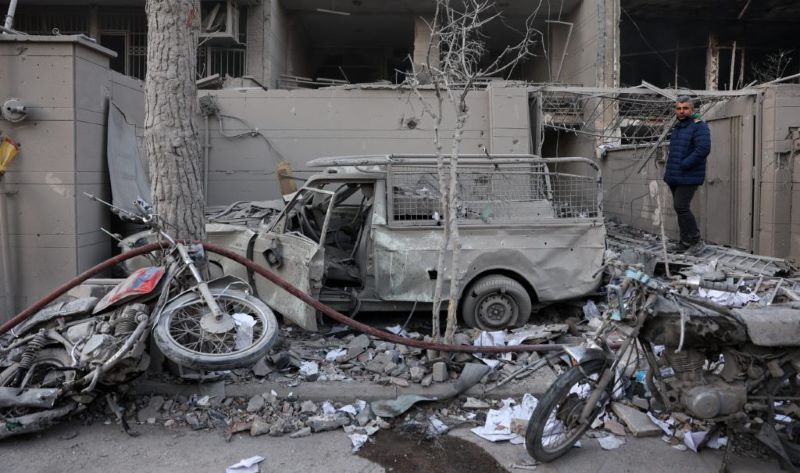
INTENSE air attacks have pounded Tehran and other Iranian cities on the seventh day of the US-Israeli war on the country, amid warnings from United States Defense Secretary Pete Hegseth that the bombardment was “about to surge dramatically”.
Israel’s military said on Friday morning it had begun a new wave of strikes on Tehran, targeting “regime infrastructure” in a “new phase” of the war, while the US said its B-2 bombers had dropped dozens of “penetrator” bombs on deeply buried ballistic missile launchers inside the country.

Huge explosions pounded locations in the Iranian capital, including targets linked to the country’s military and political establishment, as well as residential areas and the vicinity of Tehran University, according to news reports and an Al Jazeera team on the ground.


Reporting from Tehran, Al Jazeera’s Mohamed Vall reported hearing loud explosions in the latest wave of attacks.
Residential buildings in Tehran were hit, Iran’s Noor News reported, and an Iranian military academy was struck while a journalist from Iran’s state broadcaster was reporting live near the site.
Iran’s Foreign Ministry spokesman Esmail Baghaei said on X that an elementary school in Tehran’s Niloufar Square had been hit, posting footage of destroyed classrooms. Several schools have been hit in Iran since the US-Israel bombardment began, including on the first day of the war in Minab in the south that killed at least 165 schoolgirls and staff.
Of the more than 1,300 people killed in the strikes on Iran so far, at least 181 are children, UNICEF said on Friday.
Reporting from Tehran, Al Jazeera’s Tohid Asadi said the bombardment in the capital had been more intense than previously seen.
“From the very early hours of today and into the morning, we have been witnessing a continued wave of massive strikes,” he said, adding the shockwaves of the blast could be felt in the Al Jazeera bureau.

“I can say that compared to previous days, we saw heavier bombardment overnight, at least in the capital,” he said, reporting enormous explosions and fighter jets in the skies, as thick clouds of smoke from the strikes choked the city.
He said the strikes had targeted locations including near Pasteur Street, a highly secured area where key Iranian government institutions are based and where Iran’s Supreme Leader, and several family members, were killed during the early hours of the conflict.
The Office of the President of Iran is also located in the street. Strikes also reportedly hit civilian sites, including residential buildings, car parks and petrol stations, he said.


On Friday, President Masoud Pezeshkian said mediation efforts should be directed at the US and Israel. “Let’s be clear: we are committed to lasting peace in the region yet we have no hesitation in defending our nation’s dignity & sovereignty. Mediation should address those who underestimated the Iranian people and ignited this conflict,” Pezeshkian said on X.
Attacks were also reported in Iranian cities including Shiraz, Qom, Isfahan and Kermanshah, in an area home to multiple missile bases, as the Iranian Red Crescent said the death toll from attacks since Saturday had risen to at least 1,332.
Among the victims were 20 people killed and 30 injured in an attack in the Zibashahr area of Shiraz, Jalil Hasani, deputy governor of Iran’s Fars province, told Iranian state media.
Iran’s Tasnim news agency reported that two paramedics had also been killed in the city.
At least six people were injured by an Israeli missile attack on residential areas in Poldokhtar in Iran’s western Lorestan province, Tasnim reported.
Israel’s military said its air force hit six Iranian missile launchers overnight, destroying them before they fired at Israeli territory, and claimed to have destroyed “three advanced Iranian defence systems”.
In Qom, Israel’s military issued a forced displacement threat for residents in the city’s Shokouhiyeh industrial area, telling them to leave the designated zone within hours or their lives would be at risk.