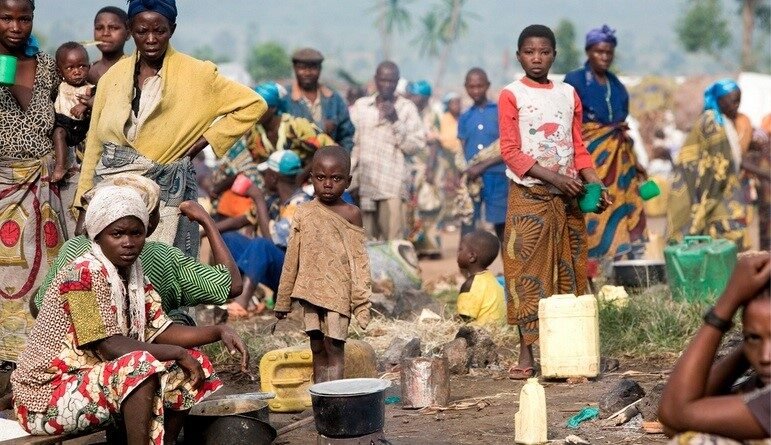
POVERTY in Nigeria rose to 63 per cent in 2025 despite a notable slowdown in inflation, highlighting the limited impact of recent macroeconomic improvements on household welfare, the World Bank has revealed.
News Point Nigeria reports that the disclosure was made in the bank’s Nigeria Development Update (April 2026) titled “Nigeria’s Tomorrow Must Start Today: The Case for Early Childhood Development,” released in Abuja on Tuesday.

Read also: Nigeria Disagrees With World Bank Over ₦7.7tn Debt Interest Payments
According to data contained in the report, the proportion of Nigerians living below the poverty line rose steadily over the period, increasing from 56 per cent in 2023 to 61 per cent in 2024, before peaking at 63 per cent in 2025.

This surge translates to roughly 140 million Nigerians living in poverty, even as inflation began to ease during the same period, underscoring a disconnect between price moderation and real income growth.
Findings by this newspaper show that Nigeria’s headline inflation rate declined sharply from 34.80 per cent in December 2024 to 15.15 per cent in December 2025, a drop of 19.65 percentage points based on figures from the National Bureau of Statistics.


Similarly, food inflation fell significantly from about 39.84 per cent in December 2024 to 10.84 per cent in December 2025, representing a decline of roughly 29 percentage points over the same period.
The sharp moderation in both headline and food inflation reflects easing price pressures and base effects following the rebasing of the Consumer Price Index (CPI). However, the earlier spike in prices had already eroded household purchasing power.
The World Bank explained that although inflation has declined considerably especially food inflation it remains sufficiently high to weaken purchasing power and worsen living conditions for many households.

“Household incomes have not grown fast enough to offset still-elevated inflation, and poverty has yet to begin declining,” the report stated.
The bank further noted that the persistence of poverty reflects the cumulative effects of earlier inflation surges, which had already weakened real incomes before the recent easing of prices. As a result, the current moderation in inflation has not been enough to reverse these welfare losses.
It also pointed to external pressures, particularly global shocks such as the Middle East conflict, which have contributed to rising living costs through higher energy, food, and transport prices.


Read also: 10.46m Households Receive ₦658.9bn As World Bank Calls For Stronger Cash Transfer Programme
According to the report, these developments are “adding pressure to inflation and poverty, including via food prices,” thereby worsening conditions for low-income households that spend a large share of their income on basic needs.
Beyond inflation, the structure of Nigeria’s economic growth was identified as a major constraint to poverty reduction.
The World Bank observed that growth has been largely driven by the services and industrial sectors, while agriculture which employs more than half of the poor has lagged behind.
“Growth in the agriculture sector where more than half of the poor work has lagged services and industry, constraining the pace of poverty reduction,” the report noted.
This imbalance, the bank explained, has limited income gains among the most vulnerable segments of the population, slowing the translation of economic growth into improved living standards.
Despite the rise in poverty recorded in 2025, the report projects a gradual decline beginning from 2026 as inflation continues to ease and macroeconomic conditions stabilise.
“Despite elevated poverty levels, a gradual decline is expected from 2026 as inflation continues to ease,” the bank stated.
It further projected that poverty, measured against the national poverty line, could decline modestly to about 59 per cent by 2028, driven largely by lower food inflation and moderate economic growth.
However, the bank warned that the pace of reduction would remain slow due to structural challenges such as weak job creation, low agricultural productivity, and persistent inequality.
The report emphasised that economic growth alone would not be sufficient to significantly reduce poverty unless it becomes more inclusive and generates jobs at scale.
Read also: Nigeria’s Passport Ranking Plunges From 90th To 181st As Visa-Free Destinations Fall To 24
It stressed the need for reforms aimed at improving livelihoods, particularly by expanding access to more productive employment opportunities.
The World Bank also linked poverty trends to broader human capital challenges, noting that poorer households tend to experience worse outcomes in nutrition, health, and early childhood development factors that reinforce long-term inequality.