

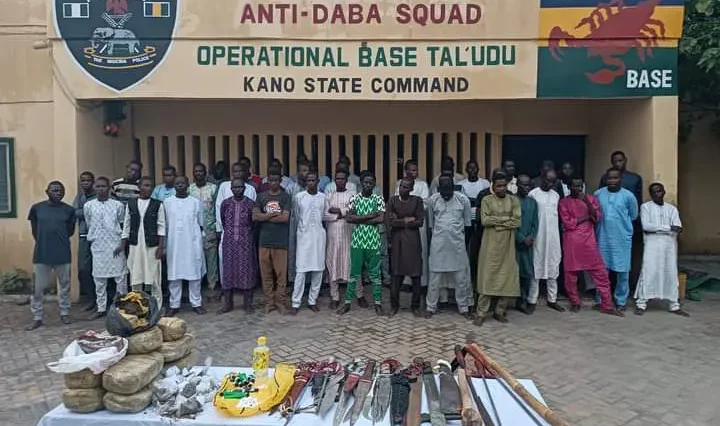
FOR decades, Kano has enjoyed a reputation as one of West Africa’s foremost commercial centres and a historic hub of Islamic scholarship, trade, and culture. However, in recent years, beneath the bustling markets, thriving businesses, and vibrant communities lies a growing security challenge that many residents say is gradually spiralling out of control.
News Point Nigeria‘s examination of the situation reveals an alarming rise in thuggery, gang violence, and politically linked mob attacks popularly known as “Fadan Daba”, a phenomenon that has increasingly transformed parts of Kano into flashpoints of violence, fear, and destruction.

From attacks on markets and shopping complexes to assaults on police officers, mosques, and public institutions, residents say nowhere appears entirely safe anymore. The consequences have been devastating: lives lost, businesses disrupted, billions of naira worth of property destroyed, and a growing sense of insecurity among ordinary citizens.


In Hausa, “Fadan Daba” or “Fadan Yan Daba” literally translates to “thug fights” or “gang wars.”
The term refers to violent clashes, territorial battles, and mob violence carried out by organised street gangs operating across various parts of Kano.
These groups are often made up of unemployed youths who engage not only in confrontations with rival gangs but also in criminal activities such as street robbery, vandalism, drug abuse, and violent muggings, including the forceful snatching of mobile phones and valuables from innocent residents.
The clashes frequently occur in densely populated metropolitan and municipal areas including Sheka, Dala, Tudun Wada, Kara, Fagge, Kurna, and several other communities across the state.
What was once perceived as isolated gang rivalry has, according to residents, evolved into a much broader security threat affecting social stability, commerce, and public safety.
Recent weeks have witnessed a disturbing escalation in attacks on commercial centres across Kano.

Residents and traders say armed thugs now move in large numbers, openly targeting markets, shopping malls, and business districts with little regard for public safety.
Among the locations reportedly attacked within the last two weeks are the popular Farm Centre GSM Market, Beirut Phone Market, and Dan Wada Shopping Mall in Sheka.
One of the most shocking incidents occurred when suspected thugs attacked a section of the popular Farm Centre GSM Market, carting away valuables belonging to traders and customers.


Traders alleged that the attackers had attended a political rally near the market before striking around noon.
News Point Nigeria could not independently verify the political gathering the suspected thugs were said to have attended.
A trader, Ibrahim Sanusi Almanzawy, described the chaos that followed.
“They attacked the plaza through the Zaria Road entrance of the market with dangerous weapons in broad daylight, carting away phones and other valuables from traders, buyers and even passersby,” he said.
According to him, the attack forced the closure of Yayo Plaza, one of the market’s major commercial centres.
“As a result of that, the whole plaza was shut down that day. Shops at the ground floor of the plaza were the worst hit as they were burgled and phones stolen,” he added.
Another trader, Muhammad Aminu, said the attackers blocked the busy Zaria Road for several minutes, forcing motorists to change routes and causing severe traffic congestion.
He said police officers later intervened and dispersed the suspects after firing tear gas.
The growing violence has not spared security personnel.
In one particularly tragic incident, a police officer attached to the Hotoro Division, identified as Sani S.O., was killed during a clash involving rival thug groups.
Sources close to the deceased told this newspaper that the officer was deployed alongside other personnel to disperse the fighting groups when he was allegedly shot by one of the thugs using a dane gun.
“He was working at the Hotoro Division and was deployed with others to disperse the thugs. Unknown to him, some of them had a dane gun, which they used to shoot him,” a source said.
The officer was rushed to hospital but was later confirmed dead.
Those who knew him described him as a respected community figure who had dedicated more than three decades of service to the country.
“He was a good person who contributed immensely to society, especially within his immediate environment. He was just a few weeks away from retirement before he was killed,” the source added.
The international human rights organisation, Amnesty International, has also expressed concern over the growing trend of violence in Kano.
The organisation strongly condemned the brutal killing of five people by armed political mobs on May 5, 2026, describing it as the biggest surge in political thuggery witnessed in recent years.
According to Amnesty International, Nigerian authorities must thoroughly investigate the incident and ensure that both perpetrators and any politicians allegedly sponsoring them are brought to justice.
A viral video reportedly showed armed political thugs moving in a mob, chasing fleeing individuals who were later violently killed.
Other videos allegedly showed victims lying in pools of blood.
Amnesty International further claimed that some of the armed thugs were seen wearing the ruling party’s T-shirts while chanting songs associated with death and destruction.
The organisation said it had received reports suggesting that supporters of certain politicians had violently targeted political opponents, whether real or perceived.
It also cited a similar incident in Gwarzo, where armed thugs allegedly working for politicians reportedly unleashed violence on residents.
According to Amnesty International, investigations are ongoing into allegations linking some prominent Kano politicians and government officials to the sponsorship of armed political thugs.
The organisation warned that the development represents a dangerous escalation in a cycle of political violence that has become increasingly frequent in recent months.
“The armed thugs reported to be working for some prominent politicians of the ruling party are increasingly posing a threat to the right to life, behaving as if they have carte blanche to kill and destroy,” Amnesty International stated.
The organisation urged authorities, politicians, and political parties to respect the rule of law and ensure that lives and property are protected before, during, and after political activities.
It also stressed that citizens’ rights to freedom of association and movement must be safeguarded.
According to Amnesty International, the rise in political violence is creating a toxic atmosphere of fear and undermining people’s ability to freely participate in politics.
Perhaps even more troubling are reports suggesting that places of worship have become targets.
A senior vigilante officer told News Point Nigeria that some thug groups now launch coordinated attacks during Subhi prayers, targeting clusters of small neighbourhood mosques.
According to the officer, the attackers often steal cash, mobile phones, and other valuables from worshippers.
He cited recent incidents in Kuntau and Karkasara as examples of such attacks.
The reports have heightened fears among residents, many of whom never imagined that mosques would become targets of organised criminal gangs.
Despite the growing concerns, the Nigeria Police Force in Kano says significant progress has been made in tackling crime.
The Commissioner of Police, Ibrahim Adamu Bakori, recently announced a substantial reduction in criminal activities during the first quarter of 2026.
Speaking during a briefing at the Command Headquarters in Bompai, Kano, Bakori attributed the achievements to strategic reforms and intensified security operations.
According to him, the command has undergone major restructuring aimed at improving efficiency and strengthening responses to emerging security threats.
“Our roadmap for 2026 is yielding tremendous results, and we are committed to maintaining and improving upon this momentum,” he said.
The police commissioner listed community policing, intelligence-led operations, officer training, the establishment of a cybercrime unit, and stronger collaboration with other security agencies as key pillars of the strategy.
He also highlighted the success of Operation Kukan Kura, which he said has played a significant role in combating thuggery across the state.
But speaking to News Point Nigeria, Security expert, Dr. Mas’ud Nasiru Alhaji expressed deep concern over the growing menace, warning that the situation is fast becoming a major threat to public safety, economic activities, and social stability.
According to Dr. Alhaji, the recurring clashes involving rival groups of youths have resulted in the loss of lives, destruction of property worth billions of naira, and widespread fear among residents. He lamented that innocent citizens are increasingly becoming victims of attacks, while businesses and livelihoods continue to suffer due to the persistent insecurity.
He noted that the activities of the thugs have gone beyond street fights, stressing that security personnel and public institutions are no longer spared. “We have witnessed cases where these criminal elements attacked police officers, vandalised police stations, disrupted activities in markets, invaded government offices, and even desecrated places of worship. When mosques, markets, and security formations are no longer safe, it is a clear indication that the situation requires urgent and decisive action,” he said.
Dr. Alhaji warned that the continued spread of Fadan Daba poses serious consequences for Kano’s reputation as a commercial hub and centre of Islamic scholarship. He argued that investors and visitors would be reluctant to come into an environment where violence appears to be escalating unchecked, adding that the social and economic costs of the crisis are already enormous.
The security expert urged the Kano State Government, security agencies, traditional institutions, religious leaders, and community stakeholders to work together in addressing the root causes of the problem. He called for more intelligence-driven policing, stricter enforcement of laws, youth engagement programmes, and the prosecution of those found culpable regardless of their status or affiliations.
Dr. Alhaji also cautioned political actors against focusing excessively on permutations and alignments ahead of the 2027 elections while pressing security challenges continue to affect ordinary citizens. “Politics is important in any democracy, but the protection of lives and property must remain the foremost responsibility of government. The conversation in Kano today should be about how to secure communities, protect businesses, and save lives, not merely about who gets what position in 2027,” he stated.
He maintained that unless urgent and sustained measures are taken, the state risks witnessing further deterioration of law and order. “The people of Kano deserve to live, worship, trade, and move freely without fear. Government must demonstrate greater commitment to tackling this menace before more lives are lost and more properties are destroyed,” he added.
As Kano grapples with the growing threat of Fadan Daba, many residents believe the state stands at a critical crossroads.
While security agencies insist progress is being made, reports of attacks on markets, roads, police officers, public institutions, and places of worship suggest that the challenge remains far from over.
The question confronting authorities is no longer whether Fadan Daba exists, but whether enough is being done to prevent it from evolving into an even more dangerous threat to public order, economic prosperity, and social cohesion.
For many residents, the answer cannot wait. Lives are being lost, businesses are suffering, and communities are living under the shadow of fear. The demand from citizens is increasingly clear: restore security, protect lives and property, and ensure that Kano remains a place where people can work, worship, and live in peace.