

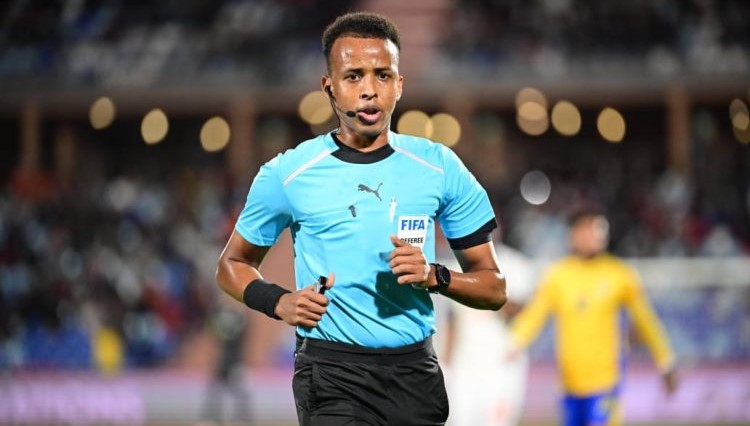
THE road to the 2026 FIFA World Cup has gathered momentum with the release of a 170-member list of centre referees, assistant referees, and Video Assistant Referee (VAR) officials.
However, the list has sparked widespread scrutiny—particularly in Africa—following the omission of five high-profile FIFA-badged referees, a decision widely linked to their controversial performances during the 2025 Africa Cup of Nations (AFCON).
News Point Nigeria Sport reports that the exclusions have drawn attention to a series of contentious officiating decisions that defined key matches at the tournament. From disputed penalties to failure to utilise VAR effectively, the performances of the affected referees have come under intense review, ultimately costing them places at the 2026 World Cup.


One of the most controversial omissions is Jean-Jacques Ngambo Ndala of DR Congo, a veteran of four AFCON tournaments. Ndala officiated four matches in Morocco, including three involving the host nation, and awarded a tournament-high three penalties. He presided over what has been described as the “shame of the century” in AFCON history during the Morocco-Senegal final.
In that match, he prematurely blew his whistle to disallow Ismaila Sarr’s second-half goal before the ball crossed the line, thereby preventing VAR intervention. He later awarded Morocco a highly controversial penalty in the dying minutes and failed to sanction Senegal after a 15-minute walk-off the pitch, an incident that drew widespread ridicule and damaged the tournament’s reputation.
Issa Sy of Senegal also came under heavy criticism for his handling of the Nigeria versus Algeria quarter-final clash. Both teams faulted his performance, accusing him of failing to consult VAR when denying Algeria an early penalty. He was also criticised for issuing yellow cards indiscriminately to Algerian players and for disallowing a goal by Calvin Bassey due to the absence of goal-line technology, despite VAR involvement.
A veteran of four AFCON tournaments and a FIFA-badged referee since 2015, Sy was further accused of poor sportsmanship after refusing to shake hands with Algerian players at the end of the match, requiring heavy security to exit the stadium. His recent conduct in a CAF Champions League match—where he was criticised for displaying a red card without clear justification—further compounded concerns and likely diminished his chances of selection for the World Cup.
Ghana’s Daniel Nii Laryea also faced intense scrutiny for his performance in the Morocco versus Nigeria semi-final. The backlash was so significant that a coordinated reporting campaign led to the takedown of his Instagram account. While the “towelgate” controversy that later affected the final began under his watch, it was his on-field decisions that attracted the most criticism.
Despite 22 fouls committed by Moroccan players, none received a yellow card, while Nigeria’s Calvin Bassey was booked for what was described as a phantom foul. Laryea was accused of disrupting Nigeria’s attacking rhythm by frequently stopping play for fouls, while allowing Morocco greater continuity. Upon returning to Ghana, he admitted that the semi-final—the first of his career—was his most difficult match. He was subsequently relegated to officiating Confederation Cup matches, a development that contributed to his exclusion from the World Cup list.

Malian referee Boubou Traoré was also omitted after a controversial performance in the Morocco versus Tanzania round-of-16 clash. Traoré was accused of denying Tanzania a crucial penalty in the dying moments of the match, thereby robbing the Taifa Stars of an opportunity to push Morocco further.
He also failed to consult VAR to review what was widely considered a clear and obvious error, prompting protests from the Tanzanian bench. CAF swiftly withdrew the 37-year-old from the tournament, and he has not officiated any major continental fixture since then. His omission from the World Cup list marks a significant setback in his career.
Cameroon’s Abdou Abdel Mefire, the youngest referee at AFCON 2025 at 29, also failed to make the list. In the Morocco versus Mali match, he awarded two penalties—one to each side—both of which were widely regarded as soft decisions. Critics argued that he lacked the experience required for matches at that level, leading CAF to send him home for performances deemed unsatisfactory.


More recently, he required security protection after controversial decisions in a CAF Champions League match, further raising concerns about his officiating. The accumulation of these incidents, coupled with his omission from the World Cup roster, represents a major setback for the young referee’s career.
The absence of these five referees from the 2026 FIFA World Cup list underscores the growing emphasis on accountability and performance in global officiating. It also highlights how controversial decisions on the continental stage can have lasting consequences on the careers of match officials.