

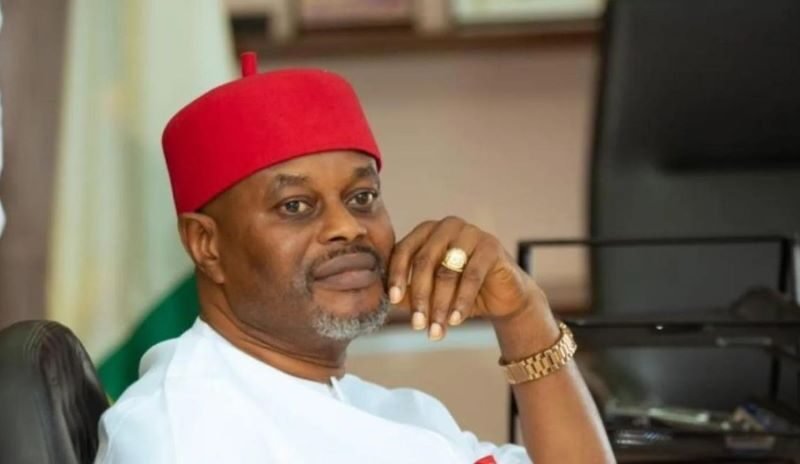
A FORMER Minister of Science, Innovation and Technology, Uche Nnaji, alongside the University of Nigeria, Nsukka (UNN) and other parties in a certificate forgery dispute, have commenced moves to resolve the matter out of court, effectively halting further proceedings in the case for now.
News Point Nigeria reports that the latest development emerged on Monday during proceedings before Justice Hauwa Yilwa of the Federal High Court in Abuja, where the matter had been scheduled for the hearing of pending applications.
Nnaji had initially approached the court in October 2025, following an investigation by Premium Times which alleged that he forged both his first degree certificate and National Youth Service Corps (NYSC) certificate. The report also accused the former minister of submitting the disputed documents to President Bola Tinubu and the Senate during his ministerial screening.


Amid the controversy that trailed the allegations, Nnaji later resigned from his ministerial position, explaining that he did not want the issue to distract from the activities of the administration.
Despite the gravity of the claims, the case has experienced prolonged delays since it was filed, largely due to procedural setbacks. These included challenges surrounding the service of court processes and multiple preliminary objections raised by the defendants.
When the case was called on Monday, counsel to Nnaji, Ope Muritala, informed the court that although the matter was slated for hearing, there had been a fresh development. He disclosed that parties were now exploring an amicable resolution and requested an adjournment to allow negotiations to continue.
“There is a new development as parties are exploring an out-of-court settlement,” he told the court.
Lawyers representing the first and second defendants—the Minister of Education and the National Universities Commission (NUC)—P.C. Ike and N.H. Obah, said they were not previously aware of the settlement discussions until arriving in court. However, they did not oppose the application for adjournment to enable the talks to proceed.
In contrast, counsel to the third to seventh defendants, including the University of Nigeria, Nsukka and its principal officers, Chidubem Ugwueze, confirmed that the move towards settlement had earlier been communicated.

Ugwueze informed the court that a Senior Advocate of Nigeria, Chris Uche, who is leading the defence team, had relayed the development to him. He added that the information originated from another Senior Advocate, Wole Olanipekun, who is representing Nnaji.
While he did not oppose the proposed settlement talks, Ugwueze urged the court to proceed with hearing the defendants’ pending motion for regularisation in the event that the negotiations collapse.
However, Justice Yilwa declined the request, noting that it would be more appropriate to consider such applications only if efforts at out-of-court resolution fail.


Consequently, and in view of the disposition of all parties, the court adjourned the matter to July 8, 2026, for a report on settlement or continuation of proceedings.
The suit itself centres on Nnaji’s attempt to prevent the release or alleged tampering of his academic records by the university and its officials.
In an ex parte application filed before the court, the former minister sought leave to apply for prerogative orders, including an order of prohibition restraining the university and its officials from interfering with his academic records.
He also requested an order of mandamus compelling the institution to release his academic transcript. Additionally, he urged the Minister of Education and the NUC to exercise their supervisory roles to ensure compliance with the request.
On their part, the defendants, through their preliminary objection, asked the court to strike out the case on the grounds that it is incompetent and that the court lacks jurisdiction to entertain it.
They argued that the application was filed outside the statutory time frame stipulated under Order 34 Rule 4(1) of the Federal High Court (Civil Procedure) Rules 2019, as well as Section 2(a) of the Public Officers Protection Act.