

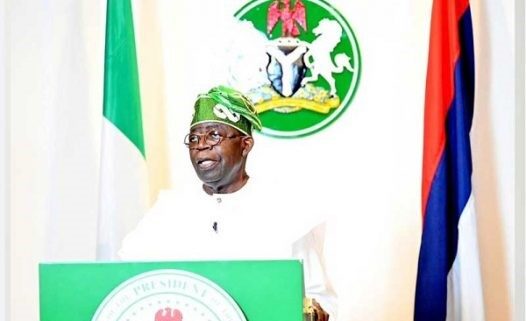
PRESIDENT Bola Ahmed Tinubu has declared that Nigeria is gradually recovering from years of economic and structural challenges, insisting that the difficult reforms introduced by his administration were necessary to prevent the country from sliding into fiscal collapse.
In a statement sent to News Point Nigeria marking the third anniversary of his administration on May 29, 2026, the President said Nigerians had made enormous sacrifices over the past three years but assured citizens that the country was now stabilising and moving forward again.
Addressing Nigerians as “fellow compatriots,” Tinubu recalled that three years ago citizens entrusted him with the responsibility of leading the nation at a defining moment in its history.


According to him, he accepted the responsibility with full awareness of the enormous challenges facing the country, while remaining confident in the resilience and potential of Nigerians.
The President said he was speaking not only as the nation’s leader but also as a fellow citizen who understands the sacrifices many families have endured and shares the hopes of Nigerians for a better future.
Tinubu stated that when his administration assumed office, Nigeria was confronted with profound economic and structural difficulties, including mounting fiscal pressures, unsustainable fuel subsidies, declining revenues, exchange-rate distortions, rising debt-servicing costs, insecurity in several parts of the country, energy supply constraints, and declining public confidence in institutions.
He disclosed that at the peak of the subsidy regime, Nigeria spent as much as ₦18.4 billion daily on petrol subsidies, amounting to over ₦4 trillion in 2022 alone.
According to him, such resources could have been invested in roads, healthcare, education, housing, and other critical infrastructure.
The President also criticised the multiple exchange-rate windows previously in operation, saying they created massive distortions and caused Nigeria to lose more than ₦8 trillion over three years through rent-seeking and speculative practices.

Tinubu maintained that the situation required urgent and courageous action to stabilise the economy and avert a deeper national crisis.
“The easy choices would have been politically convenient. But leadership demands courage, especially when the right decisions are difficult,” he stated.
According to the President, refusing to act would have pushed the nation toward fiscal breakdown, worsening poverty, and severe economic uncertainty.


“Together, we chose reform over ruin and decisiveness over hesitation. We chose long-term national recovery over short-term comfort,” he added.
Tinubu acknowledged that the reforms came with painful consequences, especially the rising cost of living, which placed heavy pressure on families, workers, and businesses across the country.
He noted that many young Nigerians searching for jobs became discouraged, while others questioned whether the difficult decisions would ultimately produce a better future.
However, the President assured Nigerians that their sacrifices had not been in vain.
“And today, I can say with confidence that Nigeria has stabilised and is moving forward again. Across the country, visible progress is taking shape,” he said.
Tinubu said Nigeria’s economy had become more competitive and better positioned for sustainable growth than it was in 2023.
He stated that public finances were improving, while states and local governments now had greater resources to invest in their people.
According to him, investor confidence was also growing significantly.
The President highlighted developments in the stock market, noting that the All Share Index rose from 53,000 and market capitalisation of ₦30 trillion in 2023 to a record All Share Index of 250,000 and market capitalisation of ₦160 trillion in 2026.
He added that companies were now declaring record profits and dividends.
Tinubu further disclosed that over 2,700 kilometres of highways and major roads were currently under construction, reconstruction, or rehabilitation across the country.
He listed projects including the Lagos-Calabar Coastal Highway, the Sokoto-Badagry Super Highway, the Abuja-Kaduna-Zaria-Kano Road, the East-West Road, and several rural access roads.
According to him, significant portions of the projects had either been completed or were nearing completion, improving transportation, reducing travel time, boosting regional trade, and creating thousands of jobs.
The President also said rail modernisation projects were ongoing nationwide to improve connectivity, logistics, and economic integration.
In the oil and gas sector, Tinubu stated that reforms introduced by his administration had attracted billions of dollars in fresh investment from international oil companies that previously avoided Nigeria.
He said the $5 billion NLNG Train 7 project was nearing completion and would boost LNG production capacity, exports, and dividends.
Tinubu also noted that domestic gas utilisation was expanding, while improved local refining capacity had strengthened Nigeria’s energy security.
According to him, the operation of large-scale domestic and modular refineries was helping Nigeria reduce dependence on imported petroleum products and conserve foreign exchange.
Speaking on electricity, the President said the power sector had suffered for years from debt, underinvestment, and uncertainty, which weakened generation capacity and limited economic growth.
He said his administration was now confronting those challenges directly by clearing legacy obligations, expanding transmission infrastructure, investing in renewable energy, and strengthening the national grid.
“No modern economy can grow in darkness. When power improves, businesses expand, industries grow, jobs are created, and families prosper,” Tinubu said.
He added that the administration remained determined to power Nigeria into a new era of industrial growth and economic opportunity.
Tinubu stated that government agricultural interventions had supported millions of farmers through improved seedlings, fertilisers, mechanisation, irrigation, and expanded access to finance and markets.
He added that new agricultural corridors were being opened to create jobs, strengthen supply chains, and reduce pressure on household incomes.
The President also highlighted the achievements of the Nigerian Education Loan Fund, saying more than 1.5 million students had gained access to higher education through the scheme.
According to him, over ₦282 billion had been disbursed to ensure no willing student was denied education because of financial hardship.
Tinubu further disclosed that the Renewed Hope Housing Programme and the Federal Housing Authority were delivering over 10,000 housing units across 14 states and the FCT.
He said the initiative had already created over 300,000 jobs while expanding access to affordable housing.
The President noted that major Renewed Hope Cities in Abuja, Lagos, and Kano were progressing steadily.
He also said the consumer credit initiative, CREDICORP, was opening new economic opportunities for workers and families.
In healthcare, Tinubu stated that thousands of primary healthcare centres were being revitalised, while health insurance coverage was expanding for vulnerable Nigerians.
The President said his administration also took decisive steps to stabilise the telecommunications sector, describing it as one of the most important drivers of modern economic growth.
According to him, confidence was gradually returning to the sector after years of operational pressures and declining investment.
Tinubu stated that telecom operators were expanding networks, investing in infrastructure, recruiting Nigerian talent, and widening digital access across the country.
“A connected Nigeria is a more competitive Nigeria,” he said, adding that digital infrastructure had become essential for commerce, education, innovation, and productivity.
Addressing Nigerian youths, the President said the nation believed in them and viewed them as the engine of Nigeria’s future rather than a problem to be managed.
He said government was expanding opportunities for young people in technology, manufacturing, creative industries, agriculture, sports, and entrepreneurship.
Tinubu added that investments were also being made in digital skills, technical education, innovation, student financing, and enterprise support.
On security, Tinubu described it as central to the administration’s national mission and the creation of a prosperous society.
He said the Armed Forces and security agencies had intensified operations against terrorists, bandits, kidnappers, oil thieves, and criminal networks.
While admitting that challenges remained, the President stated that many communities and highways were becoming safer and more economically active.
He disclosed that government continued to invest in intelligence, surveillance, logistics, technology, and inter-agency coordination.
According to him, efforts were also ongoing to improve the capabilities of security agencies and reclaim the authority of the Nigerian state wherever criminality threatened peace and order.
“I want to assure you that this government will not relent until every Nigerian can live, work, travel, and dream in safety,” he said.
Tinubu said national development could only occur when citizens were able to see and feel progress.
He admitted that although the administration had not solved every problem, the foundation for national recovery had been laid.
The President said the next phase was to ensure that the benefits of reforms were felt more directly in the daily lives of ordinary Nigerians.
According to him, government would continue efforts to keep food prices low and reduce transportation costs through the conversion of commercial vehicles from petrol engines to CNG and electric alternatives.
He also pledged to create more opportunities for decent work and business expansion.
Calling for national unity, Tinubu said the journey of renewal could not be completed within a single year or administration.
“Nations rise when their people remain united in purpose, disciplined in effort, and hopeful about the future,” he stated.
The President urged Nigerians to choose hope over despair, unity over division, and nation-building over narrow interests.
He stressed that no region, faith, or ethnic group should feel marginalised or forgotten, insisting that Nigeria’s diversity remained a source of strength.
“Whether Christian or Muslim, North or South, urban or rural, we rise or fall together as one nation under God,” he said.
Tinubu also commended youths, workers, entrepreneurs, farmers, professionals, security personnel, students, and Nigerians in the diaspora for their sacrifices toward sustaining the nation.
To the international community and investors, he reaffirmed Nigeria’s commitment to democratic stability, economic reform, responsible governance, and mutually beneficial partnerships.
Reflecting on Nigeria’s history, Tinubu said great nations were not built in comfort but through sacrifice, resilience, courage, and collective purpose.
He noted that Nigeria survived civil war, overcame dictatorship, restored democracy, and endured economic hardship while remaining a nation of hope.
“The Nigerian spirit remains strong and unbroken,” he declared.
According to him, the world was beginning to watch Nigeria again not merely as a country defined by its difficulties but as a nation determined to rise.
Tinubu said signs of recovery were becoming increasingly visible across agriculture, infrastructure, power, technology, manufacturing, and industry.
“Confidence is returning. Productivity is improving. Opportunity is expanding,” he added.
The President, however, admitted that enormous work still lay ahead but maintained optimism because of his belief in Nigeria and its people.
He urged Nigerians to reject cynicism and division and instead move forward together in unity, discipline, compassion, and confidence.
“History tests nations before it elevates them. Nigeria is passing through such a test. But I believe with all my heart that we shall emerge stronger, fairer, more united, and more prosperous than ever before,” Tinubu stated.
He concluded by calling on citizens to continue building a Nigeria that is secure, prosperous, inclusive, and respected globally.
“May God bless you all. May God bless the Federal Republic of Nigeria,” the President added.