

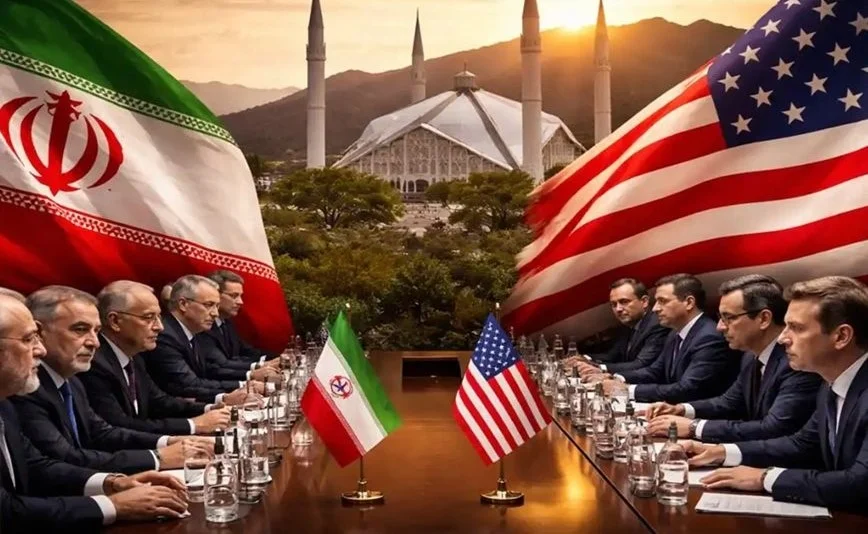
THE United States and Iran have signed a landmark memorandum of understanding aimed at ending the Middle East war, with a formal ceremony scheduled for Friday in Switzerland to mark the beginning of a crucial 60-day negotiation period intended to secure a comprehensive and lasting peace agreement.
News Point Nigeria reports that the agreement seeks to bring an end to months of conflict triggered by US-Israeli strikes on Iran in February, a war that plunged parts of the Middle East into turmoil, disrupted regional stability, rattled global markets and heightened fears of a wider confrontation involving multiple regional powers.

The memorandum, which was electronically signed on Thursday by US President Donald Trump and Iranian President Masoud Pezeshkian, was confirmed by Pakistan’s Prime Minister, Shehbaz Sharif, who played a key mediation role in the negotiations. Sharif said a ceremony would be held in Switzerland on Friday to commemorate what he described as a landmark event and to formally commence technical-level negotiations between both sides.

Under the terms of the agreement, the United States, Iran and their respective allies agreed to an immediate and permanent cessation of military operations on all fronts, including in Lebanon. Both sides also pledged not to initiate any war or military action against each other, refrain from threats or the use of force, and respect the territorial integrity and sovereignty of Lebanon.


A central feature of the agreement is a commitment by both nations to negotiate and achieve a final settlement within a maximum of 60 days, although the deadline may be extended by mutual consent. The final agreement, once reached, is expected to be endorsed through a binding resolution of the United Nations Security Council.
The memorandum also outlines an ambitious economic recovery package for Iran. The United States and its regional partners will work on a plan worth at least $300 billion for the reconstruction and economic development of the Islamic Republic. While the deal references the funding framework, US officials insist it does not commit Washington to directly paying Iran any money.
On the nuclear issue, Iran reaffirmed that it would neither procure nor develop nuclear weapons. However, despite President Trump’s repeated assertions that the agreement guarantees Iran will never develop a nuclear weapon, the text stops short of explicitly providing such guarantees.
Instead, the agreement commits Iran to maintaining the current status of its nuclear programme during negotiations while agreeing to a process that would see its stockpile of highly enriched uranium downblended under the supervision of the International Atomic Energy Agency (IAEA). The mechanism for handling Iran’s enriched uranium is still to be negotiated and agreed upon during the 60-day talks.
Senior US officials described the uranium concession as significant, but acknowledged that critical technical details, implementation timelines and verification procedures remain unresolved and will form part of the upcoming negotiations.

The agreement also includes major economic and security concessions. The United States pledged to immediately begin dismantling its blockade of Iranian ports imposed on April 13 and complete the process within 30 days. Washington further undertook not to impose additional sanctions or deploy extra military forces to the region while negotiations continue.
In addition, the US committed to terminating all categories of sanctions against Iran and making available frozen or restricted Iranian assets once the memorandum is fully implemented. The US Treasury is also expected to issue immediate waivers allowing exports of Iranian crude oil, petroleum products and related services, including banking transactions, insurance and transportation, pending the full lifting of sanctions.
On the maritime front, Iran agreed to facilitate the safe passage of commercial vessels through the Strait of Hormuz and surrounding waterways for an initial 60-day period. Commercial traffic is expected to resume immediately and return to full operational levels within 30 days after mines are cleared from the strategic waterway.


The agreement further states that the United States will remove its forces from areas close to Iran within 30 days after a final deal is reached.
Despite the diplomatic breakthrough, significant questions remain regarding the prospects of a lasting settlement. Analysts note that the memorandum effectively reopens the Strait of Hormuz and extends the ceasefire, while leaving many of the most contentious issues to be settled during the next phase of negotiations.
One of the biggest uncertainties revolves around whether the Trump administration can achieve in 60 days what took the administration of former President Barack Obama approximately 20 months to negotiate in the lead-up to the 2015 Iran nuclear agreement.
The issue of financial assistance to Iran has also emerged as a potential source of controversy in Washington. President Trump has repeatedly criticized the Obama administration’s $1.7 billion payment to Iran in 2016 and has maintained that his administration will not provide direct funding to Tehran.
However, the memorandum’s language regarding the proposed $300 billion reconstruction plan has raised questions among critics who argue that the agreement could eventually result in financial commitments benefiting Iran.
The deal has already attracted criticism, including from members of Trump’s own Republican Party. Several lawmakers have demanded detailed briefings from the administration, citing concerns about unresolved issues and the scope of concessions made to Tehran.
Among the most vocal critics was outgoing Republican Senator Bill Cassidy of Louisiana, who argued that the agreement failed to adequately address Iran’s nuclear ambitions.
“Iran’s nuclear ambitions were not curbed, and they have learned that threatening the Strait of Hormuz works and will undoubtedly leverage it in the future,” Cassidy wrote on X.
“This is the worst foreign policy blunder in decades,” he added.
Other key issues that featured prominently at the start of the conflict also received limited attention in the agreement. The memorandum briefly references the cessation of hostilities involving Hezbollah, the Iran-backed Lebanese militant group, but offers little detail on whether Tehran will be required to curtail support for Hezbollah or other regional proxy groups.
Similarly, Iran’s ballistic missile programme another issue repeatedly highlighted by both Trump and Israeli Prime Minister Benjamin Netanyahu during the conflict is not addressed in significant detail within the current framework.
Whether the agreement signed this week ultimately leads to a comprehensive peace accord remains uncertain. Although both sides have committed to the 60-day timeline, the provision allowing extensions suggests negotiators recognise the complexity of the issues still on the table.
Even President Trump appeared cautious about the prospects of a final breakthrough during his remarks at the G7 summit in France.
“If it doesn’t get done in 60 days, it’s all right,” Trump said. “We go back to bombing.”