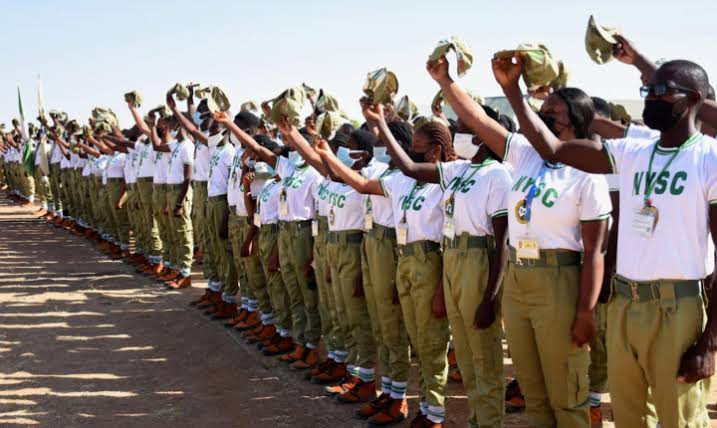
MORE than five decades after it was established to heal a nation emerging from civil war, the National Youth Service Corps (NYSC) is set for its most sweeping transformation yet.
News Point Nigeria reports that the Federal Executive Council (FEC), presided over by President Bola Ahmed Tinubu, has approved the first holistic reform of the NYSC since its creation in 1973, fundamentally altering its leadership structure, operational model, training curriculum and overall national mandate.

Read also: Tinubu Makes History As First Nigerian President In 66 Years To Receive UN Budget
The reforms represent the most significant restructuring in the scheme’s 53-year history, signalling a shift from a largely mobilisation-focused programme to one centred on skills acquisition, productivity, entrepreneurship, employment and economic development.

To ensure immediate implementation, the Federal Executive Council directed the Attorney-General of the Federation and the Federal Ministry of Youth Development to amend the NYSC Act and all relevant regulations to reflect the approved reforms.
Perhaps the most symbolic change is the decision to place the operational leadership of the NYSC under a civilian Director-General for the first time, ending more than five decades of military administrative leadership.


However, the military will continue to oversee security operations relating to corps members nationwide.
According to government officials, the move is intended to reposition the NYSC as a civilian-led, skill-oriented, productivity-driven and youth-empowering institution capable of contributing directly to the administration’s ambition of building a $1 trillion Nigerian economy.
Currently, the NYSC is headed by Brigadier General Olakunle Nafiu.

Speaking after Monday’s Federal Executive Council meeting at the Presidential Villa, Abuja, the Minister of Youth Development, Ayodele Wisdom Olawande, explained that although the NYSC has successfully promoted national unity for over five decades, Nigeria’s priorities have evolved.
“The NYSC was created in 1973 to promote national unity after the civil war. For 53 years, it has helped bring together Nigerian graduates and strengthen national unity.
“But today, our needs as a country have changed, and many expect the objectives of NYSC to also change,” he said.


According to the minister, the review committee constituted in 2025 identified numerous challenges, including outdated legislation, weak connections between university education and employment opportunities, as well as persistent concerns over corps members’ safety and welfare.
The Ministries of Youth Development and Education, alongside the Office of the Special Adviser to the President on Policy Coordination, subsequently developed the reform framework presented to FEC for approval.
One striking feature of the reforms is the government’s attempt to redefine the purpose of national service.
Rather than serving primarily as a one-year posting programme, the new NYSC seeks to become an organised national platform for workforce development, entrepreneurship, innovation and productivity.
Special Adviser to the President on Policy Coordination, Hadiza Bala Usman, repeatedly linked the reforms to President Tinubu’s economic vision.
“There is a need for us to intervene to build the present ambition of a $1 trillion economy by repositioning the NYSC as a civilian-led, skill-oriented, productivity-driven and youth-empowering national institution,” she said.
According to her, strengthening Nigeria’s human capital is essential to creating the workforce needed for long-term national development.
One of the biggest structural changes is the segmentation of corps members into 11 specialised professional streams.
Rather than undergoing uniform training regardless of discipline, graduates will now select specialised pathways based on their academic background, interests and career ambitions.
The eleven streams include:
Agriculture Corps
Medical Corps
Education Corps
Technology and Digital Corps
Legal Corps
Public Service Corps
Infrastructure Corps
Green Corps
Enterprise Corps
Creative Economy Corps
Paramilitary and Security Corps
According to Bala Usman, every corps member will choose a stream immediately after mobilisation.
“So each corps member, once he has uploaded and has been recognised and accepted as a corps member, is required to pick one of those corps.
“Once he registers in that, then we recognise him as a Medical Corps, Education Corps or whichever stream he selects, and specialised training will be provided.”
Another major reform affects the famous orientation camp.
Rather than the existing programme, the six-week orientation period will now follow three structured phases.
The first two weeks will focus on civic responsibility, national values and leadership development.
“The first two weeks speak to laying a foundation on civic responsibility.
“You’ll be made aware of what civic duties mean, our national values and leadership development.”
The second two weeks will concentrate on career mapping, entrepreneurship and financial literacy.
“The next two weeks will look at career mapping, basic accounting literacy skills, business planning, access to finance and introduce a structured career day programme.”
Read also: ‘APC Has Run Out Of Ideas On Insecurity’, ADC Slams Yari’s Remark On Tinubu
The final two weeks will deliver specialised training aligned with each corps member’s selected professional stream.
For programmes requiring longer certification—particularly within the Technology and Digital Corps—the training may extend for three to six months.
“We want them to have skills that will enable them to be self-employed,” Bala Usman explained.
Security has remained one of the biggest concerns surrounding NYSC.
The reforms therefore also review deployment procedures.
Government officials said the new framework considers security realities in deciding postings while retaining the military’s responsibility for protecting corps members nationwide.
“We recognise that NYSC is spread across the whole country, and security is a core aspect of ensuring the safety of our corps members.
“The safety aspect still remains with the military, but the operational leadership of NYSC will be civilian-led,” Bala Usman stated.
The reforms extend beyond administration and training.
Government approved the redesign of the NYSC uniform to reflect a more professional identity while retaining its unique character.
Similarly, the traditional Passing-Out Parade will be redesigned and renamed as a graduation ceremony.
News Point Nigeria Analysis: Tackling the Japa Challenge Differently
Rather than attempting to stop Nigerian graduates from leaving the country, government officials say the reforms seek to make migration economically beneficial.
Responding to questions on the “Japa” phenomenon, Bala Usman argued that brain drain cannot simply be prevented.
“Brain drain is something that we cannot stop as a country.
“We’re looking to see how we can produce more graduates that will enable us to have more and actually export and earn foreign exchange from the brain drain.”
She cited India’s experience, where many professionals eventually returned home with expertise and investments.
“What happened in India: they left, and now they are back to promote and support various areas within the tech industry; this is the model.”
The National Youth Service Corps was established through Decree No. 24 of May 22, 1973, following Nigeria’s civil war.
Its primary objective was to reconstruct, reconcile and rebuild the country by encouraging common ties among Nigerian youths and promoting national unity.
For 53 years, the scheme has remained one of Nigeria’s most recognisable institutions.
Beyond NYSC, the Federal Executive Council approved several strategic projects.
One of the most significant is the establishment of a National Snakebite Research and Medical Centre in Kaltungo, Gombe State.
According to the Coordinating Minister of Health and Social Welfare, Professor Ali Pate, snakebite remains one of Nigeria’s most neglected public health challenges.
The centre will provide specialised treatment, conduct research, train healthcare professionals and improve access to quality anti-snake venom.
Pate disclosed that Nigeria records more than 43,000 snakebite cases annually, many resulting in death, disability, disfigurement and severe socioeconomic consequences.
FEC also approved:
Procurement of tuberculosis commodities worth N62 billion
Reproductive health commodities worth N25 billion
Ten compressed natural gas-powered blood donation vans worth N6.9 billion
Construction of the Gboko Airstrip in Benue State at N34.39 billion
According to Minister of Aviation and Aerospace Development, Festus Keyamo (SAN), the airstrip will support agriculture, humanitarian operations, emergency medical services and security operations across the Middle Belt.
With FEC’s approval secured, the next stage involves legislative amendments to the NYSC Act to provide legal backing for the reforms.
Read also: AAC Writes Tinubu, Seeks Aso Rock Venue For Campaign Council Inauguration, Food For 5,000
Once enacted, Nigeria will formally begin implementing the most comprehensive transformation of its national service programme since its establishment over five decades ago.
For millions of Nigerian graduates, News Point Nigeria observes that the reforms represent far more than administrative adjustments—they signal a fundamental redefinition of what national service is intended to achieve, shifting its emphasis from mobilisation alone to preparing young Nigerians with the skills, knowledge and entrepreneurial capacity expected to drive national development and support the country’s long-term economic ambitions.