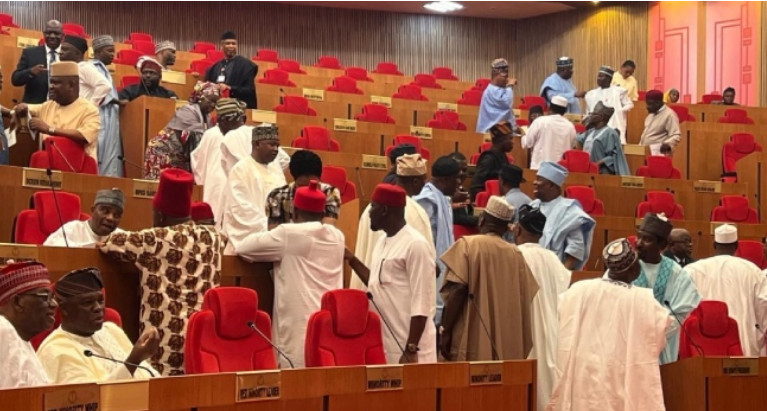
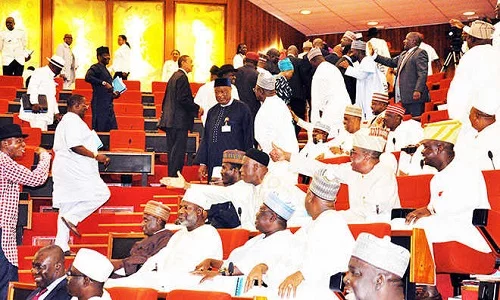
ABDULLAHI Saidu, President Bola Tinubu’s nominee for chairman of the board of the Fiscal Responsibility Commission (FRC), has said the commission has been without a board for more than 13 years, a situation he said has hindered its ability to carry out its mandate effectively.
Speaking on Thursday during the screening of nominees for the commission’s board by the Senate Committee on Finance, News Point Nigeria reports that Saidu identified the prolonged absence of a board, inadequate institutional structures and limited statutory powers as major obstacles to the commission’s effective performance.

Read also: Tinubu Sends NDLEA, Safety Investigation Bureau, National School Of Government Bills To Senate
In July, Tinubu nominated Saidu as chairman of the FRC, while Muhammad Asma’u, Muhammad Makama, Suleiman Gidado, Louis Ndukwe, Amechi Ugwele and Olaniyi Onikola were nominated as members of the board.

Saidu previously served as a board member of the Independent Corrupt Practices and Other Related Offences Commission (ICPC). Former President Muhammadu Buhari appointed him to the position on February 4, 2019, before reappointing him on March 15, 2023.
During the screening, Saidu said the commission lacked the necessary institutional structure and powers to perform its functions effectively. He added that, if confirmed, the proposed board would work with the National Assembly and other stakeholders to strengthen the agency.


“The commission has been without a board for more than 13 years now. So now this board, it’s like we are virtually going to start all over because there was nothing in place,” he said.
Saidu disclosed that the commission was supposed to have offices in at least one location in each geopolitical zone of the country but currently operates only from Abuja.
He pledged that, if confirmed, the board would work with the National Assembly to review the law establishing the commission, with a view to strengthening its independence and operational capacity.
“I am assuring that, if we go in, we will work hard to liaise with the national assembly to see how we are going to strengthen the Act, which will empower us to do our work independently and effectively,” he said.
The nominee also disclosed that the commission lacked prosecutorial powers, explaining that it could only investigate matters and forward its findings to the Attorney-General of the Federation for prosecution.
Read also: Tinubu Orders Security Chiefs To Destroy All Bandit Camps, Rescue Abducted Victims

“Because right now, we cannot do anything. We don’t have prosecution power; we don’t have any power,” he said.
“We were told we can only investigate and send our report to the honourable attorney general and minister of justice for prosecution.”
Beyond strengthening the commission’s institutional capacity, Saidu pledged to improve government revenue by monitoring operating surpluses generated by government-owned and scheduled organisations.
According to him, some revenue-generating organisations fail to remit the appropriate portions of their operating surpluses to the Federal Government, thereby undermining the commission’s responsibility to monitor compliance with fiscal rules.
He explained that such organisations were expected to remit 80 per cent of their operating surpluses to the Consolidated Revenue Fund while retaining the remaining 20 per cent for their operations.
“Because the commission is not informed, so they just declare whatever they feel they want to declare,” he said.
Saidu said the commission would strengthen its monitoring of operating revenue if the nominees were confirmed, in a bid to ensure that the relevant organisations complied with the prescribed remittance requirements.
He also pledged to examine the revenue practices of agencies that are fully funded through the national budget.
Read also: How Neighbours Discovered Senator Bello Mandiya’s Body After Three Days In Abuja, Ningi Tells Senate
“If we are given an opportunity and we are confirmed, we will monitor that operating revenue properly,” he stated.
Saidu expressed confidence that the proposed board would improve the commission’s performance within a year, provided it received the necessary support from the National Assembly and other stakeholders.