

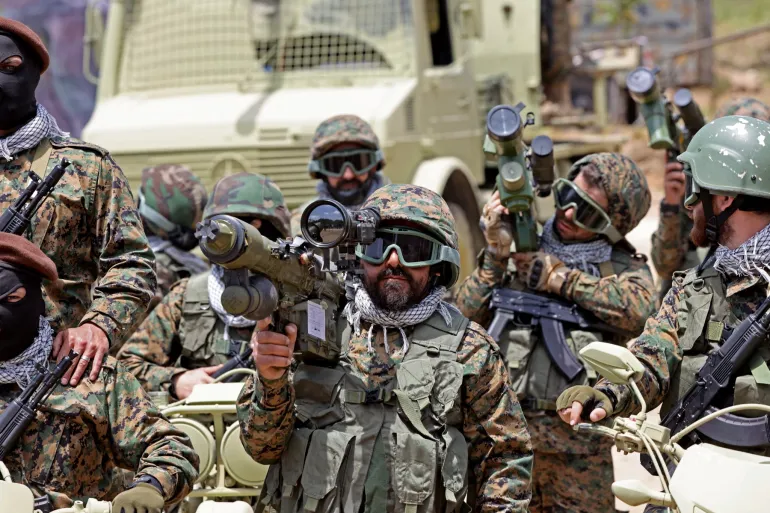
ISRAEL and Hezbollah agreed a ceasefire on Friday, a US official said, after deadly exchanges between the two sides in Lebanon put a deal to end the Middle East war under strain, less than two days after it was signed.
Talks that were scheduled to take place between the US and Iran in Switzerland on Friday to build on the deal and work towards a lasting settlement were postponed amid the fighting, with no new date announced.

Tehran’s top negotiator warned it would not bend on its red lines and that its finger was still “on the trigger”, even as shipping appeared to pick up in the Strait of Hormuz, which had essentially been closed during the war.

The deal signed this week by President Donald Trump and his Iranian counterpart Masoud Pezeshkian aims to end a war that began on February 28 with US-Israeli strikes that killed supreme leader Ayatollah Ali Khamenei.


The agreement was also meant to halt the fighting in Lebanon, which Iran has always insisted should be covered under any accord, turning Israel’s ongoing campaign there into a source of frustration for Washington.
Israel’s military said Friday that it had struck more than 80 Hezbollah targets in Lebanon and killed dozens of members of the Iran-backed group.
An Iranian woman walks past a mural depicting late Iranian supreme leaders Ayatollah Ali Khamenei (L) and Ayatollah Ruhollah Khomeini (R) in Tehran on June 18, 2026. Photo: AFP
Lebanon said 47 people were killed and 97 others wounded in Israeli strikes on Lebanon Friday. Israel’s military reported four troops were killed.
But a US official told AFP a truce between Israel and Hezbollah, beginning immediately, had been brokered by US and Qatari mediators following talks with Israel and Iran. A Gulf diplomat confirmed the ceasefire.

Yet even after the truce was announced, Lebanese state media reported an Israeli airstrike on the country’s south in the Jezzine region.
A previous truce nominally agreed in April did nothing to stop attacks by either side, and Prime Minister Benjamin Netanyahu had said just hours earlier that the Israeli army would stay in Lebanon “as long as necessary” and would make Iran-backed Hezbollah pay a “heavy price” for its attacks.
Far-right Israeli National Security Minister Itamar Ben Gvir went even further, saying after the soldiers’ deaths that “all of Lebanon must burn”.


Iran’s Foreign Minister Abbas Araghchi accused Israel of only being interested in “permanent war”.
Preparations had been made to host Iranian and US delegations led by Tehran’s top negotiator Mohammad Bagher Ghalibaf and US Vice President JD Vance at the Swiss resort of Burgenstock, overlooking Lake Lucerne.
The talks were due to kick off a two-month period of negotiations to discuss outstanding issues not covered by the initial deal, notably Iran’s nuclear programme.
Switzerland’s foreign ministry confirmed the discussions had been postponed but said it “remains ready to facilitate these talks”.