

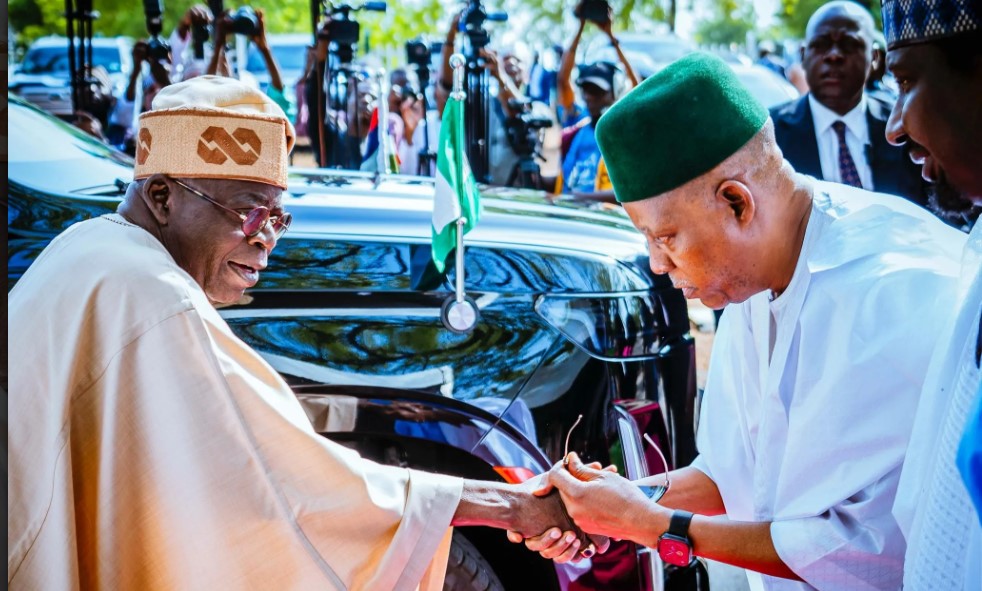
FOR months, whispers of an impending shake-up at the highest level of Nigeria’s political establishment dominated conversations in party circles, government offices and across the country. Speculation over whether President Bola Ahmed Tinubu would retain Vice-President Kashim Shettima as his running mate ahead of the 2027 presidential election intensified as political actors weighed regional interests, religious considerations and electoral calculations.
In this Sunday Political features, News Point Nigeria dissects and analyses the situation, tracing the intrigues, lobbying, internal battles and strategic calculations that eventually culminated in President Tinubu’s decision to retain Shettima, a move that has reshaped the conversation ahead of the next general election.
Ten days ago, on July 10, President Tinubu formally put an end to the speculation by retaining Vice-President Kashim Shettima as his running mate for the 2027 presidential election. The decision, which had been the subject of intense debate within and outside the ruling All Progressives Congress (APC), was formally communicated when Ibrahim Masari, the Special Adviser to the President on Political Affairs, submitted the nomination forms of Tinubu and Shettima to APC leaders at the Continental Hotel in Abuja.

The development effectively ended weeks of uncertainty over the composition of the APC ticket and reaffirmed the partnership that secured victory for the party in the 2023 presidential election.


The uncertainty had not emerged in a vacuum. In recent weeks, rumours gathered momentum amid the reluctance of some APC stakeholders, including political figures from the North-East, to openly endorse Shettima’s return. Those advocating a change argued that Tinubu could opt for a northern Christian running mate as part of broader political calculations aimed at repositioning the party ahead of the election.
The debate reflected longstanding questions over the future of the controversial Muslim-Muslim ticket that carried Tinubu and Shettima to power in 2023.
Present at the ceremony confirming the ticket were Governors Hope Uzodimma of Imo, Mai Mala Buni of Yobe, Abba Kabir Yusuf of Kano, Nasir Idris of Kebbi, Uba Sani of Kaduna, Ahmadu Fintiri of Adamawa and Babagana Zulum of Borno State.
Uzodimma, who chairs the Progressive Governors’ Forum, led APC governors to the event. Also present were members of the party’s National Working Committee, lawmakers from the APC caucus in the National Assembly, members of the Federal Executive Council and other party leaders.
The submission of the nomination forms marked the formal commencement of Tinubu’s quest for a second term, with Shettima once again completing the APC presidential ticket.

Confirming the development, the President’s Special Adviser on Media and Public Communications, Sunday Dare, announced on social media that Tinubu had submitted his nomination form as the APC’s sole presidential candidate.
“About now, at the Continental Hotel, Abuja, President Tinubu submits INEC nomination form to the APC NWC as Sole Presidential Candidate for the 2027 Elections,” Dare wrote.
He added: “President Bola Ahmad Tinubu has equally tapped Kashim Shettima, the current Vice President, Senator as his running mate for vice president in the 2027 election.”


Barely two days after the formal submission of the nomination forms, the Presidency, Speaker of the House of Representatives Tajudeen Abbas and APC leaders from the North-East mounted a vigorous defence of Tinubu’s decision.
For them, the President’s move represented much more than a routine political choice. They described it as recognition of loyalty, competence, experience and commitment to national service.
Stanley Nkwocha, Senior Special Assistant to the President on Media and Communications in the Office of the Vice President, argued in an article titled “2027: Tinubu-Shettima and the Politics of Loyalty, Capacity, Continuity” that the President’s decision had brought months of uncertainty to an end.
“By retaining VP Shettima, President Tinubu has done more than fill a space on the ballot. He has quelled a major source of needless political anxiety within the ruling party, shut down months of speculation over the Vice President’s place on the ticket, and reaffirmed the partnership that led the APC to victory in 2023,” he wrote.
Nkwocha insisted that the decision should not be viewed through the narrow lens of sentiment, but rather as a convergence of loyalty, competence and capability.
He pointed to Shettima’s role in defending government reforms, chairing major economic discussions through the National Economic Council and promoting the administration’s Renewed Hope Agenda without creating uncertainty over the chain of command.
“The President has chosen to continue with a deputy who has shown discipline in office, defended the administration’s reforms, chaired critical national economic conversations, engaged governors through the National Economic Council, and carried the Renewed Hope Agenda message into policy rooms, public fora and political spaces without creating confusion about where authority resides,” Nkwocha stated.
According to him, the Tinubu-Shettima partnership represented a carefully crafted political strategy that united Tinubu’s influence in the South with Shettima’s political strength in the North-East.
Although the ticket generated controversy in 2022 because of its religious composition, Nkwocha maintained that the APC had always insisted that competence and shared political values not religion guided its decision.
“The 2023 election eventually showed that the calculation had serious electoral weight,” he said.
He also argued that Tinubu, as an incumbent seeking re-election, required a deputy already familiar with the administration’s policies and political structure.
“A president entering a re-election cycle does not need a running mate who must first learn the language of the administration, rebuild trust with party actors, or negotiate his own place in the governing structure,” he added.
For Nkwocha, the President’s decision sent a broader message to party members: loyalty would not go unrewarded.
“Political parties are held together by more than manifestoes; they are held together by trust, predictability, and the belief that loyalty will not be discarded once power has been won,” he wrote.
Still, he acknowledged that electoral victory in 2027 would depend on convincing Nigerians with evidence of performance.
“The question is no longer whether VP Shettima will remain on the ticket. That question has been settled. The question now is how the Tinubu-Shettima partnership will convert continuity into confidence, confidence into mobilisation, and mobilisation into a renewed mandate.”
Speaker Tajudeen Abbas echoed similar sentiments, describing Shettima’s retention as proof of Tinubu’s confidence in his deputy.
In a statement by his Special Adviser on Media and Publicity, Musa Krishi, Abbas said Shettima had demonstrated loyalty and dependability since assuming office.
“Since taking office as Vice President, Kashim Shettima has remained loyal and dependable, which is why the administration stays focused and determined to improve the lives of citizens.
“With this decision, President Tinubu exemplifies extraordinary leadership and astute political judgment. The President’s confidence and belief in Shettima continue to stand firm.
“I make bold to say that this decision has further strengthened our party’s chances in the 2027 election. Without sounding conceited, APC will easily cruise to victory come January.”
Abbas described the Vice President as a trusted partner and urged party members to intensify grassroots mobilisation ahead of the polls.
Leaders of the APC in the North-East also welcomed the development.
In a statement signed by Haruna Sardauna, Coordinating Chairman of the Northeast APC Youth Critical Stakeholders Forum, the group described Shettima as “the most loyal, dependable, and result-oriented Vice President in the history of Nigeria”.
“Shettima’s re-nomination is not only a personal victory but also a reaffirmation of the strategic importance of the Northeast in the national political equation. This is about continuity, stability, and rewarding service,” the group said.
It added: “We want to sincerely appreciate His Excellency, President Bola Ahmed Tinubu, for re-allocating the VP slot to the Northeast Zone for continuity with Vice President Kashim Shettima. This decision speaks to fairness, equity, and political wisdom.”
The group pledged to mobilise support for the APC in 2027, insisting that the North-East would repay the President’s confidence with votes.
Ten days later, on July 18, Tinubu formally presented Shettima with a certificate confirming his nomination as the APC vice-presidential candidate.
The presentation, which became public through a video shared by the President’s Special Assistant on Social Media, Olusegun Dada, marked another symbolic step in the party’s preparations for the 2027 election.
The footage showed Shettima arriving at the venue and exchanging brief remarks with the President before receiving the certificate.
Sharing the video, Dada wrote: “President Bola Ahmed Tinubu presents certificate to Vice President Kashim Shettima as his running mate in 2027 election.”
He dismissed claims that Shettima’s place in the administration had ever been under threat.
“At no point was the Vice President’s place in this administration under any doubt. People just create scenarios in their head and start cooking,” Dada said.
The APC has since completed the submission of its nomination forms to the Independent National Electoral Commission ahead of the stipulated deadline.
Months before the latest developments, Minister of Art, Culture and Creative Economy Hannatu Musawa had warned that replacing Shettima could create political complications for the APC.
Speaking in January on the MIC ON podcast hosted by Seun Okinbaloye, Musawa argued that altering the religious and regional balance of the ticket carried serious risks.
“If we toy with changing the construct of what we have now, it is a problem,” she warned.
“If there is no Hausa, Fulani, Kanuri Muslim on that ticket, it creates a hurdle. That’s the reality of the way the people think.”
Musawa described northern politics as deeply rooted in identity and civic participation.
“I come from a very rural area in Katsina state. All my family and all the people that I know that have never been to school have a radio. They will tell you about the Russian Revolution. BBC Hausa did what it was supposed to do,” she said.
“When it comes to politics, the northern area really thrives on politics. That is the one thing that they feel they really have a lot of control over and power. So when you don’t understand politics in the way that they do, you come at your own peril.”
According to her, political participation in the North goes beyond elections and forms part of community identity.
“They wait every four years to be able to line up. A man with his four wives and 30 children, everybody is going to line up, because that’s where they know that they can have an impact in positioning Nigeria. For them, it is almost like an identity.”
The political drama surrounding Shettima’s renomination was further explored by Azubuike Ishiekwene, Editor-in-Chief of LEADERSHIP, who argued that the Vice President had legitimate reasons to worry about his future.
Tinubu’s history as governor of Lagos State, during which he worked with three different deputies—Kofoworola Bucknor-Akerele, Femi Pedro and Abiodun Ogunleye provided ample reason for concern.
According to Ishiekwene, some politicians had coveted Shettima’s position from the outset. Among those reportedly mentioned was former Kaduna State governor Nasir El-Rufai, who was said to have believed he deserved compensation for supporting Tinubu’s emergence.
National Security Adviser Nuhu Ribadu was said to have opposed such ambitions, while Shettima simultaneously worked to consolidate his own position.
The Vice President also faced sustained criticism from opposition figures and religious groups who portrayed the Muslim-Muslim ticket as an attempt to Islamise Nigeria.
Critics scrutinised government appointments and security policies through religious and ethnic lenses, while some sought to link Shettima to the early years of Boko Haram in Borno State.
International dimensions reportedly emerged as well. Ishiekwene wrote that some lobbyists in the United States encouraged President Donald Trump to pressure Tinubu into replacing Shettima with a Christian running mate.
According to the account, the argument was that the perception of a Muslim-Muslim presidency could be fuelling tensions.
Whether such pressure influenced Tinubu remains uncertain, but Ishiekwene maintained that the campaign against Shettima was real.
He also claimed that Shettima’s office scaled back some activities during periods of uncertainty and that the Vice President made deliberate efforts to demonstrate loyalty.
The debate over tax reforms reportedly presented another challenge, as criticism from Borno State Governor Babagana Zulum was interpreted in some quarters as a proxy battle involving Shettima.
Several names reportedly surfaced as potential replacements, including former Speaker Yakubu Dogara and former Plateau governor Simon Lalong.
Former Kano governor Rabiu Kwankwaso was also linked to speculation after holding a series of meetings with Tinubu.
Yet, despite the intense manoeuvring, Shettima survived.
As Ishiekwene observed, the Vice President appears to have mastered “the art of being present without being noticed,” a quality he described as essential for political survival.
In May, Shettima himself offered insight into the pressures surrounding his office.
Speaking at the launch of former Head of State Yakubu Gowon’s autobiography, My Life of Duty and Allegiance, the Vice President revealed that, only months into the administration, some individuals from Borno allegedly told Tinubu that he intended to eliminate him and assume power.
According to Shettima, Tinubu called him and jokingly warned him about allegations connected to traditional caps gifted to the President.
The Vice President said Tinubu dismissed the accusations after concluding that they lacked credibility.
Even after fresh attempts were made to revive the claims, Shettima said the President refused to entertain them and continued wearing garments he had earlier received.
Using the occasion, the Vice President urged Nigerians to reject divisive politics and embrace mutual trust and national unity.
Tinubu’s decision to retain Shettima has ended one chapter of political speculation, but it has opened another.
The APC leadership believes continuity, loyalty and experience will strengthen the party’s chances in 2027. Supporters argue that retaining Shettima rewards commitment and preserves a political alliance that has already delivered victory once.
Yet the debate surrounding religion, regional balancing and political inclusion remains unresolved.
The irony, as observers note, is striking. The same Muhammadu Buhari who reportedly resisted a Muslim-Muslim ticket years earlier ultimately handed over power to a government built around precisely that arrangement.
Whether Tinubu’s decision reflects a diminishing role for religion in Nigeria’s politics or merely a temporary triumph of political pragmatism remains an open question.
What is clear, however, is that Kashim Shettima has survived one of the most turbulent political storms of his career. The next and perhaps more decisive test will come when Nigerians head to the polls on January 16, 2027.