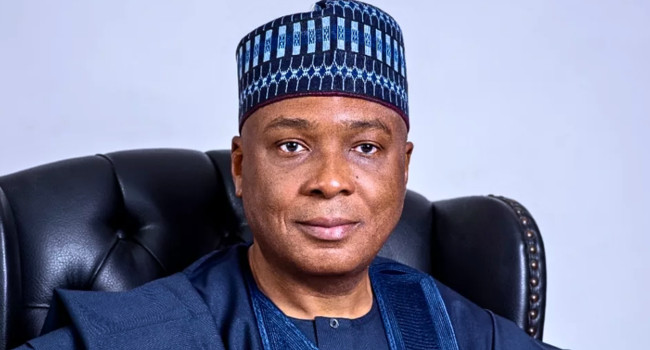

A FEDERAL High Court sitting in Abuja has ordered the final and permanent forfeiture of 57 properties valued at N212.8 billion and allegedly linked to former Attorney-General of the Federation and Minister of Justice, Abubakar Malami, SAN.
News Point Nigeria reports that Justice Joyce Abdulmalik granted the forfeiture order on Wednesday after upholding an application filed by the Economic and Financial Crimes Commission (EFCC), ruling that the respondents failed to sufficiently rebut the reasonable suspicion that the properties were acquired through proceeds of unlawful activities.

Read also: Court Fixes November 20 To Decide Atiku’s Bid To Amend Tinubu Disqualification Suit
The judge held that the central issue before the court was not merely ownership of the properties but the legitimacy of the funds used in acquiring them.

According to Justice Abdulmalik, the respondents were unable to dislodge the suspicion raised by the anti-graft agency that the assets were acquired through unlawful means.
Before delivering the substantive judgment, the court dismissed several applications, motions on notice and applications to show cause filed by Malami, members of his family and companies linked to the properties, describing the applications as lacking merit.


The EFCC had in January 2026 commenced civil forfeiture proceedings seeking the permanent forfeiture of the 57 properties, which the commission alleged were acquired through proceeds of unlawful activities connected to the former justice minister.
During the Federal High Court’s annual vacation on January 16, 2026, vacation judge Justice Emeka Nwite had granted an interim forfeiture order over the assets.
The court had subsequently directed the EFCC to publish the order in a national newspaper, inviting anyone with an interest in the properties to appear before the court and show cause why the assets should not be permanently forfeited to the Federal Government.

Checks by News Point Nigeria revealed that the properties are spread across the Federal Capital Territory, Kano, Kebbi and Kaduna states.
The assets include Rayhaan University buildings, agro-allied factory structures, machinery, hotels, pharmacies, supermarkets, primary and secondary schools, filling stations, commercial shops and other residential and business properties.
Among the properties listed by the EFCC are a luxury duplex at Amazon Street, Plot No. 3011 within Cadastral Zone A06, Maitama, Abuja, purchased in December 2022 for N500 million and valued at N5.95 billion after enhancement.


Also listed is a two-winged large storey building at No. 3 Onitsha Crescent, Area 11, Garki, Abuja, formerly Harmonia Hotels Limited, purchased in December 2018 for N7 billion.
Another major asset is Plot 683, Jabi District, Abuja, comprising a five-storey building now operated as Luxurious Meethaq Hotels Limited, Jabi, with 53 rooms and suites. The property was acquired at carcass level in September 2020 for N850 million, with an additional N300 million reportedly spent before completion, bringing its estimated value to N8.4 billion.
Other properties include a terrace building at Property No. 3130, Asokoro District, Abuja, acquired in January 2021 for N360 million; Meethaq Hotels Limited, Maitama, located at No. 3 Rhine Street, Maitama, purchased in February 2018 for N430 million and currently valued at N12.95 billion after rehabilitation.
Read also: ‘Sirika Ordered Perm Sec To Award Contract To German Friend,’ EFCC Witness Tells Court
The list also includes properties in Kano and Kebbi, including a commercial property at No. 4 Ahmadu Bello Way, Nasarawa GRA, Kano, purchased in December 2022 for N300 million; Plot 157, Lamido Crescent, Nasarawa GRA, Kano; and 100 hectares of land along Birnin Kebbi-Jega Road acquired in 2020 for N100 million.
Other forfeited assets include a four-bedroom bungalow at Gesse Phase, Birnin Kebbi, acquired in 2023 for N101 million; shops at Vegas Mall, Wuse 2, Abuja, purchased for N158 million; a property at Babbi Drive, Bua Estate, Abuja, acquired in 2022 for N136 million; and a property at Efab Estates Avenue, Gwarimpa, purchased in January 2016 for N120 million.
The assets also include residential properties in Kaduna and Abuja, including a four-bedroom bungalow with two-room boys’ quarters at Doka Crescent, Abakpa GRA, Kaduna, acquired in January 2018 for N40 million, as well as several properties in Wuse, Apo, Karsana, Gudu and other parts of Abuja.
The Khadimiyya for Justice and Development Initiative, an organisation linked to Malami, also had properties listed among the assets, including units of residential buildings and hectares of land at Academic Garden City, Birnin Kebbi.
Following the EFCC’s newspaper publication, Malami, his wife, Nana Hadiza Malami, his son, Abdulaziz Abubakar Malami, and several companies connected to the properties approached the court to challenge the forfeiture proceedings.
They urged the court to dismiss the EFCC’s application and overturn the interim forfeiture order, arguing that the properties were lawfully acquired.
The respondents maintained that the EFCC failed to establish any connection between the assets and criminal activities, accusing the commission of relying on speculation rather than credible evidence.
They argued that the anti-graft agency neither proved that the properties were proceeds of crime nor identified any specific offence from which the assets were allegedly derived.
However, during the hearing, the EFCC insisted that its investigation revealed that the properties were acquired with proceeds of unlawful activities and were held either directly or through individuals and companies allegedly acting as fronts for Malami.
The commission urged the court to convert the interim forfeiture order into a final order, arguing that civil forfeiture proceedings require only proof of reasonable suspicion and not criminal conviction beyond reasonable doubt.
In May 2026, parties adopted their final written addresses, after which Justice Abdulmalik reserved judgment.
The court had initially fixed July 6 for judgment but later moved the date to July 10 before delivering the ruling on Wednesday, July 15, 2026.
Read also: Court Dismisses Aisha Achimugu’s ₦10bn Suit Against EFCC
In her judgment, Justice Abdulmalik relied principally on Section 17 of the Advance Fee Fraud and Other Fraud Related Offences Act in granting the final forfeiture order.
The judge, however, vacated the interim forfeiture order in respect of some properties and directed that only the affected assets covered by the final ruling be forfeited to the Federal Government.