

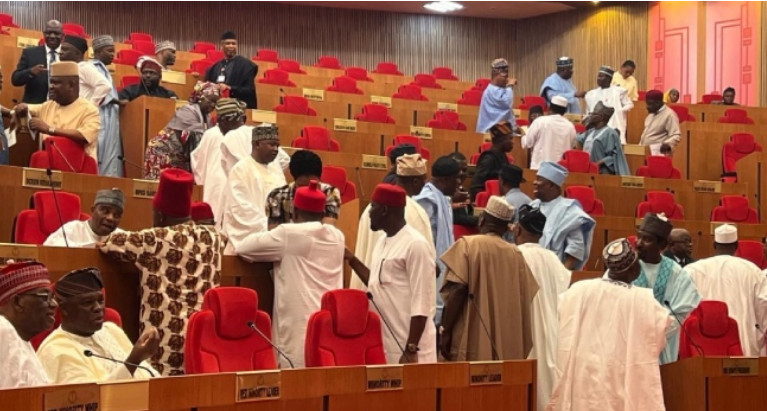
THE Senate on Tuesday passed the Electoral Act, 2022 (Repeal and Re-Enactment) Bill, 2026, following a tense and, at times, rowdy plenary session marked by sharp exchanges among lawmakers.

News Point Nigeria reports that the bill was approved after extensive deliberations and a dramatic division over Clause 60, a provision dealing with the electronic transmission of election results.
The controversy erupted when Senator Enyinnaya Abaribe (ADC, Abia South) demanded a division on Clause 60(3), specifically objecting to a proviso that allows manual transmission of election results where electronic transmission fails due to network issues.


Abaribe sought the removal of the caveat, arguing that Form EC8A should not serve as the sole basis for collating results in the event of technical failure.
Presiding over the session, Senate President Godswill Akpabio initially suggested that the demand for division had earlier been withdrawn. However, opposition lawmakers immediately objected, insisting that the matter remained unresolved.
Deputy Senate President Barau Jibrin cited Order 52(6) of the Senate Standing Orders, arguing that it would be procedurally out of order to revisit a matter already ruled upon by the presiding officer.
The submission triggered further uproar, with heated exchanges on the floor, including a brief face-off between Abaribe and Senator Sunday Karimi.
Amid the tension, Senate Leader Opeyemi Bamidele reminded colleagues that he had earlier sponsored a motion for rescission, effectively reversing previous decisions on the bill to allow for fresh consideration.
He maintained that Abaribe’s call for division was consistent with the rescission motion and therefore procedurally valid.

Following deliberations, Akpabio sustained the point of order and directed Abaribe to formally move his motion under Order 72(1).
During the division, senators were asked to physically indicate their positions.
Fifteen opposition senators stood against the proviso allowing manual transmission of results during network failure, while 55 senators voted in support of retaining it.


With the majority backing the clause, the proviso remained in the bill.
Earlier proceedings had been temporarily stalled when lawmakers dissolved into the Committee of the Whole for clause-by-clause consideration of the bill after a motion to rescind its earlier passage.
Murmurs filled the chamber as lawmakers clustered in groups and approached the Senate President’s desk for consultations before the session briefly moved into a closed-door meeting.
The rescission motion was partly driven by concerns over the timing of the 2027 general elections, as announced by the Independent National Electoral Commission (INEC).
Bamidele explained that stakeholders had flagged potential conflicts between the proposed February 2027 election timetable and provisions in the amended law requiring elections to be scheduled not later than 360 days before the expiration of tenure.
He warned that strict adherence to the 360-day notice requirement in Clause 28 could result in presidential and National Assembly elections falling within the Ramadan period.
According to him, conducting elections during Ramadan could adversely affect voter turnout, logistics, stakeholder participation, and the inclusiveness of the electoral process.
The Senate also cited several technical inconsistencies discovered in the bill, including discrepancies in the Long Title and multiple clauses such as 6, 9, 10, 22, 23, 28, 29, 32, 42, 47, 51, 60, 62, 64, 65, 73, 77, 86, 87, 89, 93, and 143.
These issues reportedly affected cross-referencing, serial numbering, and internal coherence within the legislation, necessitating fresh review and reenactment.
The Electoral Act remains a central pillar of Nigeria’s democratic framework, governing election procedures, result transmission, timelines, and compliance standards.
The passage of the 2026 Repeal and Re-Enactment Bill marks another major legislative intervention aimed at refining electoral processes ahead of the 2027 general elections.