

THE global trade environment is shifting in ways that Nigeria cannot afford to read passively. What is taking shape is not simply a competition among major powers, nor merely a question of market access. It is a reordering of how Africa is being positioned within competing trade architectures.
The United States has reauthorised the African Growth and Opportunity Act (AGOA) only through 31 December 2026, with retroactive effect to September 2025, while China has announced zero-tariff treatment from 1 May 2026 for imports from 53 African countries with which it maintains diplomatic relations. Taken together, these moves point to a wider reality: external trade preferences are becoming more fluid, more strategic, and more visibly tied to geopolitical calculation.

For Nigeria, the appropriate response is not to frame this as a binary choice between external partners. That would be too narrow, and strategically unhelpful. The more important lesson is that trade can no longer be treated as a secondary track running alongside diplomacy. It must be approached as one of the core instruments through which national interest is secured. In a world where market access is shaped by changing preference regimes, tariff recalibration, and wider geoeconomic competition, foreign policy and trade policy can no longer operate in separate compartments.

The temporary extension of AGOA is instructive for precisely this reason. It preserves access, but only for a short horizon. That offers relief, not certainty. It keeps the door open for eligible African exporters, but it does not create the kind of medium-term predictability that firms, investors, and industrial planners ordinarily require when making decisions on sourcing, standards, production, and long-term market entry. The issue, then, is not whether AGOA remains useful. It does. The issue is that temporary preference is not the same as durable strategy.


China’s new zero-tariff regime carries a different, but equally important, implication. It potentially widens access to one of the world’s largest markets. But access by itself does not guarantee advantage. The countries best placed to benefit will be those that can meet standards, solve logistics constraints, scale production, and move beyond raw commodity dependence toward more value-added exports. The opening is real, but the distribution of gains will not be automatic. It will depend on readiness. That is why China’s decision to remove tariffs on imports from 53 African countries should be read not simply as a concession, but as a test of African export competitiveness.
This is where Nigeria’s strategic challenge becomes sharper. Nigeria is too large, too economically significant, and too diplomatically consequential to approach passively. Yet the task is not simply to seek access wherever it can be found. It is to build the institutional means to use access well. Economic diplomacy should not be measured by the number of frameworks a country belongs to, or by how many openings are referenced in official communiqués. It should be measured by whether firms can actually enter markets, whether export volumes diversify, whether value addition improves, and whether trade relationships deepen resilience rather than reinforce dependence.
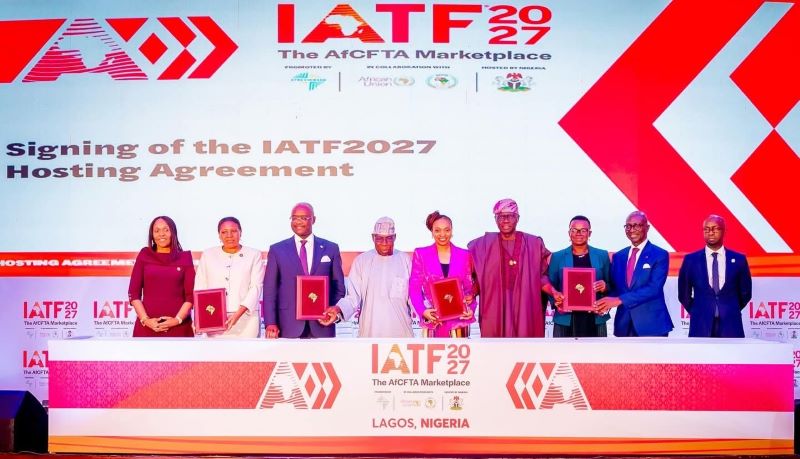
Nigeria is not starting from zero. The country has already taken important steps to strengthen its AfCFTA posture, including gazetting its provisional schedule of tariff concessions in April 2025 and publishing a market intelligence tool to support exporters. That trajectory gained further expression on 9 March 2026 with the signing of the IATF2027 Host Country Agreement between Nigeria, Afreximbank, the African Union Commission, and the AfCFTA Secretariat, confirming Lagos as host of the fifth Intra-African Trade Fair in November 2027. President Tinubu has also publicly emphasised the importance of more efficient African borders and stronger intra-African trade under AfCFTA. These are important foundations because they recognise a basic truth: in a more competitive trade environment, information, connectivity, and market access are not peripheral matters. They are part of state capacity.
The next step is to build a more integrated doctrine of trade statecraft. That begins with aligning foreign policy, trade policy, and industrial policy much more deliberately than before. When the external environment shifts, whether through a short AGOA extension, a new Chinese tariff regime, or broader changes in global trade rules, the state should be able to answer a set of practical questions quickly. Which Nigerian sectors are best positioned for the affected markets? Which products can scale within a realistic time horizon? What standards, certification, or logistics barriers remain? Which trade missions and embassies should be tasked with targeted market-opening work? A country that cannot answer such questions in an organised way will struggle to convert preference into performance.
A second requirement is sharper sectoral discipline. Not every export opportunity carries the same strategic value. Nigeria should pay particular attention to sectors where expanded market access can support domestic upgrading rather than merely accelerate the export of raw output. That means closer attention to agro-processing, light manufacturing, selected industrial goods, and minerals where downstream value addition is possible. The point is not to dismiss commodity exports. It is to avoid allowing favourable preference regimes to lock Nigeria more deeply into a pattern in which it exports primary products while importing higher-value goods and capabilities.

A third requirement is institutional coordination. Trade diplomacy cannot sit with one ministry alone, just as export readiness cannot be left entirely to private firms. This moment calls for closer alignment among Foreign Affairs, Trade and Investment, Finance, Customs, standards authorities, export-promotion institutions, and sector regulators. This is especially important because the emerging trade environment is not only about tariffs. It is also about rules of origin, customs efficiency, certification, logistics, dispute resolution, and the practical ability of firms to move goods reliably across borders.
There is also a wider African dimension that Nigeria should not neglect. If China is widening tariff-free access for 53 African countries while the United States is extending AGOA only for a limited period, African states will increasingly operate in a more competitive external environment in which market access is offered, adjusted, and interpreted through broader geopolitical calculation. In such a setting, intra-African trade becomes even more important, not as a slogan, but as a stabilising foundation. The stronger African trade platforms become, the less exposed African economies will be to the policy cycles and preference uncertainty of larger external powers.
The broader lesson is that Nigeria should approach this moment neither with anxiety nor with passivity, but with strategy. The AGOA extension and China’s zero-tariff decision are not merely external announcements to be welcomed from a distance. They are reminders that trade is now a more openly strategic domain of international politics. For Nigeria, the proper response is to move beyond treating trade preferences as standalone benefits and to begin treating them as instruments to be integrated into a larger national strategy of export competitiveness, industrial upgrading, and economic resilience. That is the real task before Nigerian statecraft.


In the years ahead, influence will not be measured only by diplomatic visibility or political voice. It will also be measured by whether countries can convert a changing external trade environment into jobs, productive capacity, and durable economic leverage. Nigeria has the scale, the market, and the diplomatic weight to do so. What matters now is the clarity and discipline with which it organises for that purpose.
- Oshodi is the Senior Special Assistant to the Nigerian President on Foreign Affairs and Protocol.