

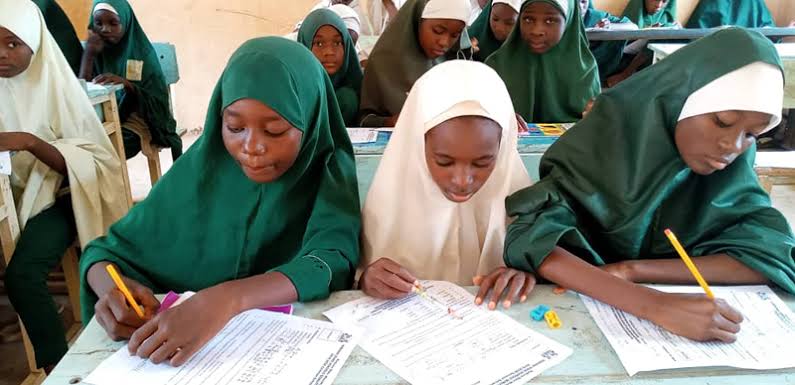
TARABA, Yobe and Adamawa states recorded the lowest participation rates in the 2026 National Common Entrance Examination (NCEE), according to figures released by the National Examinations Council (NECO) following the conduct of the examination on Saturday.

News Point Nigeria reports that the examination, which serves as the gateway for admission into Federal Government Colleges, popularly known as Unity Schools, attracted a total of 58,187 candidates across the country.

Of the total number of candidates who sat for the examination, 31,877 were female, while 26,310 were male, continuing a trend that saw female candidates outnumber their male counterparts.

Data released by NECO showed significant disparities in participation levels across states, with some recording thousands of candidates while others registered only a handful.


Lagos State emerged as the highest contributor, registering 13,228 candidates for the examination. It was followed by the Federal Capital Territory (FCT), Abuja, which recorded 9,639 candidates, while Anambra State posted 4,410 candidates.
At the other end of the spectrum, Taraba State recorded the lowest turnout in the country, with only 15 candidates participating in the examination.
Yobe and Adamawa followed with 41 and 86 candidates respectively.
Other states with relatively low participation included Bayelsa, which recorded 117 candidates; Kebbi, 139; Bauchi, 148; and Gombe, 171.
Similarly, Sokoto registered 210 candidates, while Borno recorded 243. Kogi had 253 candidates, Nasarawa 264, Ekiti 285 and Katsina 289.

The figures contrasted sharply with those recorded in some other states where participation was considerably higher.
Imo State recorded 3,292 candidates, Rivers registered 2,587, Jigawa posted 2,575 candidates, while Enugu had 2,365 candidates.
Speaking after monitoring the examination in Abuja, the Minister of State for Education, Suwaiba Ahmad, expressed satisfaction with the overall conduct of the exercise.


According to her, the examination process was orderly and commenced as scheduled at the centres visited by the monitoring team.
“We have been to three schools, and I am happy with the conduct of the examination in all the centres visited. The students are orderly, well seated, and the examination started on time,” she said.
Despite the generally smooth conduct of the examination, the minister raised concerns over absenteeism among registered candidates.
She disclosed that about 18 candidates were absent in one of the examination halls visited by the monitoring team.
Ahmad also noted that documents reviewed during the monitoring exercise showed compliance with the prescribed age requirements for candidates seeking admission into Unity Schools.
She reaffirmed the Federal Government’s commitment to improving educational infrastructure and creating a more conducive environment for teaching and learning across the country.
Also speaking, Ibrahim Wushishi, Registrar of the National Examinations Council, said the number of candidates who sat for the examination this year represented a decline when compared to the previous year.
According to him, the 58,187 candidates recorded in 2026 were fewer than the 64,578 candidates who participated in the 2025 edition of the examination.
Wushishi, however, noted that reports received from across the country indicated that the exercise was largely successful and free of major challenges.
He attributed the higher participation of female candidates to ongoing efforts by the Federal Government to promote girl-child education across Nigeria.
“I think this reflects the efforts of the ministry in promoting girl-child education and shows that positive results are being achieved in that regard,” he said.
The Minister of State for Education and members of the NECO management team monitored the conduct of the examination at several centres in Abuja, including Model Secondary School, Government Science Technical College and Federal Government Boys’ College.