EUROPEAN football’s 55 member associations have voted to boycott future FIFA World Cups if world football’s governing body proceeds with its controversial proposal to sell stakes in its competitions to private investors.
News Point Nigeria Sport reports that the decision was reached during an emergency UEFA meeting convened to discuss the proposal unveiled earlier this week by FIFA, a plan that has triggered widespread opposition across the global football community.

Read also: Okocha Backs Mbappe For 2026 Ballon d’Or, Names Man City, Barcelona, Bayern As UCL Favourites

The Confederation of North, Central America and Caribbean Association Football (Concacaf), which governs football across North and Central America and hosted this year’s World Cup, also announced that its 41 member associations had rejected the proposal put forward by FIFA President Gianni Infantino following a meeting held on Thursday.


Sources familiar with the discussions said confidence in Infantino among Concacaf members is also waning.
UEFA had already signalled its opposition through two strongly worded statements earlier in the week, and Thursday’s meeting reinforced the depth of resistance among its members.
“The World Cup cannot be treated as an investment product,” UEFA declared.
“It is one of football’s greatest sporting legacies. It has been built over generations by players, national teams and supporters across every continent. No part of it should ever be surrendered to private investors. The World Cup is not for sale.”
The proposed boycott would extend to all FIFA competitions, including the men’s and women’s FIFA World Cups as well as the FIFA Club World Cup, should Infantino’s proposal eventually secure approval from FIFA’s member associations.

The first major test of UEFA’s position could come in October during the Women’s World Cup play-offs.
Sources indicated that English Football Association Chairwoman Debbie Hewitt and Chief Executive Mark Bullingham were among those who spoke during UEFA’s emergency meeting, where the atmosphere was described as highly charged because of the overwhelming opposition to the proposals.
Despite serving as one of FIFA’s eight vice-presidents, Hewitt reportedly had no prior knowledge of Infantino’s discussions regarding the investment proposal.


Under the plan, FIFA intends to establish a commercial subsidiary known as FIFA Forward Enterprise (FFE), which would oversee the organisation’s flagship competitions, including the World Cup, while allowing external investors to purchase minority, non-controlling stakes.
According to FIFA, third-party investors would be invited to participate in the new commercial entity.
The proposal, however, requires approval from FIFA’s 211 member associations.
For the proposal to pass, Infantino must secure at least 106 votes. Combined, UEFA and Concacaf account for 96 member associations, most of whom now appear set to vote against the initiative.
Infantino has reportedly written to FIFA’s members promising each association $40 million if they support the proposal, with an initial payment of $20 million available to federations that accept the plan before the September 19 deadline.
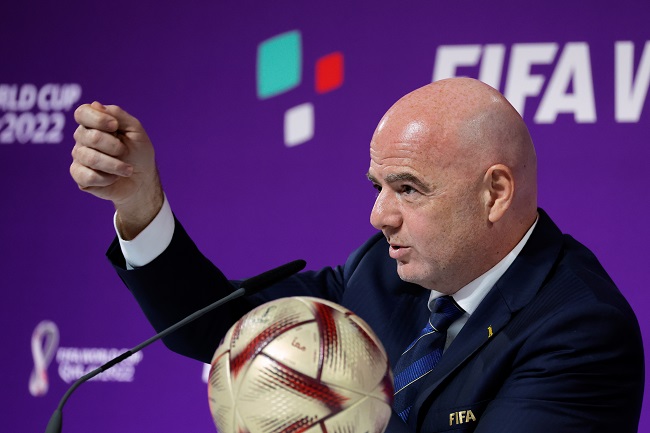
In a video released by FIFA on Wednesday, Infantino defended the proposal, insisting it was “an offer, not an obligation.”
Should the proposal be approved, FIFA said Thrive Eternal is expected to lead the consortium of investors backing the new subsidiary.
Thrive is an American venture capital firm founded by Joshua Kushner, the brother of Jared Kushner, the son-in-law of United States President Donald Trump.
Sources within FIFA also told BBC Sport there has been no discussion about Infantino or any other FIFA official becoming the chief executive of the proposed FIFA Forward Enterprise.
The White House, when asked about the proposal, said it had “nothing” to say on the matter “at the moment.”
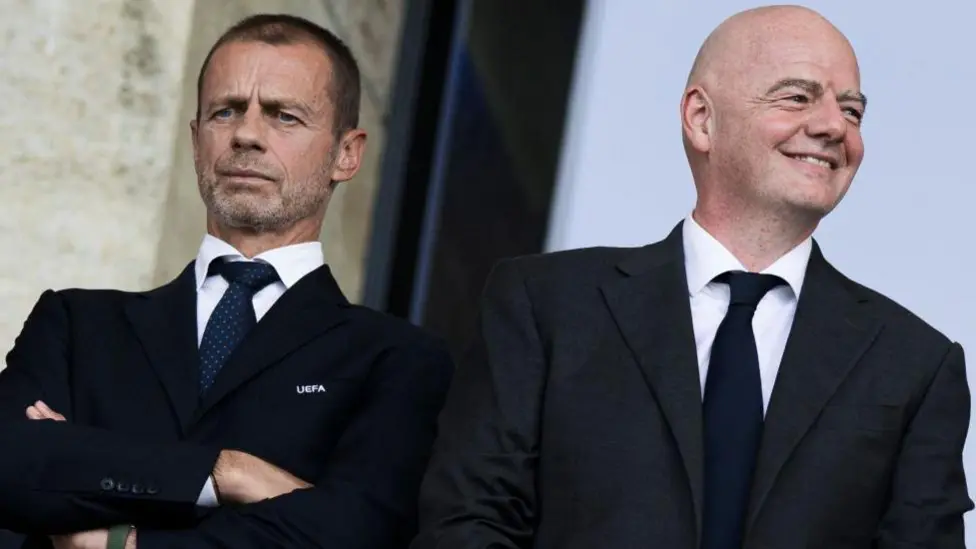
In a strongly worded statement issued after Thursday’s virtual meeting chaired by UEFA President Aleksander Ceferin, UEFA said all its 55 member associations stood united.
“We unanimously and unequivocally reject FIFA’s proposal to transfer ownership interests in the World Cup and other FIFA competitions to private investors,” the statement said.
The governing body also intensified its criticism of FIFA, having earlier accused the organisation of using football “to enrich themselves and their friends.”
Its latest statement described the proposal as “irresponsible and indefensible,” arguing that such a significant decision had been conceived in secret and introduced without meaningful consultation with stakeholders responsible for governing the game.
“This is not merely a profound failure of leadership, but an abdication of FIFA’s duty as the custodian of world football,” UEFA stated.
“National associations around the world are now presented with an ultimatum: accept the irreversible capture of football’s greatest competitions or bear the consequences.
“This is not a ‘democratic decision’, but governance by intimidation — an act of coercion unworthy of an institution entrusted with the stewardship of the global game.”
Although UEFA represents only about one-quarter of FIFA’s membership, it comprises many of the world’s strongest football nations.
European countries dominated the recent Women’s World Cup, producing six of the eight quarter-finalists, including eventual champions Spain. Europe also provided five quarter-finalists in 2022 and six in 2018.
Historically, European nations have won 13 of the 23 FIFA World Cups, with South American countries claiming the remaining 10 titles.
UEFA Vice-President Laura McAllister described FIFA’s proposal as posing a “genuine existential threat to the game.”
Speaking to BBC Radio Wales, the former Wales international expressed hope that a boycott would ultimately be avoided.
“I feel optimistic they won’t, because the reality is the powerhouse of world football is Europe,” she said.
Read also: Kanu, Toni Payne Bag Brace As Nigeria’s Super Falcons Rout Comoros In Olympic Qualifiers
She also told BBC Radio 4’s PM programme there was “real unity” among UEFA members and an “easy consensus over the need to take the strongest possible action given the existential threat that the FIFA proposal poses to our sport.”
McAllister added, “The reality is we had no choice other than to issue a threat commensurate with this dreadful, catastrophic proposal that has been rushed through with no due diligence, no proper governance and no consultation.”
England’s Football Association also declared its support for UEFA’s position.
An FA spokeswoman said England stood “shoulder to shoulder” with its European counterparts and “fully support the collective view.”
She added, “We oppose FIFA’s plans — the FIFA World Cup belongs to football and always will.”
The Scottish Football Association similarly backed UEFA’s position, saying its board “agrees unequivocally with the concerns raised by all members over the manner in which these proposals have been issued, and deadline set, without a full consultation process or consideration to good governance.”
Scottish FA President Mike Mulraney also serves as chairman of FIFA’s Finance Committee.
United Kingdom Culture Secretary Lisa Nandy welcomed UEFA’s decision, describing it as a principled stand.
“Football belongs to the fans, not billionaire investors. Enough is enough. It’s time to take a stand to protect our game,” she said.
UK Prime Minister Andy Burnham had earlier criticised the proposal, saying FIFA would have effectively “sold out” if it proceeded with the plan.
Concacaf also voiced deep concern over what it described as the absence of due process and the unusually short deadline imposed by FIFA.
The confederation questioned why private investment was necessary after what FIFA itself described as the most profitable World Cup in history.
It added that its FIFA Council members had been instructed to engage FIFA on alternative ways of using existing financial reserves to fund football development while ensuring proper governance procedures are followed.
Elsewhere, the Asian Football Confederation expressed disappointment that it had not been consulted before the proposal became public.
The Confederation of African Football (CAF) announced that its President, Dr Patrice Motsepe, would convene an executive committee meeting next week to assess and evaluate the proposal.
The World Leagues Association (WLA) also urged FIFA to withdraw the proposal, with the English Premier League, a member of the WLA, stating that it “wholeheartedly endorses” that position.
Football Supporters’ Europe Executive Director Ronan Evain described UEFA’s response as “very impressive” and “a proper show of force.”
“It is the response that football needed — it is the response Gianni Infantino deserved,” he said.
Several uncertainties remain surrounding the proposal.
FIFA is yet to issue an official response to UEFA’s latest statement, while the implications for the FIFA Women’s Under-20 World Cup in Poland, scheduled to begin on September 5, remain unclear given the September 19 deadline for associations seeking access to the initial $20 million payment.
There is also uncertainty over whether FIFA can still achieve its stated objective of receiving the first tranche of private investment funds before the end of October.
Former Football Association Chairman David Bernstein believes Infantino should abandon the proposal.
“I think on this occasion, Infantino’s got to back down,” Bernstein told BBC Sport.
“This deal is not acceptable. If they want to raise capital, there’s other, better, ways of doing it.”
He added that although such a setback might ordinarily cost a leader his position, FIFA has never operated like a conventional organisation.
“If he has the support of enough of the national associations he will continue,” Bernstein said.
Despite the escalating confrontation, Bernstein does not expect a permanent split within world football.
“I can’t believe in the long term there will be a schism because it would be a lose-lose for everybody,” he said.
“FIFA can’t afford not to have European nations play in their competitions and frankly, Europe also can’t really afford not to be part of it.”
The unfolding dispute has been widely compared to the failed European Super League project, with many observers describing it as one of the biggest governance crises football has ever faced.
Critics argue that allowing private investors into FIFA competitions could eventually lead to expanded tournaments, increased fixture congestion and mounting pressure on domestic football calendars across the world.
UEFA believes it possesses enough influence to halt the proposal, noting that a FIFA World Cup without European participation would lose many of its strongest teams and commercial appeal.
Read also: How Ten-Man United’s Champions League Defeat To Atletico Sparked Martinez Outburst
Without Europe’s leading nations, analysts argue, it would be difficult for FIFA to generate the revenues required to fulfil the financial commitments promised under the investment plan.
As opposition continues to grow across football’s governing bodies, the future of FIFA’s proposal—and potentially the structure of the global game itself, now hangs in the balance.