
NIGERIA’s Permanent Representative to the United Nations, Ambassador Jimoh Ibrahim, has dismissed claims that President Bola Ahmed Tinubu could be arrested or have his movement restricted in the United States while attending the United Nations General Assembly (UNGA).
Ibrahim said the Nigerian Mission to the UN had received no communication from the US government indicating that Tinubu would face any restriction during the General Assembly, insisting that the President and members of his family enjoy protected transit to and from the UN headquarters district.
Read also: Tinubu’s Second Term Will Be Unity Government, Says Senate President

News Point Nigeria reports that the clarification comes amid renewed claims on social media that the Nigerian President could face arrest or legal action if he attends the 81st session of the UN General Assembly in New York.


The ambassador, who also chairs the United Nations Committee on Budget and Administration, made the clarification in a statement issued on Sunday by the Office of Nigeria’s Permanent Representative to the UN in New York.
Ibrahim based his position on Section 11 of the 1947 UN-US Headquarters Agreement, which, according to him, requires US federal, state and local authorities to refrain from imposing impediments on the transit of representatives of UN member states and their families to and from the UN headquarters district.
He said the protection also extends to UN officials, officials of specialised agencies and persons invited to the headquarters district on official business.
“Social media cannot criminalise or arrest President Bola Tinubu, no matter how much the opposition invested in it. Those efforts will only end as an exercise in futility. He has immunity from arrest in the US during UNGA,” Ibrahim said.
The envoy’s statement comes amid renewed claims on social media that Tinubu could face arrest or legal action in the US if he attends the 81st session of the UN General Assembly in New York.

Ibrahim also sought to distinguish between allegations of criminal conduct and a conviction established through due process.
Read also: ‘I Won’t Go Everywhere With You,’ Tinubu Says Presidential Duties May Limit 2027 Campaign Tour
He said US law-enforcement authorities could invite individuals to provide information or statements in the course of investigations and could collect identifying information, including personal and family history, educational records and fingerprints.


According to him, such information may be used by investigators to establish links between individuals, groups and networks, but does not by itself amount to a criminal conviction.
He added that where a conviction could not be secured in a sensitive criminal matter, the consequences could include substantial compensation.
“Where a conviction cannot be secured in a sensitive criminal matter, the consequences could include substantial compensation,” he said.
Ibrahim further argued that an allegation of a crime does not, by itself, establish criminal liability, stressing that allegations must be subjected to due process and proved beyond reasonable doubt.
The ambassador also noted that participation in the UN General Assembly was ultimately a matter of national priority and that a president could delegate representation where necessary.
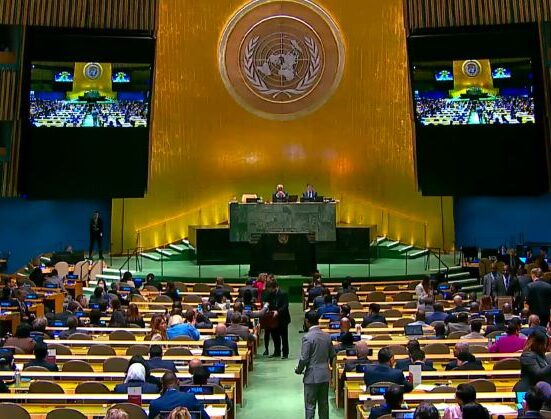
He disclosed that more than 60 per cent of the current speaking list comprised vice presidents and foreign ministers representing their respective countries.
Ibrahim said this demonstrated that heads of government were not required to personally attend every UNGA engagement, adding that member states, rather than individual presidents, were invited to participate in the high-level event.
Read also: ‘Nothing To Fear If Tinubu Wins Second Term’, Shettima To Northern Leaders
He nevertheless urged Nigerians to continue to hold the national flag in high esteem and support what he described as the economic transformation being pursued by the Tinubu administration.
The envoy’s clarification is expected to counter the renewed speculation surrounding Tinubu’s planned participation in the UNGA, particularly claims suggesting that his presence in New York could expose him to arrest or restrictions by US authorities.