

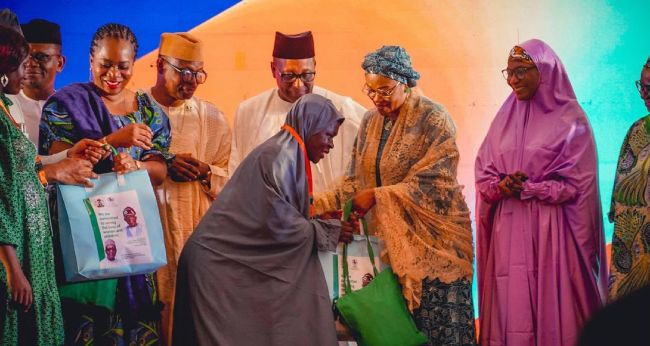
THE Federal Government has rolled out 215,000 MAMA kits, 40,000 maternal food-support packs and 40,000 sets of newborn clothing for vulnerable women and families nationwide.

This is as the First Lady of Nigeria, Senator Oluremi Tinubu, has called for stronger collaboration among governments at all levels, traditional and religious institutions, development partners and philanthropists to tackle Nigeria’s maternal and newborn mortality burden.

She said the scale of the challenge among pregnant women and infants requires collective action to ensure that the interventions reach them, particularly those in poor, underserved and hard-to-reach communities.

Speaking at the flag-off of the distribution at the State House Conference Centre, Abuja, the First Lady of Nigeria said pregnancy and childbirth should be occasions of hope and joy rather than a threat to the lives of Nigerian women.


“This occasion represents a further step towards ensuring that every Nigerian child has a healthy start in life and that no woman loses her life while giving birth”.
“The intervention is being implemented under the Maternal and Neonatal Mortality Reduction Innovation Initiative (MAMII) of the Federal Ministry of Health and Social Welfare and is designed to encourage greater use of antenatal, delivery and postnatal services”.
First Lady, Senator Oluremi Tinubu, Coordinating Minister of Health and Social Welfare, Prof. Muhammad Ali Pate, and others at the flag-off of the distribution at the State House Conference Centre, Abuja on Monday, September 14, 2026.
Senator Oluremi Tinubu said the programme aligned with President Bola Tinubu’s Renewed Hope Agenda on Health, which places healthcare at the centre of national development.
She described MAMII as a bold national intervention bringing together critical stakeholders to tackle preventable maternal and newborn deaths through greater awareness, emergency care and more effective referral systems.

“As a mother, I believe pregnancy and childbirth should be moments of hope and joy, with every woman having access to quality care. However, social, economic, cultural, and logistical barriers still exist. This is what makes today’s flag-off particularly significant”.
According to her, the 215,000 MAMA kits and bags constitute the second batch of the intervention, following the distribution of 110,000 kits in 2025.
She said the government was complementing the kits with 40,000 maternal food-support packs and 40,000 sets of essential newborn clothing, while the intervention would subsequently be expanded to additional local government areas where uptake of MAMII services remained low.


The First Lady explained that the incentives were intended to encourage economically disadvantaged pregnant women to attend antenatal clinics, prepare adequately for childbirth and remain connected to healthcare services after delivery.
“The newborn clothing represents the administration’s commitment to welcoming every Nigerian child with dignity, warmth, and care”.
“The maternal food support equally recognises that the health and nutrition of a mother are essential to a healthy pregnancy, safe delivery, and a healthy newborn”.
She urged state and local governments as well as traditional and religious leaders, development partners and philanthropists to work with the Federal Government to ensure the materials got to women who needed them most.
The First Lady also highlighted interventions she had supported in maternal and child healthcare, including the provision of professional kits to midwives, retraining of frontline health workers and advocacy against mother-to-child transmission of HIV, syphilis and hepatitis.
She commended the Coordinating Minister of Health and Social Welfare, Prof. Muhammad Ali Pate, and officials of the ministry for their commitment to reducing preventable deaths among women and newborns.