

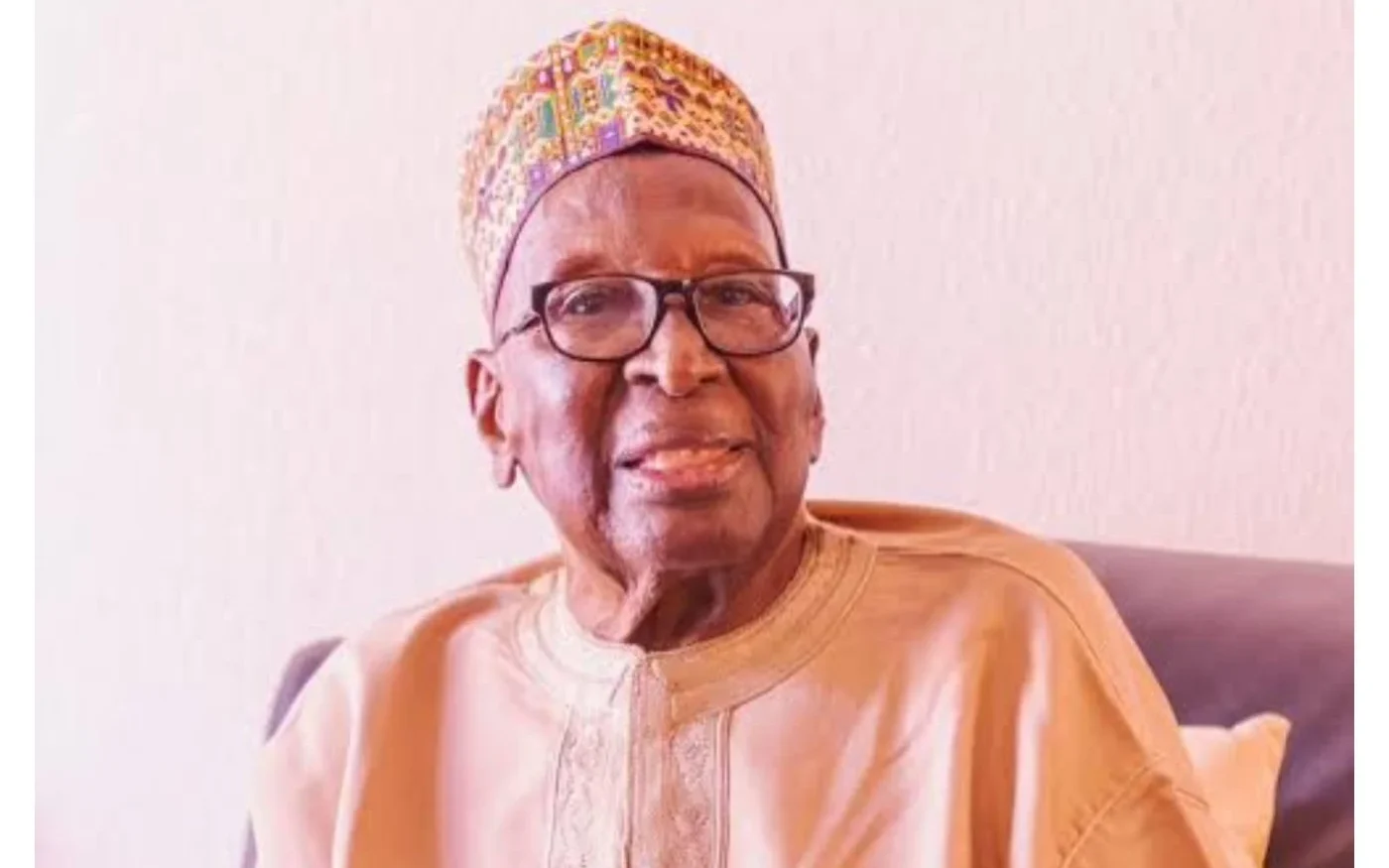
NIGERIA is mourning the death of Dr. Bamanga Muhammad Tukur (CON), an elder statesman, businessman, politician and former National Chairman of the Peoples Democratic Party (PDP), whose public career stretched across some of the most defining periods of Nigeria’s political, administrative and economic history.
In this Sunday Political feature, News Point Nigeria dissects and analyses the life, career, political journey and enduring legacy of Bamanga Tukur, a man whose story moved through public administration, governance, business, diplomacy and party politics, and whose influence extended from the management of Nigeria’s ports to the corridors of power in Abuja and the wider African business community.

Tukur, who was born on September 15, 1935, in present-day Adamawa State, died at the age of 90, leaving behind a career that spanned the Second Republic, successive periods of military rule, the return to democratic governance and the evolution of Nigeria’s Fourth Republic.

His death has triggered an outpouring of tributes from political leaders, governments, political parties and business figures across the country.


The Adamawa State Government has declared three days of mourning in honour of the former governor, with government flags directed to fly at half-staff. His death came just days before he would have celebrated his 91st birthday on September 15, 2026.
According to a statement issued by the spokesman of the Tukur family, Oliver Okpala, the elder statesman died at about 12 noon at his residence on Adetokunbo Ademola Street, Wuse 2, Abuja. Okpala said the statement was issued with the consent and approval of Tukur’s first son, the Secretary to the Adamawa State Government, Hon. Awwal Tukur, and his first daughter, Lami.
The family spokesman explained that Tukur’s body would be flown to Adamawa State immediately for the necessary burial arrangements in accordance with Islamic rites and injunctions. He was scheduled to be buried after funeral prayers at the Lamido’s Palace by 10 a.m. on Sunday.
Reacting to his father’s death, Awwal said the family would take solace in the exemplary life their father lived and the monumental legacies he left behind for posterity.
For a man whose life touched several layers of Nigeria’s national story, Tukur’s beginnings were rooted firmly in Adamawa. He held traditional titles including Tafidan Adamawa and Wakilin Ganye, positions that reflected both his standing within the region and the enduring relationship between his public life and his traditional community.

His education and professional exposure also took him beyond Nigeria. He earned a Master’s degree from the University of Pittsburgh and was later conferred with an honorary Doctorate of Law, Honoris Causa, by Benue State University, Makurdi. He was also a fellow of the Nigerian Institute of Transport Technology, Zaria.
But it was his work in public administration that first established Tukur as a major national figure.
In the 1970s, he rose to become General Manager of the Nigerian Ports Authority, serving from 1975 to 1982. At the NPA, he was involved in efforts to ease congestion at the nation’s ports, expand infrastructure and streamline import and export processes.


His years at the ports helped establish the reputation of a man capable of managing large national institutions at a time when Nigeria’s economy and infrastructure were undergoing major transformation. His experience in transport, maritime administration and international trade would later become an important part of his wider career in business and economic affairs.
Politics eventually offered Tukur another major platform for national service.
In 1983, he was elected Governor of the old Gongola State, an expansive territory that has since become Adamawa and Taraba States. His tenure, however, was brief. The military coup of December 1983 brought the Second Republic to an abrupt end, cutting short the administration of elected governors across the country.
Yet the end of the Second Republic did not end Tukur’s involvement in national affairs. He remained active in public life and returned to government at the federal level a decade later when he was appointed Minister of Industries under the administration of the late General Sani Abacha, serving from 1993 to 1995.
That period added another dimension to his career, placing him at the centre of Nigeria’s industrial policy and economic administration.
Outside government, Tukur built a formidable reputation as an entrepreneur and advocate of African economic development. He founded BHI Holdings, also known as the DADDO Group of Companies, with interests spanning manufacturing, agriculture, logistics and trading, while his broader business expertise covered transport, investment advisory services and infrastructure.
His influence was not limited to Nigeria.
Tukur served as Executive President of the African Business Roundtable and Chairman of the NEPAD Business Group, positions through which he became an advocate of private-sector participation, intra-African trade, economic integration and sustainable development.
He also served on the UNIDO International Business Advisory Council, the Ghana Investors Advisory Council and the OECD Africa Investment Advisory Board.
His work in debt management and economic reforms was credited with helping free resources for development initiatives in several African countries, further strengthening his reputation as a businessman and policy advocate with a continental outlook.
One of the more remarkable chapters of his international career was his appearance before the United Nations General Assembly in New York. Tukur became the first African to address the UN General Assembly as a private person rather than as a head of state or government, an unusual distinction that reflected the breadth of his international business and economic engagement.
But if business gave Tukur a continental platform, Nigerian politics remained a central part of his identity.
His return to the centre of partisan politics culminated in March 2012, when he was elected National Chairman of the Peoples Democratic Party with the backing of then-President Goodluck Jonathan.
At the time, the PDP was Nigeria’s governing party, and its national chairmanship placed Tukur at the heart of the country’s political machinery.
His tenure, however, coincided with one of the most turbulent periods in the history of the party. Internal disagreements, competing political interests and growing tensions within the PDP increasingly overshadowed his leadership. After less than two years in office, Tukur stepped down as national chairman in January 2014.
He also served on the PDP Board of Trustees and remained associated with the party’s political and strategic affairs.
His political career, therefore, cannot be separated from the broader story of Nigeria’s evolving democracy. He had experienced elected government during the Second Republic, military intervention, successive military administrations and the restoration of democratic rule. By the time he became PDP chairman, he had already accumulated decades of experience across government, business and political institutions.
That breadth of experience is central to understanding why tributes have described his death as the end of an important chapter in Nigeria’s political and economic history.
President Bola Tinubu, in a condolence statement issued by his Special Adviser on Information and Strategy, Bayo Onanuga, described Tukur’s death as the end of a remarkable chapter in Nigeria’s political and economic history.
Tinubu described the late Tafidan Adamawa as a towering figure whose distinguished career covered public administration, governance, industry, politics and pan-African business leadership.
“Alhaji Tukur was urbane, generous and deeply rooted in the values of integrity and service that the Adamawa Emirate and the nation hold dear. He was a man of big ideas and bold enterprise who believed in Nigeria’s limitless potential. Nigeria will sorely miss his wise counsel and fatherly guidance,” the President said.
Tinubu recalled Tukur’s political journey during the Second Republic, which culminated in his election as governor of the old Gongola State in 1983.
The President also highlighted Tukur’s work in the private sector as Chairman of BHI Holdings and the DADDO Group of Companies, as well as his service as Minister of Industries under the Abacha administration.
On the continental stage, Tinubu said Tukur was an eloquent champion of Africa’s economic renaissance.
“As Executive President of the African Business Roundtable and Chairman of the NEPAD Business Group, he was a relentless advocate for intra-African trade, private sector-led growth and sustainable development,” the President added.
Tinubu also acknowledged Tukur’s period as PDP National Chairman between 2012 and 2014, saying he made contributions to democracy through the enforcement of party discipline and efforts to build consensus.
Former President Goodluck Jonathan also mourned Tukur, describing him as a distinguished elder statesman, patriot, accomplished businessman and committed democrat.
In a condolence message released by his spokesman, Ikechukwu Eze, Jonathan said Tukur dedicated much of his life to the service of Nigeria and made significant contributions to the country’s political development and democratic consolidation.
“His contributions to Nigeria’s political development, democratic consolidation, and national unity remain significant,” Jonathan said.
For Speaker of the House of Representatives, Tajudeen Abbas, Tukur was one of the firmest politicians in the North who left an indelible mark on Nigeria’s history.
Abbas expressed sadness over the passing of the former Gongola State governor, describing his death as a huge loss to the business and political communities.
In a message signed by his Special Adviser on Media and Publicity, Musa Abdullahi Krishi, the Speaker recalled Tukur’s contributions to public administration, governance, industry, politics and pan-African business leadership.
Abbas also described Tukur as a devoted Muslim who propagated Islam and blessed humanity with his wealth. He added that Tukur, as national chairman of the PDP, contributed immensely to improving Nigerian democracy and political practices.
The Northern Nigeria Governors’ Forum also joined in mourning the elder statesman.
Chairman of the NNGF and Governor of Gombe State, Muhammadu Inuwa Yahaya, described Tukur’s death as a profound loss to the North and the nation, saying Nigeria had lost one of its most experienced public servants, political leaders and champions of economic development.
In a condolence message issued by the Director-General, Press Affairs, Government House, Gombe, Ismaila Uba Misilli, Yahaya noted that Tukur’s experience in public administration, politics, business and continental affairs established him as one of the prominent figures of his generation.
“Alhaji Bamanga Tukur lived a long and impactful life, serving Nigeria in several critical capacities and contributing significantly to the growth of our economy, institutions and political development,” Yahaya said.
Governor Ahmadu Umaru Fintiri of Adamawa State described Tukur’s death as a monumental loss to Adamawa and Nigeria.
Fintiri commended his courage, foresight, patriotism and lifelong commitment to public service, saying his experience and wisdom earned him a place of honour in Nigeria’s national history.
“His wealth of experience, wisdom and commitment to public service earned him a place of honour in our national history,” the governor said in a statement issued by his Chief Press Secretary, Humwashi Wonosikou.
For the PDP, Tukur was a distinguished statesman, elder, administrator, businessman and committed member of the party.
In a statement issued by its National Publicity Secretary, Hon. Partyudo Haruna Mohammed, the party described Tukur as a towering figure whose remarkable public service career spanned several decades.
According to the PDP, his tenure as national chairman came at a significant period in the party’s political history, during which he brought his wealth of experience, institutional knowledge and longstanding commitment to public service and democratic development to the leadership of the party.
Similarly, a statement issued by the National Publicity Secretary of the Tanimu Turaki-led faction of the PDP, Ini Ememobong, noted that Tukur played prominent roles in shaping policies and projects across various sectors of the Nigerian economy, particularly ports administration, international trade and industries.
Former Senate President and National Chairman of the African Democratic Congress, Senator David Mark, also described Tukur’s death as a great loss to Nigeria, particularly at a time when the country needs the wisdom, experience and counsel of its older generation of leaders.
In a statement by his media aide, Kola Olagbodiyan, Mark said Tukur was a prominent figure whose contributions to Nigeria’s political, administrative and economic development spanned several decades.
Other political figures who mourned Tukur included the presidential candidate of the All Progressives Congress and Governor of Oyo State, Bola Ahmed Tinubu, and the APC National Chairman, Alhaji Abdulmajeed Jega, who expressed sadness over the elder statesman’s passing.
Taken together, the tributes paint a picture of a man whose relevance extended beyond any single political party, government or business organisation. Tukur occupied positions under different political arrangements and maintained relationships across ideological and institutional lines, giving him a perspective shaped by the many phases of Nigeria’s post-independence political history.
His legacy is therefore not simply that of a former governor or former party chairman. It is the story of a public administrator who managed one of Nigeria’s most important economic institutions, a governor whose tenure was cut short by military intervention, a minister who participated in the country’s industrial administration, an entrepreneur who built businesses, and a pan-Africanist who advocated a stronger role for African businesses in the continent’s economic future.
He leaves behind two wives and 18 children, including Awwal Tukur, the Secretary to the Adamawa State Government.
Tukur was also honoured during his lifetime with the Commander of the Order of the Niger (CON), the Commander of the Order of the Mono (COM), as well as honorary doctorate degrees and fellowships in transport and business-related fields.
For more than five decades, Bamanga Tukur remained part of Nigeria’s public conversation. His career crossed the boundaries between politics, business, administration and diplomacy, while his life reflected the changing fortunes of the Nigerian state itself.
As Nigeria mourns him, attention will inevitably turn to his family, political associates, former colleagues and the institutions he served. But beyond the tributes and ceremonies, the larger question will be how history ultimately remembers a man who lived through and participated in some of the most consequential chapters of Nigeria’s political and economic journey.
Bamanga Tukur’s enduring legacy lies in that intersection of governance, enterprise, political leadership and African economic diplomacy: a career that began in public administration, passed through the governorship of Gongola State and federal ministerial office, expanded into private enterprise and continental business leadership, and eventually returned to the centre of Nigerian party politics.
In death, as in life, his story remains inseparable from the story of Nigeria itself.