

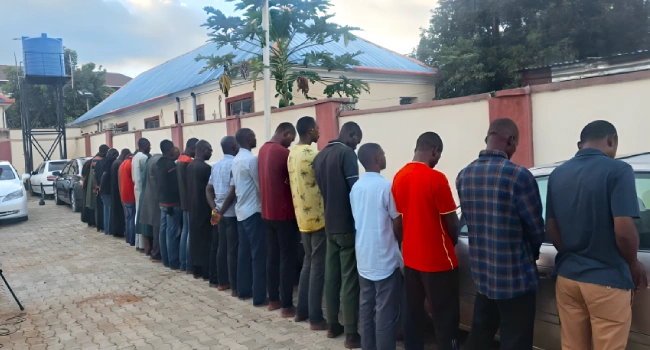
NIGER State Governor, Umaru Bago, has called for an executive order from the Presidency or the Federal Ministry of Solid Minerals Development to ban mining activities in locations identified as problematic across the state, as the Nigeria Security and Civil Defence Corps (NSCDC) on Sunday paraded its suspended Niger State Commandant, Commandant Suberu Aniviye, and other officers linked to the deaths of 37 suspected illegal miners in custody.

News Point Nigeria reports that Bago made the call during an interview on Channels Television’s Sunday Politics programme, following the deaths of the 37 suspected illegal miners in NSCDC custody, while the Corps, at its National Headquarters in Sauka, Abuja, briefed journalists on its preliminary findings into the incident and paraded the officers being investigated.

Bago said the state government needed stronger intervention from the Federal Government because of the limitations surrounding the enforcement of mining regulations, arguing that decisive federal action was required to address problematic mining locations and the growing involvement of minors in artisanal mining.

Asked what his administration was doing about the presence of minors at mining sites, the governor said decisive action was required to stop the practice.


“I am in between the devil and the Red Sea because, as a governor, yes, it’s in my state. As a governor, I cannot just go and order the police or military to start shooting people or arresting people. As a governor, I can only make advocacy.
“But these people, because they have tasted the mining money, they cannot leave that side. We need decisive action. We need an executive order from the Presidency or from the Ministry of Mineral Resources to ban mining in certain locations where we have seen they are problematic. Once that is done, it can be enforced,” he said.
The governor said illegal mining had become a major challenge in Niger State, particularly as children were increasingly being drawn into artisanal mining at the expense of their education.
“We know that gold mining in Niger State has become habitual. The UNICEF report says by 2027 there will not be a single child in Grade 7, that is JSS1, because all of them are into artisanal mining, and all of them have left the classroom and they are not in schools. And this is a problem for us,” he said.
Bago also said the state government had not been informed of any arrests arising from the incident, while expressing concern over the limits of his authority in matters involving federal security agencies. According to him, the state government only became aware of the arrests after information about the deaths emerged, underscoring what he described as the limited control state authorities have over federal detention facilities.

“I am just chief security of the state by mouth,” he said, adding, “I cannot take an oath for what I cannot control.”
He said the Department of State Services (DSS) and the police were investigating the incident, noting that the state government had limited control over detention facilities.
“We don’t have much control over detention centres,” he said.


Describing what he saw after the deaths, Bago said, “I saw a lot of corpses on the floor,” adding that some of the victims were not miners.
He also said the location where the suspected miners were arrested was not licensed for mining, explaining that it was actually a housing estate.
The governor’s comments came as the NSCDC on Sunday paraded its suspended Niger State Commandant, Commandant Suberu Aniviye, and other officers linked to the deaths. The officers were paraded at the NSCDC National Headquarters in Sauka, Abuja, as the Corps’ National Public Relations Officer, Assistant Commandant Babawale Afolabi, briefed journalists on its preliminary findings. Reports said 24 NSCDC personnel were being detained in connection with the incident, including Aniviye and 23 other officers.
The 37 detainees died on Thursday, September 17, after they were arrested during anti-illegal mining operations in the M.I. Wushishi and Lukoto areas of Niger State on September 15 and 16. Bago had earlier disclosed that 67 artisanal and suspected illegal miners were detained at an NSCDC facility before 37 of them died. The exact cause of death remains under investigation.
The NSCDC had initially suggested that a suspected disease outbreak might have been involved, but later said the actual cause of death had not yet been established. Survivors have alleged overcrowding and poor ventilation, with one survivor saying detainees struggled to breathe after an unpleasant substance was allegedly sprayed inside the cell. The authorities have said medical, forensic and other investigations are required before the cause can be conclusively established.
The Federal Government has also suspended officers in connection with the deaths and ordered an independent investigation. The Minister of Interior, Olubunmi Tunji-Ojo, constituted a 10-member independent committee chaired by retired DSS Deputy Director-General Jonathan Kure to investigate the circumstances surrounding the deaths, determine responsibility, complicity, negligence or misconduct, and recommend appropriate action. The committee was given two weeks to complete its assignment.
Meanwhile, the Federal Ministry of Solid Minerals Development has deployed a team of experts to Niger State to investigate the deaths, while Bago has announced the suspension of mining activities across the state pending the outcome of the investigations. The governor has also called for stronger enforcement and responsible mining practices.
The development has therefore brought together two closely related issues confronting Niger State: the need to tackle illegal and unsafe mining activities, particularly the involvement of children, and the need to establish what led to the deaths of 37 people after they were taken into the custody of a federal security agency.
While Bago is calling for executive action to prohibit mining in locations considered problematic and says stronger federal intervention is needed, the NSCDC is conducting its own preliminary investigation alongside the broader probes ordered by the Federal Government.
The outcome of those investigations is expected to establish the circumstances surrounding the arrests, detention and deaths, as well as determine responsibility where wrongdoing, negligence or misconduct is established.