

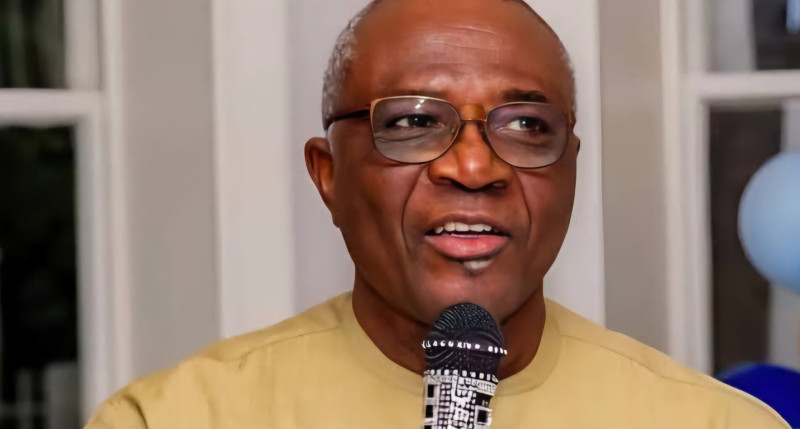
THE Special Adviser to President Bola Tinubu on Information and Strategy, Bayo Onanuga, has defended the administration’s economic policies, saying he does not personally see the level of hunger often highlighted in public discourse, while also dismissing claims that the President vowed not to seek re-election if he failed to significantly improve electricity supply in the country.
News Point Nigeria reports that Onanuga, speaking during separate interviews on Arise Television and Arise News on Tuesday, argued that several government programmes, infrastructure projects and reforms are already delivering tangible benefits to Nigerians, contrary to widespread criticism of the administration’s performance.
Defending the government’s economic record, the presidential spokesman said public conversations about the economy often overlook gains recorded since Tinubu assumed office.


He cited improvements in road infrastructure as one of the visible outcomes of the administration’s policies, recounting a recent trip from Ibadan to Lagos.
“One day, I was travelling from Ibadan to Lagos, and Google Maps told me that there’s a go-slow in the approach to Lagos, and I decided to take Ijebu-Ode via Shagamu.
“What struck me most was that I just found myself on a paved road, a concrete road. I said, ‘Wow, when was this one built?’” Onanuga said.
According to him, residents in the area have also reacted positively to the development.
“I found that our people, I mean, our Ijebu people, have stopped complaining. I said, ‘Oh, no wonder they now have a brand new road that’s not just an asphalt road, a concrete road,’” he added.
Onanuga also pointed to the ongoing coastal highway project, saying it has significantly improved travel times for commuters.

“I live in Ajah. Anytime I go to Lagos, and I ask Google Maps to tell me how soon I will get home, Google Maps will tell me one hour, seven minutes. Before, it was two hours, 30 minutes, and the reason for that is that we now have a coastal road that has shortened my travel time,” he said.
Questioning persistent criticism of the administration, he asked: “Is that not beneficial? What are people talking about, really?”
The presidential aide further highlighted the Federal Government’s student loan scheme and access to low-interest credit facilities for workers as measures designed to ease financial burdens on citizens.


“If you are a parent and you have four children in university, and they’re able to access federal loans, which are interest-free, are they not benefiting?
“If you are a civil servant and you can access the credit card, a very cheap loan at below interest, it is about seven per cent. Now people can access that loan at a single digit. Are they not benefiting as well?” he asked.
According to him, many of the positive developments under the current administration are often ignored because public discussions have become trapped in preconceived narratives.
“We have been pigeonholed into certain assumptions, certain conclusions,” he said.
Onanuga also recalled a viral video from the early days of the Tinubu administration that featured a voice-over suggesting widespread hunger among Nigerians.
“I think the President went to Lagos, he was coming from the Central Mosque, and somebody now did a voice-over saying ‘Ebi n pawa o,’ and that means we are hungry. Since then, people have been saying that,” he stated.
While acknowledging that many Nigerians are facing economic difficulties, he maintained that his personal interactions do not reflect the level of hardship often portrayed in public discussions.
“I’m a Nigerian. I have people working for me privately. I don’t see the level of hunger people are talking about because I see them, and I keep asking them questions: how are things, how are they adjusting, what are the problems?” Onanuga said.
The presidential spokesman also used the interview to address claims that President Tinubu promised not to seek a second term if he failed to improve electricity supply across the country.
This newspaper recalls that Tinubu, during a business luncheon in December 2022 ahead of the 2023 presidential election, said, “If I don’t give you constant electricity for four years, when I come back for a second term, don’t vote for me.”
However, Onanuga insisted that the President’s remarks have been repeatedly taken out of context and misrepresented by critics.
Speaking on Arise News, he argued that Tinubu’s statement was conditional and not an outright pledge to forgo a re-election bid.
According to him, critics often quote only part of the President’s remarks while ignoring the broader context in which they were made.
When asked whether Tinubu had promised not to seek re-election if electricity supply failed to improve significantly, Onanuga responded:
“That is not exactly what he said. He said he will give Nigerians power. I’m paraphrasing now. He said he will also say he will end the area of estimated billing. A problem that he has largely solved because it should not be his business, but his government is producing meters, asking the DISCOS to give people meters free of charge.
“And he said, if by any chance he has reasons not to give Nigerians adequate power, then they should understand the problem that he inherited.”
When reminded that the President had publicly stated that Nigerians should not vote for him if he failed to improve power supply, Onanuga replied:
“He didn’t say that way. Let me see if I can open my phone and tell exactly what he said.”
The presidential aide further argued that Tinubu has demonstrated commitment to reforming the power sector since assuming office, citing the signing of the Electricity Act as one of the administration’s most significant interventions.
“The first thing he did when he came to office was sign the Electricity Act, which enables states to generate power, transmit power and distribute power,” he said.
According to Onanuga, the legislation has opened up the electricity sector, encouraged competition and created opportunities for states to take greater control of power generation and distribution.
“That is a good thing. Some of the states are taking advantage of that, and more are going to do so. That will make the electricity sector open and competitive,” he added.
He also pointed to efforts aimed at addressing the country’s metering challenges, saying the Federal Government has intervened to ensure more Nigerians receive electricity meters free of charge.
“He also learnt the error of estimated billing, a problem that his government is largely solving because the government is producing meters and asking distribution companies to give people free of charge,” Onanuga said.
While admitting that electricity supply has not yet reached the level envisioned by the President, he attributed the situation to longstanding structural challenges inherited by the administration.
“We are not at the level that the President meant it. I can tell you that,” he acknowledged.
Explaining the challenges confronting the sector, Onanuga said Nigeria already has an installed generation capacity of about 13,500 megawatts but continues to face constraints linked to gas shortages, legacy debts and weak infrastructure.
“What people don’t know is that we already have an installed capacity of 13,500 megawatts. What are the problems? No gas. The players in the sector owe the gas companies legacy debts of over four trillion naira,” he said.
According to him, the Tinubu administration is working to address these bottlenecks while implementing reforms aimed at improving generation, transmission and electricity delivery nationwide.
“The transmission grid is outdated, but that is part of the reforms that need to be put in place,” he stated.
He added that the government is exploring additional initiatives to optimise existing power assets and improve electricity supply to Nigerians.
Despite the challenges, Onanuga maintained that the administration remains focused on delivering its promises, improving infrastructure, strengthening the economy and reforming the power sector for long-term national development.