

CAPE Verde’s remarkable journey to a dream World Cup showdown against Lionel Messi’s Argentina has become one of the defining stories of the 2026 FIFA World Cup, but the Blue Sharks are only one chapter in what has emerged as a historic triumph for African football.
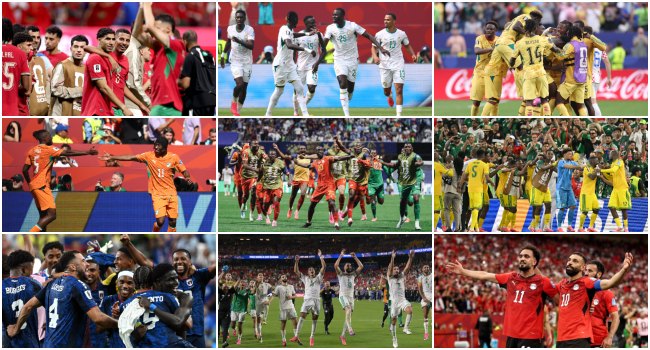
News Point Nigeria Sport reports that as the group stage of the expanded 48-team tournament comes to a close, Africa has delivered its strongest-ever collective performance at the FIFA World Cup. A record 10 African nations qualified for the competition, with only Tunisia failing to reach the knockout rounds as nine teams booked places in the last 32.
The achievement has further strengthened the argument that African football deserves greater representation on the global stage, with several of the continent’s teams not only qualifying but also competing toe-to-toe with some of world football’s traditional heavyweights.

Among the biggest statements made during the group stage was the inability of football powerhouses Spain, England, Portugal and Brazil to defeat African opposition, underlining the continent’s growing competitiveness.


For Algeria captain Riyad Mahrez, the performances have validated years of steady progress across African football.
“That shows the quality of African football,” Mahrez said.
“When you see nine out of 10 teams going through for the next round in the biggest tournament, that shows a lot.”
Perhaps no story has better illustrated Africa’s rise than that of Cape Verde.
The tiny island nation, with a population of just over 500,000 people, has become the smallest country ever to reach the knockout stages of a FIFA World Cup.

Their achievement has also provided a major boost for FIFA as football’s governing body continues to defend its controversial decision to expand the tournament from 32 to 48 teams—a move critics argued was motivated more by commercial interests than sporting merit.
Cape Verde justified their place in spectacular fashion.
The Blue Sharks earned a memorable draw against European champions Spain in their World Cup debut before following it up with further draws against two-time champions Uruguay and 2034 World Cup hosts Saudi Arabia.


Those results proved enough to send Cape Verde through while both Uruguay and Saudi Arabia crashed out.
Veteran goalkeeper Vozinha emerged as one of the tournament’s breakout stars.
The 40-year-old produced a stunning man-of-the-match performance against Spain, instantly becoming an internet sensation and seeing his Instagram following soar to an astonishing 17 million.
Their reward is a glamorous last-32 encounter against Lionel Messi’s defending champions Argentina.
Africa’s allocation of World Cup places doubled for the expanded tournament, and—with the exception of Tunisia’s disappointing campaign—the continent has fully justified FIFA’s decision.
Tunisia endured a miserable tournament, conceding 12 goals while suffering defeats in all three group matches.
Elsewhere, African nations consistently matched or outperformed opponents from traditionally stronger football regions.
DR Congo head coach Sebastien Desabre believes the continent’s progress is the result of years of investment and development.
“I have been working on the African continent for 15 years now. I see federations becoming better organised, coaches improving and players getting better—Africa keeps progressing,” Desabre said.
“For me that won’t stop because there is still room for growth. I think and hope that an African team will win the World Cup this year or in the coming years. To me, it is just a matter of time.”
Morocco continue to carry the continent’s highest expectations after becoming Africa’s first-ever World Cup semi-finalists four years ago.
The Atlas Lions reinforced their credentials by dominating Brazil for long spells during an impressive 1-1 draw and now head into a difficult Round of 32 clash against the Netherlands full of confidence.
Head coach Mohamed Ouahbi insists Morocco are no longer content with simply competing—they now believe they can win the World Cup.
“We need to believe in this objective, this target (to win the World Cup),” Ouahbi said.
“Morocco have entered a whole new dimension. The players, the fans believe in their team and our opponents respect our team.”
While Africa celebrated unprecedented success, the story was very different elsewhere.
Tiny Caribbean nation Curacao enjoyed a memorable moment by holding Ecuador to a goalless draw during their World Cup debut.
However, Curacao eventually exited alongside Haiti and Panama, with all three CONCACAF qualifiers—coming from a qualifying campaign without co-hosts the United States, Mexico and Canada—finishing the tournament without a single victory.
Asia also struggled to justify its expanded allocation of World Cup places.
Only Japan and Australia progressed to the knockout stages.
Tournament debutants Jordan and Uzbekistan ended their campaigns without earning a point, while Iraq endured one of the toughest group-stage experiences after conceding 12 goals against France, Senegal and Norway.
The expanded World Cup has produced plenty of entertainment.
Some of football’s biggest stars—including Lionel Messi, Kylian Mbappe, Vinicius Junior and Erling Haaland—have delivered the prolific performances fans expected throughout the group stage.
Yet, alongside the excitement, fresh questions have emerged about whether expanding the tournament has reduced the overall competitiveness.
The group phase witnessed eight victories by margins of four goals or more—just one fewer than the total recorded across the previous three World Cups combined.
Despite those concerns, Africa’s remarkable performance has undoubtedly become one of the tournament’s defining narratives.
With nine nations advancing to the knockout rounds and belief across the continent stronger than ever, African football has sent perhaps its clearest message yet that its long-awaited breakthrough on football’s biggest stage may no longer be a distant dream, but an approaching reality.
Round of 32:
Sunday June 28
South Africa vs Canada, kick-off 8pm – Los Angeles, USA
Monday June 29
Brazil vs Japan, kick-off 6pm – Houston, USA
Germany vs Paraguay, kick-off 9.30pm – Foxborough, USA
Tuesday June 30
Netherlands vs Morocco, kick-off 2am – Guadalupe, Mexico
Ivory Coast vs Norway, kick-off 6pm – Arlington, USA
France vs Sweden, kick-off 10pm – New Jersey, USA
Wednesday July 1
Mexico vs Ecuador, kick-off 2am – Mexico City, Mexico
England vs DR Congo, kick-off 5pm – Atlanta, USA
Belgium vs Senegal, kick-off 9pm – Seattle, USA
Thursday July 2
USA vs Bosnia-Herzegovina, kick-off 1am – Santa Clara, USA
Spain vs Austria, kick-off 8pm – Los Angeles, USA
Friday July 3
Portugal vs Croatia, kick-off 12am – Toronto, Canada
Switzerland vs Algeria, kick-off 4am – Vancouver, Canada
Australia vs Egypt, kick-off 7pm – Arlington, USA
Argentina vs Cape Verde, kick-off 11pm – Miami, USA
Saturday July 4
Colombia vs Ghana, kick-off 2.30am – Kansas City, USA