

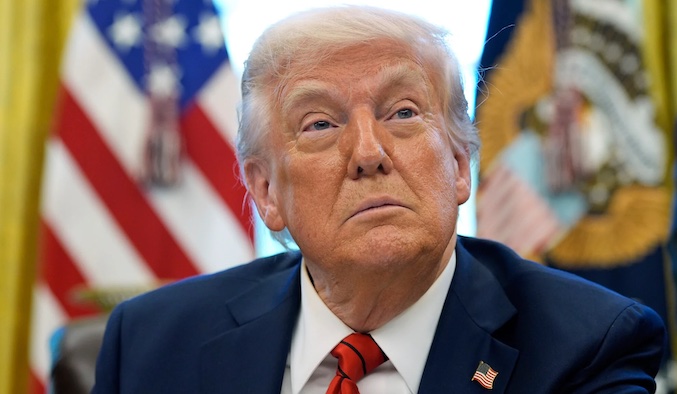
UNITED States President Donald Trump has demanded that Iran surrender and threatened to bomb Oman if it interfered with the reopening of the Strait of Hormuz, as a 60-day ceasefire deal between Washington and Tehran expired without an agreement to end the war.
Speaking on Fox News on Monday, Trump said that Iran should “put up the white flag of surrender” in the five-month-long US-Israel war, confirming that his administration had opened a direct backchannel with Iran’s Islamic Revolutionary Guard Corps (IRGC).

He described the IRGC as “good poker players” who are “dying”.

But he insisted that he was in no rush to end the conflict, which he has lost significant control of and which has hurt his political support ahead of US midterm elections in November, in which Democrats are seeking to retake Congress.


“I have no time schedule,” he said. “I’m not in a hurry.”
Rather, Trump once again sought to project strength, threatening that he could bomb US ally Oman if it “gets in the way” of a deal to reopen the Strait of Hormuz, a critical waterway for global oil supplies that Iran has blockaded.
“If Oman gets in the way, we’ll bomb the s*** out of them,” he said during the interview.
Iranian and Omani officials have spent weeks discussing arrangements for maritime navigation through the strait, with Tehran insisting on oversight of shipping in the waterway.
Iranian officials say the two sides have reached an agreement on a new shipping route in the strait, and the Ministry of Foreign Affairs in Tehran said earlier on Monday that Iran and Oman were working on a joint declaration.

Foreign Ministry spokesperson Esmaeil Baghaei said the proposed mechanism would seek to protect the interests of both Iran and Oman while maintaining commercial shipping.
“This is the first time that a mechanism is being developed to simultaneously safeguard the sovereign rights of the two littoral states and ensure the safe passage of commercial vessels,” said Baghaei.
Baghaei accused the US and Israel of working to undermine the talks, while adding that the deadlock between Tehran and Washington stemmed not from a shortage of mediators but from the Trump administration’s repeated reliance on approaches that have “failed hundreds of times”.


Baghaei also rejected the significance of the expired deadline, arguing that the memorandum of understanding – which had set 60 days for negotiations on sanctions relief and the nuclear file – had already been rendered void by earlier US violations, meaning talks never properly began.
“Due to the gross and widespread violation of the memorandum by the United States just a few weeks after it was signed, no talks were initiated,” Baghaei said, adding that Iran would not be moved by proposed US sanctions, including a reported land blockade.
He linked the current standoff to a longer pattern of hostility dating to the 1953 coup in Iran, arguing that both the “crippling sanctions” imposed under US Democratic administrations and Trump’s first-term “maximum pressure” campaign had failed to alter Tehran’s position.
Iran, he said, does not make decisions under pressure.
The comments are just the latest in the rhetorical tit-for-tat between the US and Iran as mediators continue to try to bring the parties back to the negotiating table. But despite the expiry of the memorandum, neither has signalled a willingness to extend it.
Iranian Foreign Minister Abbas Araghchi said on Saturday that Tehran had “not yet made a decision to restart negotiations with the United States”.
Trump, meanwhile, claimed on Friday that he would even declare the Strait of Hormuz part of US territory, while Iran retorted that the waterway “will remain Iranian”.