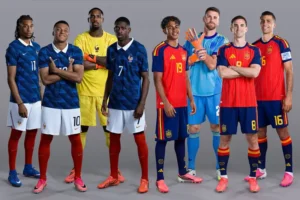
WE have had 100 matches in the World Cup, with four more to go.

The 101st game promises to be very special indeed with two of football’s heavyweights up against each other.
European champions Spain, second in the world rankings, take on a France side that are ranked third but who have arguably been the most impressive side so far in this tournament.


A place in the World Cup final is up for grabs.
Luis de la Fuente has named the same Spain XI side that started Friday’s quarter-final victory over Belgium.
It means Arsenal midfielder Mikel Merino, the match-winner in each of the past two rounds, has to settle for a place on the bench again.
Lamine Yamal starts on the right with Mikel Oyarzabal, Spain’s top-scorer with four goals at this World Cup, leading the line.
Spain XI: Simon; Porro, Cubarsi, Laporte, Cucurella; Rodri, Ruiz; Yamal, Olmo, Baena; Oyarzabal.
Bradley Barcola comes in for Desire Doue in the only change to the France line-up that began their 2-0 win over Morocco in the last eight.

The Paris St-Germain winger will start on the left and complete a formidable forward line that also includes Ballon d’Or winner Ousmane Dembele, Bayern Munich star Michael Olise and Golden Boot-chasing Kylian Mbappe.
France XI: Maignan; Kounde, Saliba, Upamecano, Digne; Tchouameni, Rabiot; Dembele, Olise, Barcola; Mbappe.
Mbappe’s global breakthrough came at the 2018 World Cup, when his quickfire double helped France beat Lionel Messi’s Argentina in the last 16 on their way to winning a second champions’ star.


Outshining one of the greatest players of all time was the first indicator that a changing of the guard was on the horizon – but now there is a new global star. Eight years later, teenager Lamine Yamal is looking to replicate what Mbappe did to Messi and ignite on the biggest stage after a quiet debut World Cup so far.
It is hard to look past Mbappe as the best player in the world right now.
After scoring 42 goals in 44 games for Real Madrid last season – making him the top scorer in both La Liga and the Champions League – he has helped establish France’s attack as the most fearsome at this World Cup.
Lamine Yamal only turned 19 on Monday, but he is already the best young forward on the planet.
A breakout 2023-24 season with Barcelona ended with him being included in Spain’s Euro 2024 squad, and like Mbappe in 2018, he shone in his first major tournament and inspired his team to glory.
Last year he was the Ballon d’Or runner-up aged 18, but a hamstring injury sustained in April disrupted his preparations for the World Cup. With just one goal in five starts, he certainly has not sparkled like Mbappe, Messi or Jude Bellingham.
“I ask him to be calm,” said manager Luis de la Fuente. “He came of age last year. He is 19. Now imagine I just told him to be calm, enjoy and forget about any anxiety. He should enjoy his football. The big day for Lamine has yet to come at this World Cup.”
Get comfortable, this is going to be a thrilling few hours.
ANALYSIS:
A question that Deschamps’s staff have been asking themselves is whether to fully adapt for that, or continue to entrust the forwards to improve on a record of 16 goals in six games.
Spain, after all, are going to continue to do exactly what they do. They are the team with the most complete tactical idea at this World Cup, by an immense distance. An argument even pervades that this is one reason why Lamine Yamal hasn’t excelled in the manner of other stars, because he is in the one team closest to an elite club side.
The deeper tactical integration means he has a more defined role, even if a lot of that ends up utterly exhausting his double markers. Most of them have had to go off early.
Given that, any Spanish adaptation is likely to be to move their possession shape back 20 metres so as not to expose their half to France’s searing pace.
That is the actual way they have accumulated this immense defensive record, of only one goal conceded. It’s of course complemented by the relentlessness of the counter-press. Spain win the ball back 11.57 seconds after losing it, on average, the quickest of all the quarter-finalists.
It can be seen in the way they’re immediately snapping at the heels of opposition players, with an energy that roofed stadiums aid. Ultimately, though, Spain do their defending in forward areas. Hence that vast expanse in their own half, that Kylian Mbappe and Ousmane Dembele will be looking at greedily.
So, while this is obviously a match between the tournament’s best defence and best attack, the modern game means it is far from that simple; that it’s obviously not backline against forward line, in the way the description conjures. There’s so much more to it, and numerous tactical layers, illustrated by how Spain will have so more of their possession closer to the opposition goal. Deschamps is meanwhile more willing to release his attackers from much further back.
That is one of many dichotomies at play, that explain why this is best defensive record against best attacking record, without that necessarily being the defining contrast.
Above all, of course, this is a derby between two neighbours with a long actual history and rich recent football history. Look at how Adrien Rabiot’s quotes about Yamal needing to “do more” from before the Euro 2024 semi-final have resurfaced.
That points to how the two have met a lot in the modern era, as both have become pioneers of talent production in very different ways.
In that last big meeting, the roles were almost reversed. Spain were viewed as the more freewheeling and fresh team, spearheaded by young talent. France looked worse than defensive, barely able to score, and it seemed a tournament too far for Deschamps already.
The two years since have shown how much can change between tournaments. Personnel have had a profound effect.
Virtually all of Spain’s most electric attackers have had fitness issues, with Nico Williams only coming back now. They can’t stretch games in the same way, which has required a more compact structure. Many watching on would say it’s far too compact, as the “boring” debate has resurfaced.
France have enjoyed the opposite. They’ve had a flood of young talent come into the side since Euro 2024, to become the great entertainers.
One of those talents has suddenly become one of the best five players in the world, in Michael Olise, while Desire Doue is among the best young stars in the world. Even some of those present in Germany are in completely different form. Bradley Barcola has gone from an impact sub to an effervescent attacker, Dembele is now a Ballon D’Or winner, while Mbappe looks liberated.
And, ever the pragmatist, Deschamps has just played to his strengths. He’s created the most anti-Deschamps team possible, at least going by his coaching history with the French team.
That is what has fostered the real dichotomy of the game, and a genuine philosophical duel.
It is the “positional game” – essentially, the Pep Guardiola game, which has long taken hold in Spain – against the evolving competing idea of “relationism”.
Whereas almost everything Spain do with the ball is dictated by the team structure’s position on the pitch in relation to the ball – outside more licence to Yamal and Dani Olmo – Deschamps has afforded his attackers infinitely more individual interpretation.
The idea of an orchestra coming up against free jazz has rarely been as applicable.
That will naturally provoke a lot of debate about future influence on how the game is played and who should win. That, also, is far from so simple.
A bit like with Guardiola, no one can come close to playing Spain’s positional game like Spain.
France’s approach can’t be anywhere near as devastating, or even that effective, without attackers of this astounding quality.
It is nevertheless natural that it’s the French who are the first to pose this specific ideological challenge in such a high-stakes game. Their model of talent production never adapted that Spanish-Dutch approach in the way that the Germans did, arguably giving them more variety of player – if also missing one archetype: the Rodri.
Deschamps has had to adapt to a more industrious two-man midfield of Rabiot and Aurelien Tchouameni because he does not have that classic number-six. Spain instead have two on the bench.
And that is why the onus is on France to do more, despite doing so much more damage throughout this World Cup in attacking play.
You can already see the way the game will go. Spain are going to take control of possession, gradually moving up the pitch, as France seek to pounce on any break in play.
And, almost reflecting how this defensive record isn’t actually about defence, there is a sense that the Spanish backline hasn’t been properly pressured yet.
Football figures present for the quarter-final in Los Angeles were struck by how Belgium got at them. There’s a vulnerability.
Deschamps just has to figure out how to put more even more stress on it, to get the midfield to funnel more of the play towards the attack despite Spain outnumbering them.
At the same time, Spain didn’t buckle when Charles De Ketelaere finally ended Unai Simon’s clean-sheet record. That can happen when a long record is finally broken, and there’s suddenly doubt again.
They instead kept playing.
They’re going to have to do even more of it against France, if only to limit how much those attacking stars have the ball.
For all the billing, this is much more than attack against defence.
And, in a purely tactical sense, it may end up meaning more than any modern World Cup game.
There is so much to consider.
PREDICTIONS:
Sadiq’s Prediction: France’s biggest advantage lies in the one area Spain deliberately expose: the space behind their pressing structure. Luis de la Fuente’s side have built the tournament’s best defensive record, conceding only one goal and regaining possession in an astonishing average of 11.57 seconds after losing it. Yet that defensive solidity depends heavily on winning the ball high up the pitch. Against France’s explosive front line, that strategy carries enormous risk.
Didier Deschamps is unlikely to abandon the approach that has yielded 16 goals in six matches. Instead of matching Spain’s intricate positional football, France will rely on the pace and improvisation of Kylian Mbappé, Ousmane Dembélé and Michael Olise. With Adrien Rabiot and Aurélien Tchouaméni absorbing pressure in midfield, France will look to spring devastating counter-attacks into the spaces left by Spain’s advancing full-backs.
Recent history slightly favours Spain, who defeated France in the Euro 2024 semi-final, but the balance of power has shifted dramatically. Dembélé is now a Ballon d’Or winner, Mbappé appears liberated, and Olise has emerged as one of the world’s elite creators. Spain’s structure may dominate possession, but France’s superior firepower could decide the contest.
My Prediction: France 4-2 Spain
Peter’s Prediction: Despite France’s attacking brilliance, Spain remain the team with the most complete tactical framework at the tournament. Their positional game has reached a level unmatched by any other side, blending defensive security with suffocating control of possession. The fact that they have conceded only once is not accidental; it stems from an extraordinary collective understanding of space and timing.
Spain’s counter-press remains their greatest weapon. By recovering possession faster than any other quarter-finalist, they deny opponents the transitions they rely upon. If they succeed in pushing their possession shape slightly deeper—as many expect—they can limit the spaces that Mbappé and Dembélé crave while still dictating the rhythm of the match through Dani Olmo and Lamine Yamal.
There is also the psychological factor. Spain defeated France at Euro 2024 when Yamal announced himself on the international stage, and they have consistently demonstrated resilience under pressure. When Charles De Ketelaere ended Unai Simón’s clean-sheet streak, Spain did not panic; they simply continued to play their football. If they impose their “orchestra” on France’s “free jazz,” they possess the tactical discipline and technical quality to reach another major final.
My Prediction: France 1-2 Spain
Gbenga’s Prediction: This could easily become one of the most sophisticated tactical battles of the modern World Cup era. Spain will monopolise possession, moving the ball patiently through midfield and attempting to suffocate France with relentless pressing. France, however, have shown that they are comfortable defending deep before striking with devastating efficiency.
Deschamps faces a difficult choice: adapt to Spain’s strengths or trust the attacking unit that has already produced 16 goals. The French coach has generally chosen the latter path, allowing Mbappé and Dembélé to remain high and dangerous while Rabiot and Tchouaméni provide balance. Spain’s defenders have not yet faced attackers of this calibre, and there remains a lingering sense that their impressive defensive numbers have not been fully tested.
A narrow French victory would not necessarily reflect dominance but efficiency. Spain may finish with superior possession statistics and territorial control, yet France’s ability to turn one defensive mistake into a decisive goal could be the difference. In a game of fine margins, one moment of brilliance from Mbappé or Olise may settle the contest.
My Prediction: France 3-2 Spain
Gloria’s Prediction: The contrast between the two teams is striking. Spain arrive with the clearest tactical identity in the competition, operating almost like an elite club side, while France have evolved into a fluid and unpredictable attacking machine. Deschamps has built what many consider the most unorthodox team of his managerial career, trusting individual brilliance rather than rigid structure.
Spain’s possession game, inspired by Pep Guardiola’s philosophy, revolves around positional discipline and collective movement. Lamine Yamal and Dani Olmo enjoy greater freedom, but even their creativity is shaped by the system. France, by contrast, have embraced what analysts call “relationism,” giving players such as Bradley Barcola, Désiré Doué and Olise the freedom to interpret situations instinctively. The result has been the tournament’s most prolific attack.
Fitness concerns surrounding Spain’s wide players, particularly Nico Williams, have also altered their style. Unable to stretch teams as effectively as before, Spain have become more compact, prompting criticism that they have lost some of their attacking edge. France’s younger stars, meanwhile, are peaking at exactly the right time, and their speed in transition could prove too much for a Spanish defence that Belgium exposed in moments.
My Prediction: France 4-1 Spain