

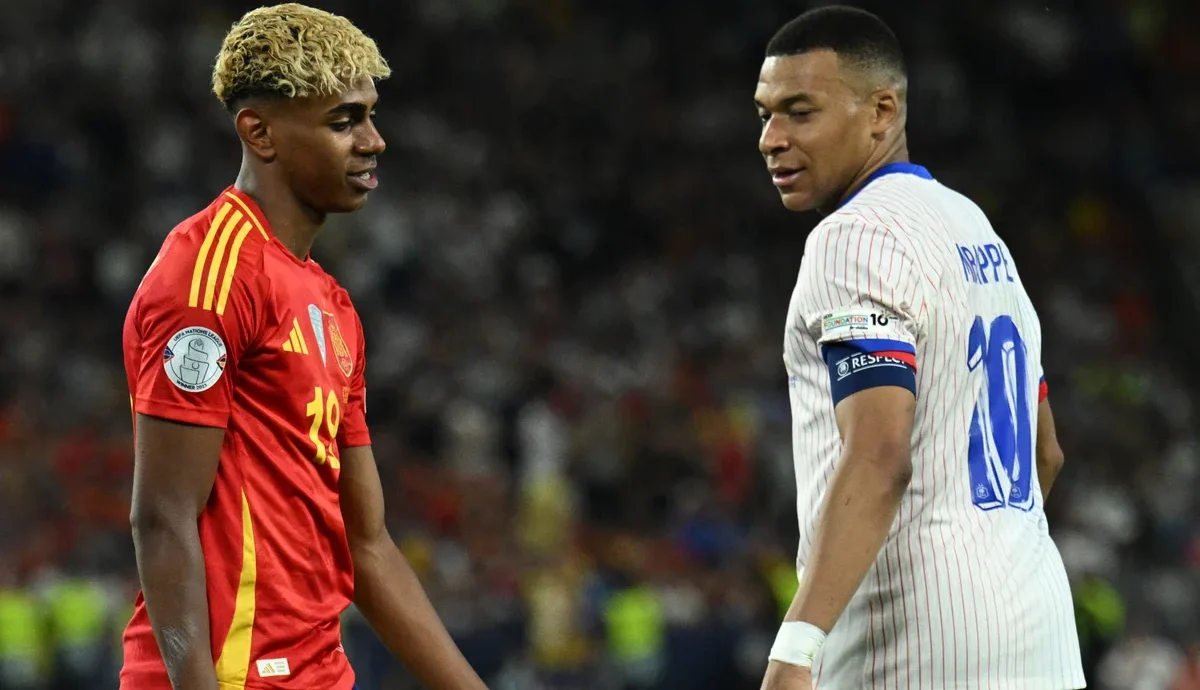
AS the cliché goes, ‘attack wins you games, defence wins you titles’. That could well be put to the test on Tuesday when France take on Spain in the first semi-final of the 2026 FIFA World Cup.
Many believe the eventual champions will come from this semi-final, with both France and Spain having a higher likelihood of winning the World Cup than England or Argentina.
They have each taken slightly different routes to get to the final four. La Roja have built their success on a solid defensive foundation, while Les Bleus have made use of their star-studded attack.

Ahead of what promises to be a fascinating game in Dallas, we’ve looked at what might happen when an irresistible force meets an immovable object.


Defensive strength is not something that football fans would immediately associate with Spanish football, but Luis de la Fuente’s side have not only added it to their repertoire, but made it a key factor in their recent success.
Spain have maintained their trademark passing style, completing 598 passes per match at this World Cup (behind only Argentina) and averaging more possession than any other side (66.0%). On top of that, though, they have also been able to keep chances conceded to a bare minimum.
After six games, Spain have faced just seven shots on target. That’s the fewest shots on target faced per match (1.17) of any side at a men’s World Cup on record (since 1966).
As well as being good at keeping the number of shots on target they concede down, Spain have also been excellent at minimising their expected goals (xG) against in general.
They have conceded just 0.31 xG per match at this World Cup; only Uruguay (0.31 xG against per match at the 1990 World Cup) can match that since 1966. The average xG value of the shots they’ve conceded is a mere 0.05, the lowest of any team at the 2026 tournament, and a joint-record low since 1966.

Defending well is a team effort, but there have been a few individuals who have stood out without the ball thus far.
Aymeric Laporte has expertly marshalled the Spanish defence. His 11 interceptions can only be bettered by Dayot Upamecano.
Unai Simón in goal has also excelled at sweeping up any balls in behind the Spanish backline, which usually plays quite high as they look to press high up the field; only three goalkeepers have attempted to keeper sweep more than Simón.


Additionally, Spain’s captain, Rodri, has been playing as well as he has since recovering from his anterior cruciate ligament injury. He has made 18 tackles in total; only three players at this World Cup have made more, while Rodri has won possession 32 times; fewer than only four players.
De la Fuente has stuck with a very settled backline. Simón, Laporte, Pau Cubarsí and Marc Cucurella have all started every game for Spain, and that familiarity shows.
But they are likely to face their toughest test yet in North America.
On paper, France’s attack looked utterly ridiculous heading into this World Cup. But things don’t always work that way.
In this case, it absolutely has worked that way. Les Bleus’ attack has been utterly ridiculous, with France scoring 16 times in just six games.
Their offensive numbers have been off the charts. France have landed 47 shots on target in 2026, the most they have had at a World Cup since 1998 when they hit the target 53 times on the way to winning the trophy. Their current average of 7.8 shots on target per game is the highest on record since 1966.
Additionally, Didier Deschamps’ side have registered by far the highest xG of any team in the tournament. France have created 14.3 xG in total, at least 1.6 more than any other team (Argentina in second).
That’s perhaps unsurprising, given the elite-level quality that is littered throughout the team.
The frontline is of course headed by Kylian Mbappé who is enjoying yet another outstanding World Cup. Having scored eight goals, Mbappé is battling with Lionel Messi for the 2026 Golden Boot. But he has also proved to be an important creator. The France captain has created 16 chances, a total that can only be bettered by three other players, and he has also recorded three assists.
Mbappé has formed a good partnership with current Ballon d’Or holder, Ousmane Dembélé. The duo have created 19 chances for one another at the World Cup, (10 Mbappé to Dembélé, 9 Dembele to Mbappé); only three pairs of players since 1966 have created 20+ chances for each other at a World Cup finals. On an individual level, Dembélé has also turned up at a major international tournament, scoring five goals and creating two assists in six games.
As well as Mbappé and Dembélé, Michael Olise has starred in North America. The Bayern Munich winger has been France’s major creative force, seemingly able to complete impossibly hard passes.
He tops the assist rankings with five, and is the first player to hit that mark at a single World Cup since Germany’s Thomas Häßler (1994). Olise is just one assist away from equalling Pele’s record for the most at a men’s World Cup (since 1966).
What is particularly scary is that Deschamps hasn’t even needed to dig much deeper into his arsenal yet. Bradley Barcola and Désiré Doué have played supporting roles but also produced a combined five goal involvements between them (2G, 1A for Barcola, 1G, 1A for Doué), while Rayan Cherki has played just 50 minutes, and Maghnes Akliouche and Marcus Thuram have played fewer than 10 minutes between them.
We should be set for a titanic World Cup clash tonight.