

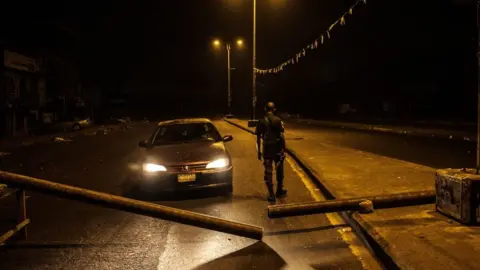
FOR years, police checkpoints across Nigeria have remained one of the most controversial features of the country’s security landscape. To some Nigerians, they represent unnecessary obstruction, harassment and a breeding ground for extortion. To security experts and law enforcement practitioners, they remain critical tools for intelligence gathering, crime prevention and interception of criminal elements.
In this Weekend Feature, News Point Nigeria dissects and analyses the situation, examining the latest controversy involving the alleged extortion of the Chairman of the Independent Corrupt Practices and Other Related Offences Commission (ICPC), Dr Musa Aliyu (SAN), by police officers in Abuja, while also looking at the broader debate surrounding the role, challenges and future of checkpoints in Nigeria.

The recent incident involving four police officers detained by the Federal Capital Territory Police Command once again pushed the issue of police checkpoints into national conversation.

The officers were accused of extorting ₦53,000 from the ICPC chairman during what the police described as an illegal stop-and-search operation around the Banex area of Wuse, Abuja.


The Commissioner of Police in the FCT, Ahmed Sanusi, while addressing journalists, described the officers as “thieves” who had no business wearing the police uniform.
According to him, the officers had abandoned their assigned duty posts, formed an unauthorised checkpoint and allegedly forced the anti-corruption agency chairman to withdraw money through a Point of Sale operator before sharing the proceeds among themselves.
Sanusi said investigations revealed that the officers operated like a criminal gang, moving away from their official assignments to create an illegal checkpoint where motorists were allegedly targeted.
“They are a gang of criminals who left various divisions, clustered together, moved to Wuse Banex and created a checkpoint where they perpetrated this act before fleeing,” the police commissioner said.
He added that the command had arrested the alleged leader of the group after declaring the officers wanted, promising severe punishment for those found guilty, including dismissal from service.

The incident also brought renewed attention to the directive of the Inspector-General of Police prohibiting officers from carrying out indiscriminate searches of citizens’ mobile phones during roadside operations.
Sanusi warned Nigerians against allowing unlawful searches and encouraged citizens to report officers who demand access to phones or engage in extortion.
“You cannot stop anybody on the road and ask the person to bring out his phone for search. If any policeman stops you and asks to search your phone, don’t agree. Call the police emergency lines and we will ask them why,” he said.


However, beyond the immediate controversy lies a much deeper national debate: are checkpoints themselves the problem, or is the problem the manner in which they are operated?
Originally designed as security measures to prevent crime and detect threats, checkpoints have gradually become associated with public frustration and distrust.
Across Nigerian roads, highways and urban centres, citizens have complained about frequent stops, unnecessary delays, harassment and alleged demands for unofficial payments.
The controversy became particularly intense in the South-East, where several groups and community leaders raised concerns about what they described as an excessive concentration of police and military checkpoints.
The Cultural Credibility Development Initiative, for instance, complained about the large number of checkpoints across the region, arguing that excessive security stops had created hardship for residents, travellers and businesses.
The group described the situation as a form of “suffocation” caused by the overwhelming number of checkpoints and called for a major reduction.
Critics argue that instead of strengthening security, some checkpoints have become sources of intimidation and economic exploitation.
There have also been allegations from individuals and organisations that some security personnel use checkpoints to extort motorists, demand unofficial payments from commercial drivers and inconvenience ordinary citizens.
Former leaders of socio-cultural organisations and lawmakers have repeatedly raised concerns about alleged human rights abuses linked to roadside operations.
They have accused some officers of humiliating citizens, engaging in unlawful searches and creating distrust between security agencies and the communities they are meant to protect.
The central question remains: how can security agencies effectively gather intelligence and gain public cooperation when citizens associate checkpoints with fear and frustration?
By definition, a checkpoint is simply a location where vehicles or individuals are stopped for security checks. Across the world, checkpoints are common security measures used at borders, conflict zones and strategic locations.
The challenge, however, is that in Nigeria, a system designed for public protection has often been weakened by human misconduct. Technology has reduced the need for excessive human interference in security monitoring, yet implementation remains slow.
As a result, some checkpoints continue to depend heavily on discretionary actions by individual officers, creating opportunities for abuse.
For many Nigerians, encountering a police barricade often comes with anxiety — not because they oppose security checks, but because of fears of harassment or unofficial demands.
The controversy over checkpoint abuse is not new.
Successive Inspectors-General of Police have issued directives restricting unauthorised checkpoints and warning officers against extortion and misconduct.
Former IGP Ibrahim Idris ordered the dismantling of illegal checkpoints in 2017, stressing that the move was necessary to improve the ease of doing business and ensure free movement of goods and citizens.
Similarly, former IGP Mohammed Adamu directed that only operationally necessary checkpoints should remain on Nigerian roads.
He also warned officers assigned to checkpoints to remain professional, courteous and corruption-free.
Despite these repeated directives, complaints have continued, suggesting a gap between policy statements and actual enforcement.
While criticism of checkpoint abuse remains valid, Nigeria’s security challenges cannot be ignored.
The country continues to face terrorism, kidnapping, banditry, armed robbery and organised criminal activities. In such an environment, security experts argue that abandoning checkpoints entirely could create additional risks.
Criminal networks often exploit weak security structures to move weapons, stolen vehicles and abducted victims across communities.
The argument, therefore, is not whether checkpoints should exist, but whether they are properly authorised, intelligence-driven and professionally managed.
Speaking on the controversy, retired Nigerian police officer Danladi Nuhu Dominic argued that Nigerians often focus heavily on police failures while ignoring the sacrifices and contributions of officers who work daily to protect lives and property.
According to Dominic, checkpoints have played a significant role in intercepting criminals, recovering stolen vehicles, preventing attacks and stopping the movement of illegal weapons.
He maintained that while there is no justification for extortion or misconduct by police officers, it is unfair to present corruption as though it exists only within the police institution.
Dominic argued that corruption remains a wider societal challenge affecting several sectors, including public and private services.
He noted that professionals such as doctors, lawyers, journalists, civil servants and others have also been accused at different times of demanding illegal payments or abusing their positions.
According to him, the police often become the focus of public anger because their work places them directly in contact with citizens on the streets.
The retired officer said Nigerians must also recognise that many police personnel operate under extremely difficult conditions, confronting dangerous criminals while dealing with inadequate welfare, poor equipment and challenging working environments.
He argued that government must accept responsibility for years of underfunding, poor remuneration and welfare challenges within the police force.
According to Dominic, discussions about police reform should not focus only on punishing bad officers but must also address the conditions that affect the morale and effectiveness of the institution.
He insisted that while corrupt officers must face disciplinary action, thousands of hardworking policemen and women who perform their duties professionally should not be judged solely by the misconduct of a few.
The future of police checkpoints in Nigeria depends on achieving a balance between security needs and citizens’ rights. Experts argue that checkpoints must be intelligence-based, properly authorised and subjected to strict supervision.
The use of technology, including body cameras, digital monitoring systems and stronger complaint mechanisms, could help reduce abuse and improve accountability.
There is also a need to clarify the responsibilities of different agencies and reduce situations where police officers perform multiple overlapping roles.
Most importantly, restoring public confidence requires accountability from officers and support from citizens. Motorists must comply with lawful requirements, while security personnel must respect constitutional rights and professional standards.
The debate over checkpoints is therefore not simply about removing barriers from Nigerian roads. It is about rebuilding trust between citizens and the institutions created to protect them.
Nigeria needs security structures that protect lives without creating fear, checkpoints that represent safety, not suspicion; professionalism, not exploitation; and public service, not public frustration.