

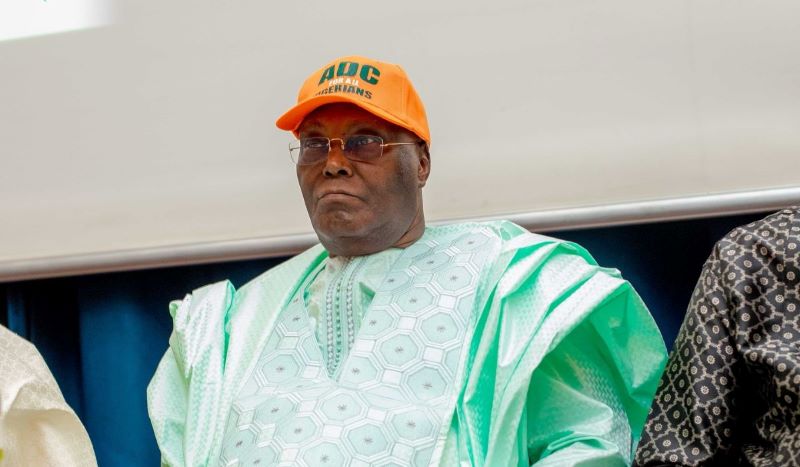
FORMER Vice-President Atiku Abubakar would restore petrol subsidy if elected president in 2027, but phase it out later as part of a temporary economic intervention, his spokesperson, Paul Ibe, has said.
News Point Nigeria reports that Ibe made the disclosure while speaking on AIT, explaining that Atiku’s proposed subsidy would be fundamentally different from the previous system and would be tied to crude oil production and domestic refining.

According to him, the temporary intervention would provide Nigerians and businesses with the breathing space needed to recover from current economic pressures, stimulate economic activity and increase productivity before the subsidy is eventually phased out.

Ibe stressed that the proposal should not be interpreted as a plan to revive the old subsidy regime, which he described as opaque and unsustainable.


“We are not returning to Egypt. We are not going back to the old regime that was opaque,” he said.
“What he’s simply saying is that the subsidy that he is advocating will be tied to the barrel, the crude oil barrel. This is perhaps the only thing that we have in so much abundance that Nigerians have not yet benefited from.”
Under the proposed arrangement, Ibe said crude oil would be supplied to domestic refiners at a discounted or subsidised price, allowing them to produce petrol and diesel at lower costs.
He explained that reduced production costs would ultimately translate into cheaper pump prices for consumers, while ensuring that the intervention was linked directly to Nigeria’s crude oil resources.
“The crude oil will be sold at a discounted price, subsidised to refiners, and that will enable refiners to be able to produce fuel and diesel at a cheap cost. And when they produce cheaply, they will sell at the real pump price,” Ibe said.

He added that an independent committee would be responsible for determining an appropriate refinery price, taking prevailing market conditions into account.
Although the downstream petroleum sector has been deregulated, Ibe said government could still monitor prices to ensure that refiners and marketers operated within the framework of the proposed policy.
“There’ll be a window because, of course, we deregulated. You may not fix the price but you can have price monitoring to ensure that everybody aligns with what government hopes to achieve,” he said.


According to Ibe, the proposed intervention would only last for a limited period and would be designed primarily to stimulate economic activity, support businesses and improve productivity.
He recalled that Atiku had advocated a phased approach to the removal of petrol subsidy during the 2023 presidential election campaign.
“Yes, if you recall, his argument, even in 2023, was that they’re going to have recourse to having a phased removal,” Ibe said.
Ibe also criticised the administration of President Bola Ahmed Tinubu for implementing several major economic reforms simultaneously, arguing that Nigerians and businesses were not given sufficient time or support to adjust.
He likened the approach to subjecting a patient to several major surgeries without allowing adequate time for recovery.
“No surgeon, no doctor would carry out two or more serious major surgeries, one after the other. They would do one, allow the patient to recuperate, and then undertake the second, or the third,” he said.
“But what has this administration done? The issue of subsidy, flippant. No cabinet. No advisers. Just in the heat of the moment, it has been removed. No shock absorbers. Nothing. No palliatives. Absolutely nothing.”
He argued that the simultaneous removal of petrol subsidy, deregulation of the foreign exchange market and electricity subsidy had compounded the economic hardship faced by Nigerians.
Ibe maintained that Atiku’s proposed temporary intervention would provide households, manufacturers and other businesses with the necessary room to recover and expand production.
“You need to give Nigerians and give manufacturers an opportunity to ensure that there is productivity,” he said.