

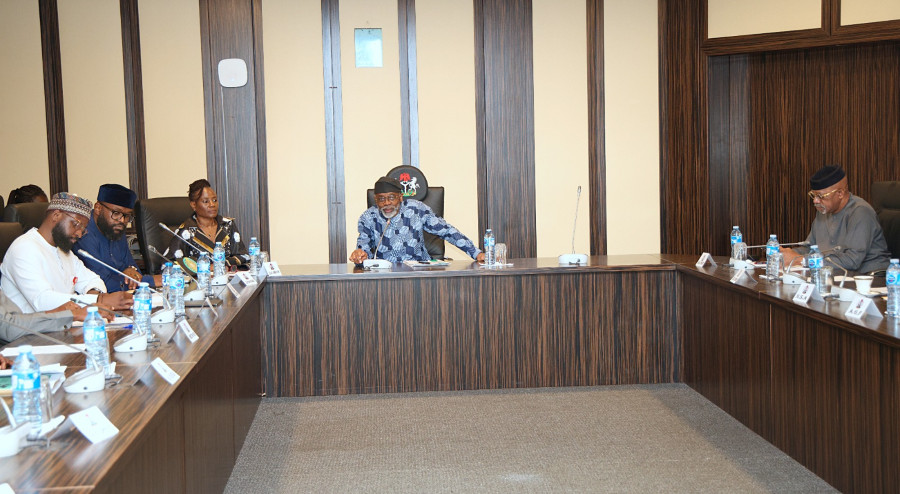
PRESIDENT Bola Ahmed Tinubu on Tuesday inaugurated the Presidential Working Group on the National Policing Bill and appointed his Chief of Staff, Femi Gbajabiamila, as chairman of the committee, in a fresh vote of confidence that came amid the ongoing controversy surrounding the alleged fake Presidential Foreign Intervention Promotion Council (PFIPC).

News Point Nigeria reports that the new appointment comes on the same day President Tinubu ordered the Independent Corrupt Practices and Other Related Offences Commission (ICPC) to conduct a comprehensive investigation into the activities of the purported Presidential Foreign Intervention Promotion Council (PFIPC), while Gbajabiamila simultaneously threatened a ₦10 billion defamation suit against the council’s self-acclaimed Director-General, Adeniyi Adeyemi, over allegations of bribery and murder.
The President, represented by Gbajabiamila, inaugurated the Presidential Working Group at the Presidential Villa, Abuja, charging members to immediately commence work on producing the legal framework that will operationalise state police across Nigeria.


The inauguration followed the National Assembly’s passage of the Constitution Alteration (State Police) Bill, 2026, through which the President is proposing a dual policing structure comprising the Federal Police Service and 36 State Police Services.
According to President Tinubu, while the constitutional amendment establishes the framework for state police, the proposed National Policing Bill will provide the legal structure necessary for its implementation.
“The Constitution Amendment Bill establishes the framework for dual policing, but it does not operationalise it. That work is left to the National Policing Bill,” the President said.
He explained that the proposed legislation would address all legal and institutional issues required for the smooth implementation of the state policing system.
“The proposed National Policing Bill will include provisions on minimum policing standards, state readiness certification, federal-state coordination, accountability, human rights safeguards and fiscal conditions.”
President Tinubu said the committee had been constituted to produce a technically robust and implementation-ready draft bill immediately after the constitutional amendment process.

“The Working Group has been constituted to produce a technically robust, implementation-ready draft National Policing Bill for transmission to the National Assembly,” he said.
The President stressed that work on the legislation should not wait until the constitutional amendment process is concluded.
“We must not wait until the constitutional process is concluded before beginning this important assignment,” he added.


Gbajabiamila will chair the committee, whose membership includes the Attorney-General of the Federation, the President of the Nigerian Bar Association (NBA), the Chairman of the Nigeria Governors’ Forum (NGF), the National Security Adviser, the Inspector-General of Police, the Chairman of the NGF Committee on State Police, while a secretariat will provide administrative support.
Earlier on Tuesday, President Tinubu directed the ICPC to investigate the activities of the PFIPC and all related matters, ordering that the investigation be concluded and a comprehensive report submitted to him within 30 days.
The directive was also disclosed in a statement issued by the Special Adviser to the President on Information and Strategy, Bayo Onanuga.
According to Onanuga, the order followed the discovery of what he described as the fictitious PFIPC, which, according to the Presidency, was never established by the Federal Government and has no basis in any law, presidential instrument, executive approval or any other lawful act of government.
The Presidency alleged that one Adeniyi Adeyemi Matthew falsely presented himself as the Director-General of the purported council and claimed to be a presidential appointee.
According to the statement, the ICPC has been directed to investigate alleged forged appointment letters and other government documents, the use of an alleged false claim of presidential appointment to obtain official recognition and diplomatic support, including visa facilitation, and the opening of multiple bank accounts in the names of purported government agencies using allegedly forged documents.
The Presidency further stated that the anti-graft agency would investigate not only Adeyemi and his alleged collaborators but also the broader circumstances that may have enabled a fictitious body and false claims of presidential appointment to gain an appearance of official legitimacy.
The investigation, according to the statement, will examine the origin and use of the alleged forged official documents, the processes through which official recognition or diplomatic support may have been obtained, the opening and operation of related bank accounts, the movement of funds and the role of any public officials, private individuals, financial institutions or intermediaries who may have facilitated the alleged scheme.
President Tinubu also directed the commission to identify institutional weaknesses that may have been exploited and recommend immediate measures to prevent a recurrence.
All Ministries, Departments and Agencies of the Federal Government have equally been directed to provide the ICPC with all relevant records, information and assistance required for the timely completion of the investigation.
According to the Presidency, the President stressed that the integrity of the Presidency and other federal institutions must be protected against impersonation, forgery, abuse of official identity and the exploitation of weaknesses within the public service.
He further ordered that anyone found culpable should be dealt with strictly in accordance with the law.
The controversy centres on Adeniyi Adeyemi, who insists he was lawfully appointed Director-General of the PFIPC despite the Presidency’s repeated insistence that the council does not exist.
Adeyemi had accused Gbajabiamila of allegedly receiving ₦400 million through a proxy before demanding an additional ₦200 million to facilitate his appointment. He also questioned the Presidency’s denial of the PFIPC’s existence, arguing that the council was referenced in the 2026 Appropriation Act.
The claimant subsequently challenged President Tinubu to establish an independent investigative panel, insisting he was prepared to defend his allegations in court.
The Presidency, however, dismissed the claims, describing Adeyemi as an impostor who allegedly forged appointment documents, impersonated a government official, fraudulently opened a Central Bank of Nigeria account and operated under a non-existent government agency.
According to the Presidency, police investigations have already resulted in an eight-count criminal charge being filed against Adeyemi and two others, with the matter scheduled for hearing on July 27.
Meanwhile, Gbajabiamila has threatened a ₦10 billion defamation suit against Adeyemi over the allegations of murder and bribery.
In a letter signed by his lawyer, Kemi Pinheiro, SAN, the Chief of Staff gave Adeyemi 72 hours to remove all videos and comments containing the allegations against him.
Gbajabiamila also demanded a full retraction and apology to be published in at least five national newspapers and across all social media platforms where Adeyemi’s June 26 press conference was circulated.
Pinheiro described the allegations as “malicious, reckless and entirely without factual foundation,” alleging that they were intended to portray Gbajabiamila as “corrupt, morally bankrupt, and a murderer.”
The legal team further demanded that Adeyemi immediately cease making or publishing any further defamatory statements against the Chief of Staff and provide a written undertaking that he would refrain from doing so in the future.
The letter warned that unless all the demands were complied with within 72 hours, Gbajabiamila would institute appropriate civil and criminal legal proceedings against Adeyemi, including filing a criminal defamation complaint under the applicable laws of the Federal Capital Territory.
Reacting to the inauguration of the Presidential Working Group, Ogun State Governor Dapo Abiodun, speaking on behalf of the Nigeria Governors’ Forum, pledged governors’ support for the speedy implementation of the state police reform.
Abiodun said all 36 governors would work towards accelerating consideration of the constitutional amendment once transmitted to their respective state Houses of Assembly.
Describing state police as a response to Nigerians’ longstanding demand for community-based policing, he said the reform validated the success of regional security outfits such as Amotekun in the South-West.
“This bill has answered the cries of Nigerians about cascading policing and removing it from the Exclusive Legislative List.”
He added that if each state recruited about 6,000 personnel, nearly 200,000 additional security officers would be deployed nationwide to complement the existing federal police.
The governor also commended President Tinubu for commencing implementation planning before the constitutional amendment process was concluded.
“This inauguration demonstrates the proactiveness of the Executive in preparing for effective implementation,” he said.
The Attorney-General of the Federation and Minister of Justice, Lateef Fagbemi, described the initiative as timely, given Nigeria’s security challenges.
“There is no denying the fact that we are in a critical moment security-wise, and all hands must be on deck,” he said.
Fagbemi appealed to governors to ensure the speedy ratification of the constitutional amendment by their respective state legislatures.
The President of the Nigerian Bar Association, Afam Osigwe, reaffirmed the association’s support for the establishment of state police but stressed the need for adequate legal safeguards against abuse.
“Nigeria can hardly be effectively policed by one national police. We fully support the constitutional amendment providing for state police.
“We must ensure we do not create a monster. The right legal framework must guarantee accountability and prevent oppression.”
Osigwe pledged the NBA’s support for the committee in developing legislation that would strengthen national security while safeguarding the rights of citizens.
Also present at the inauguration were the Attorneys-General and Commissioners for Justice of Plateau, Lagos and Ondo states, representatives of the Inspector-General of Police and the National Security Adviser, as well as other senior government officials.