

IN a state where political power has historically revolved around influential personalities, entrenched structures and carefully cultivated alliances, the battle for Jigawa Government House ahead of the 2027 governorship election is already emerging as one of the most intense and politically explosive contests in the state’s modern democratic history.
What initially appeared to be a routine re-election journey for Governor Umar Namadi is rapidly evolving into a high-stakes political confrontation fuelled by shifting loyalties, growing internal tensions within the ruling All Progressives Congress (APC), the resurgence of the Peoples Democratic Party (PDP), and the quiet but increasingly visible alignment of some of Jigawa’s most powerful political forces.
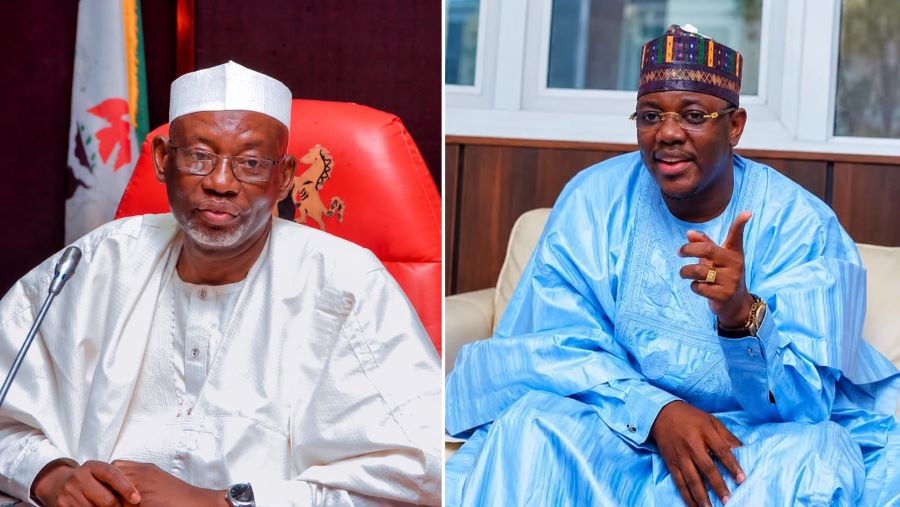
At the heart of the unfolding political drama are Governor Umar Namadi of the APC and Mustapha Sule Lamido of the PDP, two figures whose rivalry is steadily redefining the future political direction of Jigawa State ahead of 2027.


While Governor Namadi still enjoys the enormous advantages of incumbency, including control of government structures, political appointments and the influence that naturally comes with power, Mustapha Sule Lamido is gradually building what many political observers now describe as a dangerous and potentially game-changing coalition capable of shaking the governor’s grip on power.
In this Sunday political feature, News Point Nigeria examines the growing political storm in Jigawa, the widening cracks within the APC, the strategic resurgence of the PDP, and how the emerging alliance involving former Governor Sule Lamido and ex-Minister Mohammed Badaru Abubakar may turn the 2027 governorship election into the biggest political test of Governor Namadi’s career.
The unfolding political calculations became even more significant following the emergence of Mustapha Sule Lamido as the consensus governorship candidate of the PDP ahead of the next election cycle.
The development is widely viewed as an early signal that the opposition party intends to avoid internal divisions and focus its entire energy on confronting the APC in what could become a defining election in Jigawa politics.
The motion for Lamido’s adoption was moved by former Secretary to the State Government, Dr Aminu Taura, and seconded by Wada Abubakar Dokaji during a stakeholders’ meeting attended by party leaders across the 27 local government areas of the state.
The process, supervised by the PDP State Chairman, Babandi Ibrahim, ended in a resounding voice vote, symbolising what party leaders described as a united front ahead of the 2027 election.

Mustapha Sule Lamido, businessman, politician and son of former Jigawa State Governor Sule Lamido, is not a newcomer to the state’s political frontline.
In the 2023 governorship election, he emerged as the PDP candidate and mounted one of the strongest opposition challenges witnessed in Jigawa in recent years.
Governor Umar Namadi eventually secured victory with 618,449 votes after winning 26 out of the 27 local government areas in the state.


Mustapha Sule Lamido polled 368,726 votes, while Ibrahim Ringim of the NNPP secured 37,156 votes in a contest that significantly reshaped Jigawa’s political dynamics.
Although Namadi won convincingly, sources told this newspaper that the 2023 election also revealed the existence of a sizeable opposition base capable of becoming even stronger under favourable political circumstances.
Since the election, Mustapha Sule Lamido has remained politically active, sustaining grassroots mobilisation, consolidating PDP structures and strengthening alliances within and outside the opposition party.
Supporters increasingly portray him as not just a continuation of his father’s political legacy, but also as a younger political figure attempting to appeal to youth voters through messages centred on governance reform, institutional rebuilding and empowerment.
Following his emergence as consensus candidate, Lamido urged PDP members to close ranks and focus on rescuing Jigawa from what he described as worsening socio-economic conditions.
He warned that sectors such as healthcare and education were facing serious strain and called for sacrifice, discipline and unity within the party.
According to him, the PDP must “do everything humanly possible to protect the interests of the party and the interests of the state.”
He further stated that only collective commitment could rescue Jigawa “from the devastation and catastrophe it has found itself once again.”
While the PDP continues consolidating internally, perhaps the biggest political development altering the 2027 calculations is the widening rift between Governor Umar Namadi and his predecessor, former Minister of Defence Mohammed Badaru Abubakar.
For years, Badaru was widely seen as the political godfather who played a major role in Namadi’s emergence as governor.
However, political insiders say the relationship began deteriorating barely months after Namadi assumed office.
According to sources familiar with the development, disagreements over appointments, political control and allocation of influence triggered early tension between both camps.
The first major public crack reportedly emerged during preparations for the inauguration of the current Jigawa State House of Assembly in June 2023.
At a stakeholders’ meeting in Kano convened by Badaru, Governor Namadi was reportedly persuaded to support the re-election of Idris Garba Jahun as Speaker in order to preserve the existing zoning arrangement within the state’s political structure.
However, shortly after the meeting, Namadi allegedly changed course and backed Aliyu Dangyatin from Miga State Constituency for the position instead.
The governor’s decision reportedly angered Badaru’s political camp.
To further underscore his determination, Governor Namadi was physically present inside the Assembly chambers during the election and inauguration of Dangyatin.
Meanwhile, Idris Jahun and APC State Chairman Aminu Sani Gumel reportedly stayed away from the exercise.
Although opposition to Jahun’s return as Speaker was reportedly popular in several quarters due to allegations of high-handedness, political observers insist the incident marked the beginning of a deeper struggle over political control between Namadi and his predecessor.
Sources also claimed that some close allies of Governor Namadi encouraged him to gradually free himself from what they described as Badaru’s overwhelming political influence, warning that continued dependence could result in excessive external control over appointments and government contracts.
The tension reportedly reduced temporarily after Badaru was appointed Minister of Defence and became increasingly occupied with national responsibilities in Abuja.
However, sources told this newspaper that the rift resurfaced strongly after Badaru exited the ministry, with some of his loyalists quietly blaming Governor Namadi for allegedly contributing to his removal.
The conflict escalated dramatically after the Jigawa State House of Assembly adopted a report from its Committee on Public Accounts recommending investigations into alleged financial irregularities linked to Badaru’s administration between 2019 and 2024.
The committee cited alleged questionable procurement procedures, unverifiable expenditures, missing financial records and budget overruns involving the former administration and local government councils.
Supporters of Badaru immediately interpreted the move as politically motivated.
Although the Assembly insisted the investigation represented normal legislative oversight, the development deepened hostilities between both camps.
And in what many now describe as the most dangerous political threat facing Governor Namadi, reports have emerged suggesting growing cooperation between the Badaru political bloc and the Sule Lamido camp.
Several sources claim the biggest beneficiary of the Namadi-Badaru crisis is Mustapha Sule Lamido.
According to insiders, Badaru’s loyalists will support Mustapha Sule Lamido’s governorship ambition in exchange for strategic concessions involving deputy governorship and legislative positions.
Another source confirmed to News Point Nigeria that discussions were ongoing regarding political arrangements that could see Badaru’s camp provide support structures and strategic mobilisation for the PDP candidate.
Although Badaru has publicly denied reports suggesting plans to defect from the APC, his recent interactions with opposition figures have continued to fuel speculation.
Political tension further intensified after one of Badaru’s loyalists, Zakari Kafin-Hausa, shared a video criticising President Bola Tinubu’s policies and alleging that Northern Nigeria had not benefited proportionately despite its electoral support for the APC in 2023.
The symbolism of such actions reflects growing dissatisfaction within sections of the APC political establishment in Jigawa.
According to prominent political commentator Abdullahi Ubale Gumel, Governor Namadi may be heading into what could become the most difficult political battle of his career as powerful forces continue to align behind Mustapha Sule Lamido ahead of the unfolding political contest in Jigawa State.
Gumel observed that the emerging alliance between Sule Lamido and Badaru Abubakar, represents a major political threat to the governor’s ambitions, describing the duo as the two most influential political figures the state has produced in the last two decades.
According to him, Sule Lamido remains arguably the most dominant political figure in Jigawa’s history, with deep-rooted structures, loyal grassroots networks and longstanding political influence that still resonates across the state. He added that in more recent years, Badaru has built himself into another formidable political heavyweight with extensive reach across party lines and strong influence within the APC establishment.
“The coming together of Sule Lamido and Badaru Abubakar is not something any politician in Jigawa can ignore,” Gumel stated. “These are two political giants with structures, loyalists and influence spread across virtually all the local governments in the state. If they truly unite behind Mustapha Sule Lamido, Governor Namadi will face the biggest political test of his life.”
He, however, acknowledged that Governor Namadi still possesses significant advantages that could shape the outcome of any political confrontation, particularly the power of incumbency and the possible backing of the Federal Government and the ruling APC structure at the national level.
Gumel noted that incumbency in Nigerian politics remains a powerful weapon, especially when combined with access to government structures, appointments, political patronage and institutional influence. He added that if the Presidency and federal political machinery fully rally behind Namadi, the governor could still remain highly competitive despite the growing coalition against him.
Despite this, the Gumel claimed there were already growing signs of internal discontent within the Jigawa APC, alleging that some government appointees and cabinet members may secretly work against the governor in favour of the Badaru-Mustapha political camp.
“From what I have been reliably informed, many political appointees within the government may engage in anti-party activities quietly while publicly remaining loyal to the governor,” he alleged. “That is one of the biggest dangers facing Governor Namadi because internal sabotage is often more damaging than external opposition.”
He further argued that the battle may ultimately test not just political popularity, but also loyalty within the ruling structure, grassroots mobilisation, and the ability of both camps to sustain influence across Jigawa’s complex political landscape.
Despite this glaring fall, however, political analysts insist Governor Namadi still possesses significant advantages.
Foremost among them is the power of incumbency.
As sitting governor, Namadi controls state structures, appointments, patronage systems and administrative influence that naturally strengthen incumbents in Nigerian politics.
There is also the possibility of strong backing from the Presidency and the federal APC structure.
Governor Namadi’s administration has consistently aligned itself with President Bola Tinubu’s policies and the APC’s national agenda through its “12-point agenda” focused on infrastructure, agriculture and governance reforms.
A soruce argues that if the Presidency throws its full weight behind Namadi, the governor could remain politically formidable despite the growing opposition coalition.
Yet, even within government circles, there are reports of growing internal dissatisfaction.
Unlike previous elections driven mainly by party loyalty, the coming battle may revolve more around political structures, elite alignments, personal influence and grassroots mobilisation.
For now, Jigawa remains politically tense, uncertain and increasingly polarised.
What initially appeared like a straightforward re-election journey for Governor Umar Namadi is gradually evolving into a far more complicated political war involving old alliances, wounded loyalties, competing ambitions and strategic realignments.
And with Sule Lamido’s enduring influence, Badaru’s political machinery and Mustapha Sule Lamido’s growing momentum converging at the same moment, the road to 2027 may prove far more difficult for Governor Namadi than many initially imagined.