
THE political atmosphere in Enugu State has once again been thrown into controversy, confusion and deep moral debate following the emergence of parallel governorship candidates from the Peoples Democratic Party ahead of the 2027 governorship election.
What should ordinarily have been a straightforward democratic process has instead evolved into a troubling spectacle capable of damaging the credibility of the opposition party in one of its traditional strongholds.

Read also: I Never Purchased Governorship Nomination Form, Says Ogun 2027 PDP Aspirant
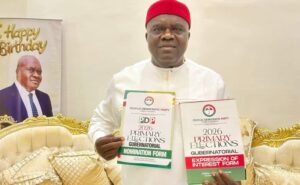
At the centre of the storm is former Minister of Innovation, Science and Technology, Uche Nnaji, whose controversial emergence from a parallel factional primary has reopened painful national conversations about integrity, leadership, accountability and the dangerous normalisation of scandal in Nigerian politics.

For many political observers, the development represents far more than a mere internal party disagreement. It raises difficult ethical questions about the standards political parties now apply when choosing individuals seeking the highest offices in society.
It also places Enugu voters before what many now describe as a defining moral and political moment.


News Point Nigeria reports that the crisis began after frontline governorship aspirant, Chief Samson Chukwu Nnamani, emerged winner of the officially recognised PDP governorship primary election held on Sunday, May 24, 2026.
Nnamani secured what party officials described as a landslide victory after polling 13,576 votes to defeat his closest rival, Uche Nnaji, who garnered 768 votes during the exercise conducted across the 17 Local Government Areas of Enugu State.
Declaring the results on behalf of the electoral committee, High Chief Wilson Okoye announced that having scored the highest number of valid votes cast, Nnamani was duly returned as the PDP governorship candidate for the forthcoming election.

In his acceptance speech, Nnamani thanked God, party delegates, leaders and supporters for what he described as an overwhelming mandate.
He assured party faithful that he would not betray the confidence reposed in him and called for unity within the party ahead of the governorship election.
The exercise itself was monitored by officials of the Independent National Electoral Commission, while security agencies maintained order throughout the process.

But even before the dust from the primary had settled, another drama emerged.
In what many party members and observers described as a parallel and undemocratic move, Uche Nnaji also emerged as a governorship candidate of another faction of the PDP after a separate primary reportedly conducted in Enugu on Monday.
According to reports, Nnaji polled 7,424 votes to defeat Samson Nnamani, who allegedly scored 600 votes in the parallel exercise conducted under the supervision of Austin Nwachukwu, chairman of the State Gubernatorial Committee of the PDP.
The conflicting outcomes immediately deepened the crisis within the party and exposed serious fractures in its internal structure ahead of a crucial election cycle.
However, beyond the confusion surrounding the parallel primaries, the greatest source of controversy remains the personality of Uche Nnaji himself.
For many Nigerians, his political comeback attempt is shocking considering the weight of allegations that forced his resignation from the federal cabinet under the administration of President Bola Ahmed Tinubu.
Nnaji resigned from office after investigations reportedly uncovered allegations bordering on certificate forgery involving his academic qualifications and National Youth Service Corps documents.
The scandal generated widespread outrage across the country, with many Nigerians insisting that resignation alone was insufficient punishment for such allegations.
Questions surrounding forged certificates are particularly sensitive in Nigeria because they touch directly on trust, competence and legitimacy.
For a nation already battling corruption, institutional decay and declining public confidence, many believe political parties should be extremely careful about elevating individuals linked to credibility scandals into positions of leadership.
That is why many observers now argue that the PDP risks severe reputational damage by allowing Nnaji’s political ambition to continue under such circumstances.
Critics say the controversy goes beyond partisan politics and enters the dangerous territory of normalising ethical compromise in public office.
A civil society organisation, Defence for Democracy, openly criticised the PDP for clearing Nnaji to contest despite the lingering allegations.
Read also: Adebutu, Pantami, Gwarzo: PDP, NDC Set October 24 Deadline For INEC To Address Omitted Candidates
The group warned that the decision raised serious concerns about the integrity of the party’s screening process and could expose the PDP to avoidable legal and political complications.
Its National President, Dr. Emeka Nwachukwu, accused the party of acting in a manner capable of benefiting rival political parties during the election.
For many Enugu residents, the issue is not simply whether a candidate can win votes. The deeper concern is what message such a candidacy sends to younger Nigerians.
In a country where millions of students struggle honestly through schools and universities despite hardship, unemployment and poor infrastructure, critics argue that promoting anyone associated with certificate forgery allegations sends a dangerous signal that integrity no longer matters in leadership recruitment.
Several political analysts have described the situation as embarrassing for a state like Enugu, long regarded as one of the intellectual and educational centres of southeastern Nigeria.
To such critics, it would be deeply humiliating for a state known for producing academics, legal minds, professionals and respected public servants to eventually elect a governor battling such damaging allegations.
Legal practitioner Liborous Oshoma had earlier criticised the Nigerian government for allegedly failing to prosecute Nnaji over the scandal.
According to him, individuals implicated in certificate forgery cases should face prosecution and be banned from public office as deterrence to others.
Political scientist and public commentator, Robert Fidelis Chukwuma, popularly known as RFC, also weighed into the controversy in a strongly worded reaction that has continued generating debate within political circles.
According to Chukwuma, the PDP must understand that politics is not only about winning elections but also about protecting public confidence in democratic institutions.
“Leadership is moral before it becomes political,” he said.
“When people accused of certificate forgery continue appearing on ballots and seeking executive offices, society gradually begins to normalise deception as part of governance. That is dangerous for democracy.”
RFC warned that the development could damage the credibility of Enugu politics beyond the immediate election cycle.
“Enugu is historically respected for education, intellectualism and elite political culture. The state should not become associated with controversies surrounding forged credentials. That would be tragic.”
He further cautioned influential businessmen and elite political financiers, including Africa’s richest businessman, Aliko Dangote, against indirectly encouraging a political culture where integrity becomes secondary to power and influence.
“People with enormous influence in Nigeria must be careful what type of politics they legitimise through association, silence or support,” RFC stated.
“When questionable characters continue rising politically despite unresolved scandals, it weakens the moral authority of the entire political system.”
Across Enugu State, discussions surrounding the PDP crisis have now moved beyond party offices into markets, campuses, churches and social gatherings.
While supporters of Nnaji insist he remains innocent until proven guilty, critics argue that public office requires a higher ethical standard than ordinary legal technicalities.
For them, leadership must inspire confidence rather than controversy.
The parallel primaries have also exposed the PDP to possible prolonged legal battles capable of weakening the party ahead of the governorship election.
With rival factions laying claim to legitimacy, analysts warn that the opposition party risks entering the election deeply divided and morally vulnerable.
For many voters, however, the central issue remains simple.
Read also: El-Rufai Loses ₦120m Suit Against DSS, EFCC, ICPC As Court Orders Him To Pay ₦800,000 Damages
Should a politician whose public image has been overshadowed by allegations of certificate forgery be entrusted with the future of an important state like Enugu?
That question may ultimately define not only the PDP’s future in the state but also the larger direction of Nigerian politics itself.