

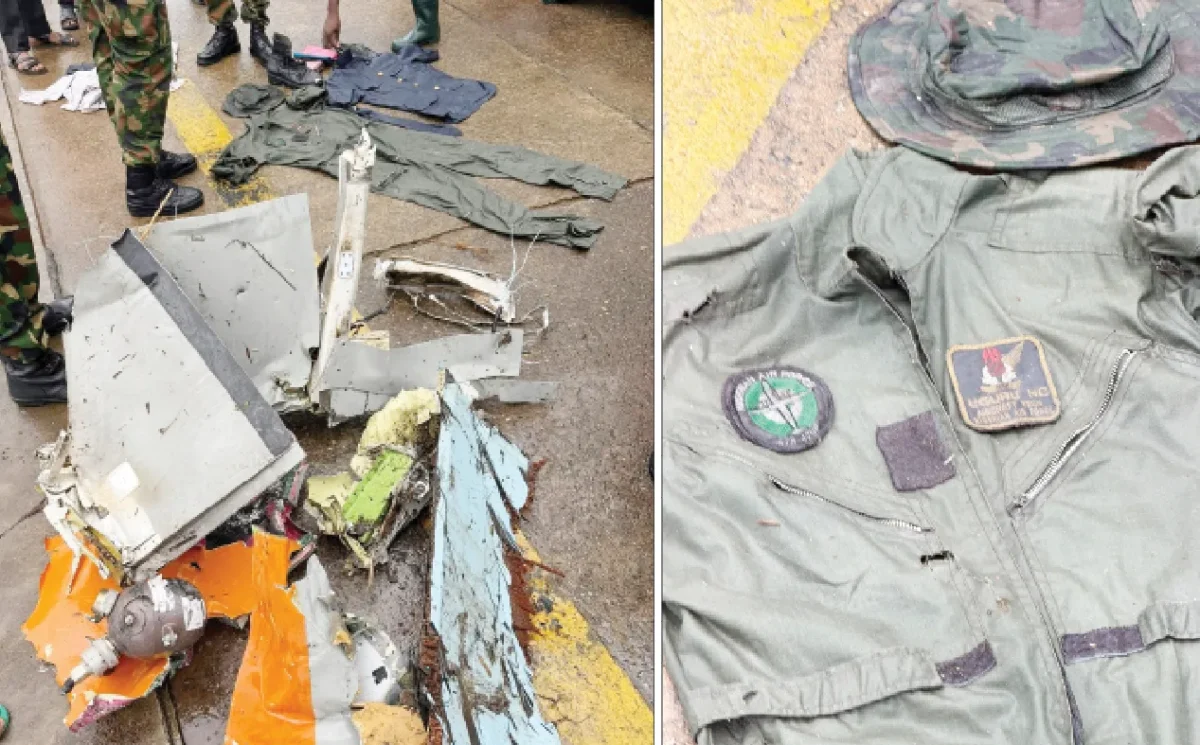
THE crash of a Nigerian Air Force (NAF) ATR-42 aircraft in Igbokoda, headquarters of Ilaje Local Government Area of Ondo State, has left residents, families and eyewitnesses grappling with horror, grief and uncertainty, as human remains, aircraft parts and personal effects were reportedly scattered across the swampy crash site.

News Point Nigeria dissects and analyses the situation, piecing together eyewitness accounts, official statements and information from aviation and local sources to examine what happened, the difficulty of accessing the crash site, the conflicting early accounts about casualties and the circumstances surrounding the aircraft’s disappearance from radar shortly after take-off.

The aircraft, with tail number NGR 931, was on a routine mission from Benin City in Edo State to Lagos when it crashed into a swampy area near the Naval Base in Igbokoda. The incident triggered immediate concern in the coastal community, with eyewitnesses recounting scenes of devastation and fearing that there might be no survivors.

One of the residents who visited the scene, Oluboyo Olusola, said he saw parts of the aircraft, human remains and personal effects scattered around the swampy area, with some bodies inside the water.


Olusola explained that the incident occurred around 10am, adding that the difficult terrain made access to the crash site extremely challenging.
According to him, it took the intervention of naval personnel in the area to eventually assist residents in reaching the crash site. Although Olusola did not witness the actual crash, he said the deafening sound alerted residents to the accident.
“We heard a loud noise like thunder and rushed to the scene, only to discover that it was an aircraft crash. Initially, we thought it was a helicopter, but later got to know it was an aircraft,” he stated.
“It was difficult to access the terrain, but with the assistance of some naval officers, we were able to get there and saw the remains of the aircraft, as well as human remains, clothes, shoes and other personal effects.
“Some of the bodies were also inside the water. From what I saw, it appeared that there was no survivor.”

The account painted by another eyewitness who spoke with Nigerian Tribune was equally grim. The man said that by the time the rescue team arrived at the crash site, there was little that could be done to rescue anyone, as human remains and personal belongings were scattered across the ground.
According to him, local vigilantes and other people who had gone to the scene eventually left in sorrow.
“We all left what we were doing, but unfortunately, when we eventually located the spot, it was a gory tale.


“We saw the debris of the plane; the human flesh; shoes of passengers; intestines that forcefully came out from the stomach of passengers.
“It was a gory scene to behold. There was nothing to rescue again. We all left the place with our eyes filled with tears.”
For the Olu of Igbokoda, Oba Afolabi Odidiomo, the first concern was the possibility that the aircraft could have been a commercial passenger plane. The traditional ruler said he was in court when the incident occurred and immediately directed some of his palace aides to visit the crash site and establish what had happened.
He said the uncertainty surrounding the type of aircraft initially heightened his concern because of the potentially large number of casualties that could have resulted if it had been a commercial passenger plane.
“I was in court when the incident happened, and I directed some of my palace officials to visit the site. At that time, nobody could determine whether it was an aircraft or a helicopter.
“I was worried because it must not be a plane, because the number of casualties would be just too high.
“Our first thanks to the Almighty God is that it did not happen inside the town; otherwise, the casualties would have been too many but we sympathised with the families of the victims.”
The monarch said the aircraft crashed into a river and swampy area while it was raining, leaving the terrain waterlogged and difficult to navigate.
“The aircraft crashed into the river and a swampy area. It was raining when the incident happened, and the place was waterlogged.
“The aircraft did not catch fire, but a substantial part of it has gone into the water.
“We cannot describe the exact situation for now, but from my investigation and what we have gathered so far, there was no survivor.”
Odidiomo, who spoke again on the incident, maintained that authorities were still working to establish the full circumstances surrounding the crash.
Beyond the aircraft itself, accounts emerging from the community suggest that those on board were not simply military personnel on a routine journey. Sources said the aircraft carried airmen, soldiers, family members and crew, making the tragedy one that potentially affected several families at once.
Sources disclosed that some of the family members included children returning to school, as well as relatives who had visited their bread-winners serving in Edo and Delta states.
According to the sources, the turbo-prop aircraft was on a logistics mission to Lagos for NAF operations and provided an opportunity for families, particularly those of military personnel, to travel to Lagos.
It was learned that the difficulty in releasing the names of the dead passengers from military authorities stemmed from the fact that civilian passengers were also on board, with efforts ongoing to reach out to them first.
This aspect of the tragedy also added another layer of complexity to the immediate aftermath, as authorities had to establish the identities and conditions of those on board while families waited for confirmation.
Perhaps one of the most troubling aspects of the crash was the account of what happened to the aircraft after it took off from Benin City. A senior Air Traffic Controller familiar with the aircraft’s final journey said the aircraft disappeared from radar shortly after take-off.
The senior Air Traffic Controller, who spoke with our correspondent on condition of anonymity because he was not authorised to comment on the matter, said communication with the aircraft was established shortly after it took off, but contact was subsequently lost, with efforts to reconnect proving unsuccessful.
“I must tell you that this is looking somehow shoddy. When the aircraft took off, we were in touch with it shortly afterward, but it disappeared from the radar. Efforts to reach it were unsuccessful,” the source said.
According to the source, personnel at the closest reporting points in Okitipupa later reported hearing a loud bang believed to have been the sound of the crash.
The source said the military immediately commenced search-and-rescue efforts after the aircraft was reported to have disappeared from radar. He, however, stressed that the ongoing search-and-rescue operation would provide more information about what happened.
“But it was strange. Almost immediately after it took off, we lost communication with it. There was no communication, nothing. And that makes it suspicious. The aircraft just vanished until the crash.
“Even as we speak, the search-and-rescue operation is still ongoing, and when that is concluded, I should be able to get more information,” the source said.
While describing the loss of communication as suspicious, the source said the circumstances surrounding the crash would become clearer as rescue and recovery operations progressed.
“The loss of communication is very suspicious, but God will help us anyway. It is very possible for us to get clearer information as things unfold,” the source added.
The Minister of Aviation and Aerospace Development, Festus Keyamo, also disclosed that air traffic controllers had informed him about the disappearance of the aircraft.
“I regret to inform the general public that Air Traffic Controllers have informed me of the disappearance of a military aircraft with tail number NGR 931, enroute Lagos from Benin at 0913 hours earlier today. All efforts to raise the aircraft on radio proved abortive,” Keyamo said.
He later confirmed that the wreckage had been located close to the Naval Base in Igbokoda.
“Subsequently, information, however, confirmed that the military aircraft had crashed close to the Naval Base in Igbokoda, Ondo State. The wreckage has been located, and search and rescue operations are ongoing,” he said.
Keyamo said 32 people, comprising 25 passengers and seven crew members, were on board the aircraft.
While the rescue and recovery efforts continued, President Bola Ahmed Tinubu ordered an immediate investigation into the crash.
He also declared three days of national mourning for the victims and directed that flags be flown at half-mast throughout the country as a mark of respect to the officers.
The presidential response came against the backdrop of growing grief over the incident and the accounts emerging from the crash site.
For now, however, the people of Igbokoda are left with the memory of a deafening sound, a sudden crash and a rescue operation unfolding in a waterlogged landscape.
And as authorities continue the search for answers, the most important questions remain: What exactly happened to NGR 931 after it took off from Benin? Why was communication lost so quickly? Did weather conditions contribute to the accident? And what can the investigation reveal about the final moments of the ill-fated aircraft?
Those questions will ultimately have to be answered by the official investigation, even as families, colleagues and the wider Nigerian public wait for certainty about the fate of those who were on board.