

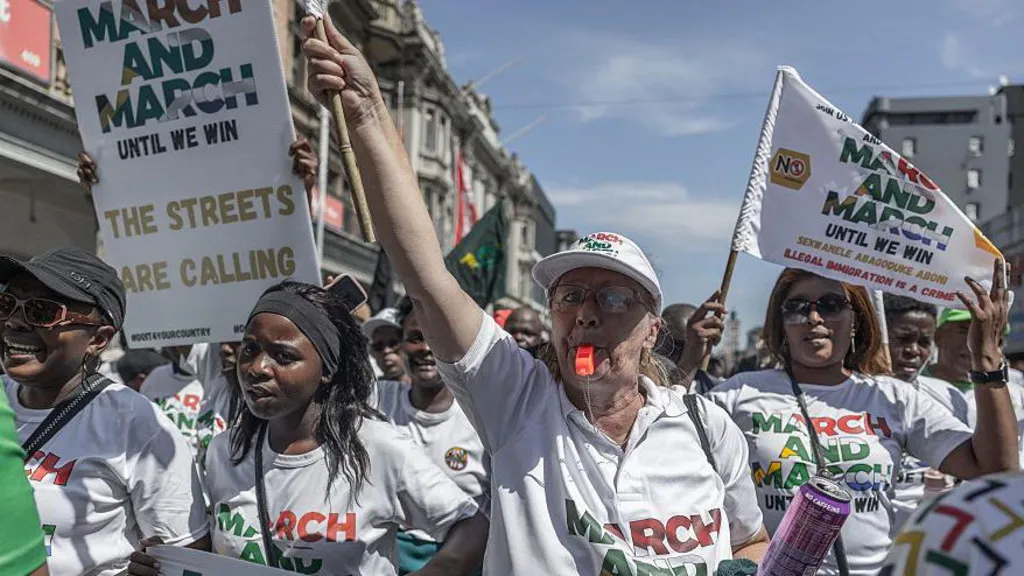
FRANK Onyekwelu, president of the Nigerian community in South Africa, has disclosed that more than 130 Nigerians have voluntarily registered for repatriation following renewed xenophobic attacks against foreign nationals in the country.

News Point Nigeria reports that Onyekwelu made the disclosure during Channels Television’s Morning Brief programme on Thursday.
The development comes days after the Federal Government announced plans for the voluntary evacuation of Nigerians willing to return home from South Africa.


On Sunday, the Federal Government said it had commenced arrangements for the voluntary repatriation of Nigerians in South Africa following attacks targeting foreign nationals.
Nigeria’s Minister of Foreign Affairs, Bianca Odumegwu-Ojukwu, had disclosed that President Bola Tinubu directed that evacuation flights be provided for Nigerians interested in returning home.
Odumegwu-Ojukwu also revealed that efforts were ongoing to collate the details of affected Nigerians, noting at the time that 130 citizens had registered with Nigeria’s mission in South Africa.
According to her, the number was expected to increase as Nigerian associations in the country continued assisting with the registration process.
Speaking on Thursday, Onyekwelu confirmed that the number had already exceeded the earlier reported figure, as many Nigerians continued to struggle with economic hardship and health-related challenges in South Africa.
“As we speak now, the numbers have increased more than 130. We have other Nigerian citizens that have also applied for such voluntary and free repatriation,” he said.

“Some of them have issues with the economy —economic hardship — they are struggling to survive.”
He explained that several Nigerians were also facing documentation difficulties, particularly delays associated with the renewal of residence permits and acquisition of work permits.
“Some of them have applied either to renew their existing residence permit or to get another kind of permit that will allow them to trade or do work or get employed in some companies,” Onyekwelu said.


“But due to the documentation process and the delays and the challenges in terms of requirements that you have to provide as a foreign national, it becomes a bit challenging for them to provide such records or such requests.”
He added that many Nigerians had concluded that returning home was now their best option.
“So, at this point, many of them have considered their best option is to go back home. Some have worked for two or three years and currently there is no more job or business or resources has finished; and they are now deciding that it’s better for them to go back home, find another source of livelihood and then start up life again, which is considerably easier.”
Onyekwelu further noted that some of the returnees believed reintegrating into life in Nigeria might prove more sustainable than remaining in South Africa under current conditions.
“They believe they will not be dealing with rentals, maybe if they are staying in their family home and they will be able to concentrate —maybe continue with one or two agricultural farming products to sustain livelihood,” he stated.
The community leader also identified rising healthcare costs and medical challenges as major factors influencing the decision of some Nigerians to seek repatriation.
“Some are because of health issues they fell sick or have some health challenges and the cost of treatment as a foreign national here has increased whereby you cannot go to some hospitals at the moment and then receive treatment free as it used to be,” he said.
“In some hospitals, you are now meant to pay or consult a private hospital and some of them now consider that it will be easier and even much cheaper for them to attend health clinic in Nigeria or attend the medical facilities in Nigeria where they might afford the payment.”