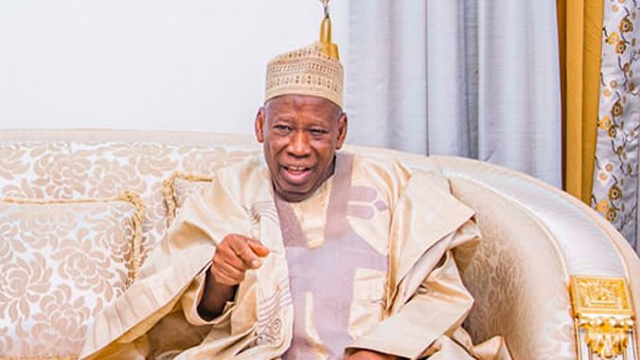
THE former National Chairman of the All Progressives Congress (APC), Dr. Abdullahi Umar Ganduje, has responded to recent remarks by former Kano State Governor, Rabiu Musa Kwankwaso, insisting that the latter once benefited from his political mentorship and support during the early stages of his career.
News Point Nigeria reports that Ganduje, who is currently in Saudi Arabia for the Hajj pilgrimage, made the clarification in a statement issued on Friday by his Chief of Staff, Comrade Muhammad Garba.
Read also: Kano Shuts Nine Private Schools For Failing To Meet Registration Requirements

The statement was a direct response to Kwankwaso’s recent comment in which he reportedly said, “Even Ganduje was once my boy,” a remark that has generated political reactions across Kano State and beyond.


Reacting, Ganduje emphasized that politics is fundamentally built on relationships, mentorship, sacrifice, and mutual support, stressing that no political leader rises without the backing of others at different stages of their journey.
According to the statement, Ganduje recalled that he played a significant role in supporting Kwankwaso during his early political trajectory, particularly during the National Assembly election that led to Kwankwaso’s emergence as Deputy Speaker of the House of Representatives.
It noted that at the time, Ganduje could have equally been described as politically senior to Kwankwaso, having offered moral and financial support that contributed to his political advancement.
The former APC chairman also referenced his years of public service as a senior civil servant in the Federal Capital Territory and later as Kano State Commissioner for Works, Housing and Transport, stating that Kwankwaso frequently visited his offices in Abuja and Kano during that period.
Read also: Police Block Venue Of ‘Tinubu Must Go’ Movement’s Meeting In Kano

The statement added that Ganduje considered it unnecessary to introduce “boy-master” narratives into contemporary political discourse, especially at a time when citizens expect leaders to focus on governance, development, and public welfare.
Ganduje further revisited the 1998 governorship primaries in Kano State, noting that although many stakeholders believed he had won the contest, he was persuaded by senior political figures to step down in favour of party unity and instead accept the deputy governorship position alongside Kwankwaso.
Despite their long history of collaboration and subsequent political rivalry, the statement recalled that both men served together as governor and deputy governor between 1999 and 2003, and again within overlapping political engagements from 2011 to 2015.


Ganduje also drew attention to the evolving nature of political relationships, citing the example of Kano State Governor Abba Kabir Yusuf, who once served as Kwankwaso’s Personal Assistant but now holds the highest elected office in the state.
He stressed that leadership trajectories often change over time, noting that political mentorship does not diminish with shifting positions, and that a “father can nurture a child who eventually grows to become more prominent.”
Read also: Zamfara, Kano, Delta, Four Other States: INEC Raises Alarm Over Fake Governorship Candidates’ List
“Politics should not be about who is superior to the other. It should be about service, continuity, and development,” Ganduje was quoted as saying.
He urged political leaders and their supporters in Kano State to avoid statements capable of deepening divisions, calling instead for unity and a renewed focus on peace, progress, and governance in the state.