

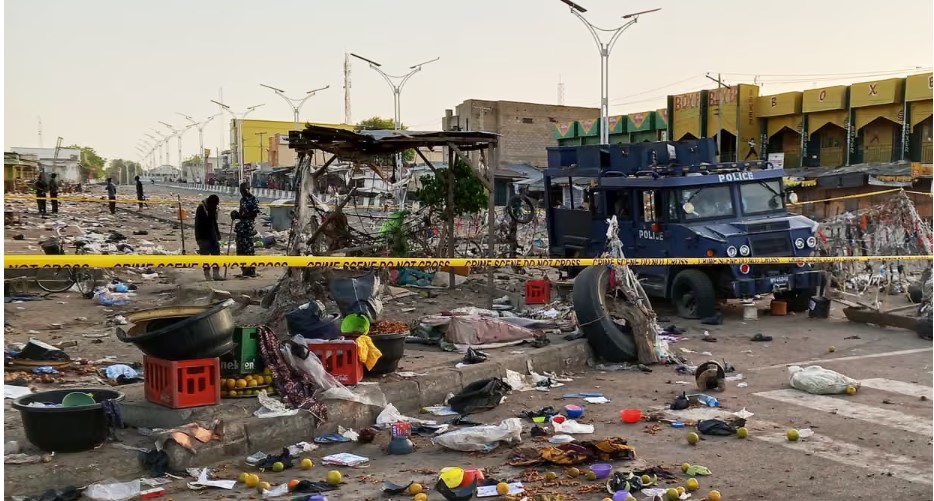
AT least 1,932 people were killed across Borno, Adamawa and Yobe states between April and June 2026, according to the latest humanitarian access snapshot released by the United Nations Office for the Coordination of Humanitarian Affairs (OCHA).

News Point Nigeria reports that the figure is contained in OCHA’s 2026 Second Quarter Humanitarian Access Snapshot for the three North-East states, compiled by the Humanitarian Access Working Group using data from the Armed Conflict Location and Event Data Project and the UN Mine Action Service.

The report identified insecurity, attacks on humanitarian workers and assets, bureaucratic bottlenecks, and a harsh physical environment as the major factors constraining humanitarian operations across the region during the period under review.

A breakdown of the data showed that 60 explosive ordnance incidents were recorded across the three states during the quarter, representing a 10.5 per cent decline from the 67 incidents documented during the corresponding period in 2025.


Similarly, incidents involving improvised explosive devices (IEDs) dropped from 65 to 54, reflecting a 16.9 per cent decrease, while civilian casualties linked to explosive ordnance and IEDs fell sharply from 163 to 54, representing a 66.9 per cent reduction.
According to the report, the reduction in explosive-related incidents was largely attributed to intensified joint military operations conducted by the Armed Forces of Nigeria and United States forces in northern and central Borno State. It added that civilians also became more cautious about movement because of heightened insecurity.
“The high-tempo nature of US and AFN military operations witnessed during this period contributed to a reduction in IED/EO incidents.
“Additionally, civilians aware of the heightened insecurity and threats by NSAGs moved around less during this period, contributing to a narrowing of the locations affected by IEDs this quarter,” the report stated.
Despite the reduction in explosive incidents, OCHA noted that the military operations triggered retaliatory attacks by non-state armed groups on Monguno, Damasak, Damboa, Bama, Konduga, Marte, Dikwa, Kukawa, Mobbar and Gwoza local government areas in Borno State, as well as Gujba in Yobe State and Madagali in Adamawa State, many of which were hosting civilians recently relocated from other communities.

The report further disclosed that health and nutrition partners suspended operations in Dapchi, Bursari Local Government Area, on April 4 following repeated attacks by non-state armed groups.
It added that similar attacks compelled humanitarian organisations to temporarily suspend activities in Madagali town and scale down operations in Chibok in early April after armed raids on both locations.
According to the report, Nigerian troops successfully repelled an attack on Bazamri village in Konduga Local Government Area on May 13, as well as another assault on Alou Dam, located a few kilometres from Maiduguri, on May 31.


OCHA also disclosed that 11 airstrikes were carried out in Borno State during the quarter, with the most significant targeting Jilli Market, situated on the boundary between Gubio and Geidam local government areas, on April 12. Most of the remaining air operations were concentrated in the Sambisa Forest and Mandara Mountains.
The report also highlighted an increase in attacks on humanitarian personnel and relief assets compared to the first quarter of 2026.
It revealed that a truck transporting humanitarian supplies was attacked and looted near Gubio town on April 11, while two staff members of a non-governmental organisation were abducted in Monguno on June 24.
On June 29, government troops repelled another attack on a truck returning to Maiduguri after delivering relief materials to Damasak. However, the driver sustained critical injuries after the vehicle ran over an IED near Kareto in Mobbar Local Government Area.
Beyond security challenges, OCHA noted that harsh environmental conditions also hampered humanitarian access, revealing that a bridge collapsed due to flooding in Rann town on June 18.
The report linked the development to the Nigerian Meteorological Agency’s 2026 Seasonal Climate Prediction, which forecast an early and above-normal rainy season across most parts of the country.
It also pointed to bureaucratic challenges that affected humanitarian operations during the quarter.
According to OCHA, the military imposed restrictions on the transportation of fertiliser without official permits across the three states to prevent non-state armed groups from accessing materials used in manufacturing improvised explosive devices.
While the measure was aimed at strengthening security, the report said it disrupted farming activities as many farmers were preparing for the planting season.
OCHA disclosed that it intervened to obtain approvals that enabled humanitarian partners to transport fertiliser to farmers in hard-to-reach communities.
The report added that a spike in fuel prices arising from the US-Israel conflict with Iran further increased the cost of transporting humanitarian supplies across the region.
It further revealed that on June 1, state authorities intercepted a truck carrying humanitarian supplies and demanded additional approvals before allowing the cargo to proceed.