

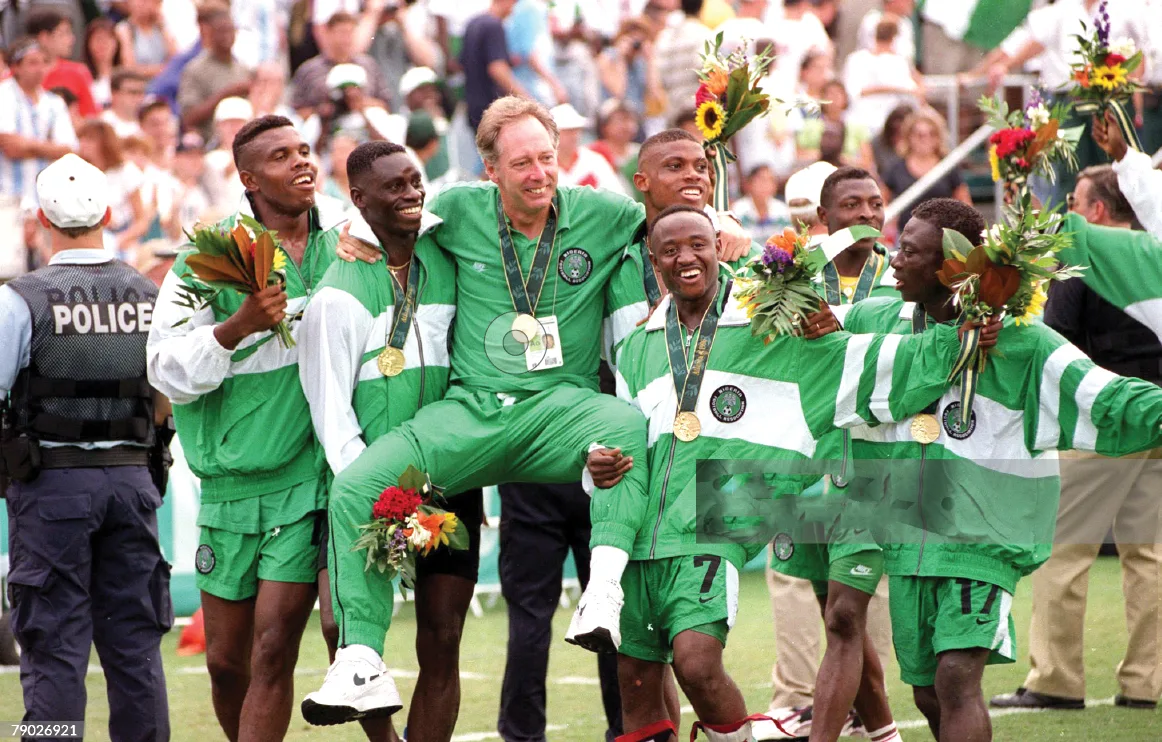
THIRTY years after leading Nigeria to its first and only Olympic football gold medal, former Dream Team coach Johannes “Bonfrère” Jo has expressed disappointment that the Nigerian government is yet to recognise or reward his contribution to one of the nation’s greatest sporting achievements.
News Point Nigeria Sport reports that Bonfrère, who guided the Dream Team to Africa’s first-ever Olympic football gold at the Atlanta 1996 Olympic Games, said he remains saddened that while many players and officials were honoured, he has yet to receive any reward from the government. He also revealed that the Olympic gold medal presented to him after the historic triumph was stolen while it was in the custody of a team official.
Bonfrère led a talented Nigerian side featuring Nwankwo Kanu, Austin Okocha, Daniel Amokachi, Taribo West, Celestine Babayaro, Garba Lawal and Emmanuel Amuneke to one of the greatest stories in Olympic football history.

Nigeria defeated Brazil 4-3 after extra time in a memorable semi-final before staging another dramatic comeback to beat Argentina 3-2 in the final at the Sanford Stadium in Athens, Georgia, becoming the first African nation to win Olympic football gold.


While many members of the victorious squad received national honours, cash rewards and houses in the years that followed, Bonfrère believes his own contribution has largely been forgotten.
The 80-year-old Dutchman disclosed that the Olympic gold medal he received after Nigeria’s historic triumph was stolen, describing the incident as one of the most painful memories of his association with Nigerian football. He lamented that despite leading the Dream Team to Africa’s first-ever Olympic football gold, he not only missed out on government recognition but also lost the medal that symbolised the greatest achievement of his coaching career.
“They were claiming that everyone has received their rewards, but I have not received anything; they have never given me the reward for winning the gold medal,” Bonfrère told this newspaper.
“Even my gold medal was stolen from me, and I still didn’t get a reward from the government, which all the players have received, including players who were not on the list.”
Recounting how the medal disappeared, the Dutch tactician said he was prevented from following the players upstairs by a team official, only to later discover that the medal was missing.

“I don’t know how the medal was collected from me; I only know that when the players went upstairs, an official stopped me from going with them and the medal was gone,” he said.
Bonfrère also revealed that his repeated efforts to seek recognition from the relevant authorities had yielded no results, despite reaching out on several occasions.
The retired coach, however, said he has not given up hope and would be grateful if the Federal Government or the appropriate authorities eventually acknowledged his contribution to Nigeria’s greatest Olympic football achievement.


“I will be happy if something can be done because I have made several calls and sent messages but nobody was interested in helping me,” he said.
Three decades after the unforgettable Atlanta 1996 Olympic Games, the historic achievement remains Nigeria’s greatest performance since the country’s Olympic debut in 1952. For Bonfrère, however, the anniversary evokes mixed emotions, serving as a painful reminder of what he describes as 30 years without the recognition or reward he believes he deserves.
As celebrations continue to honour the players and officials who made history in Atlanta, Bonfrère expressed hope that the milestone would also inspire reflection on those whose contributions, according to him, have remained largely unrecognised.