

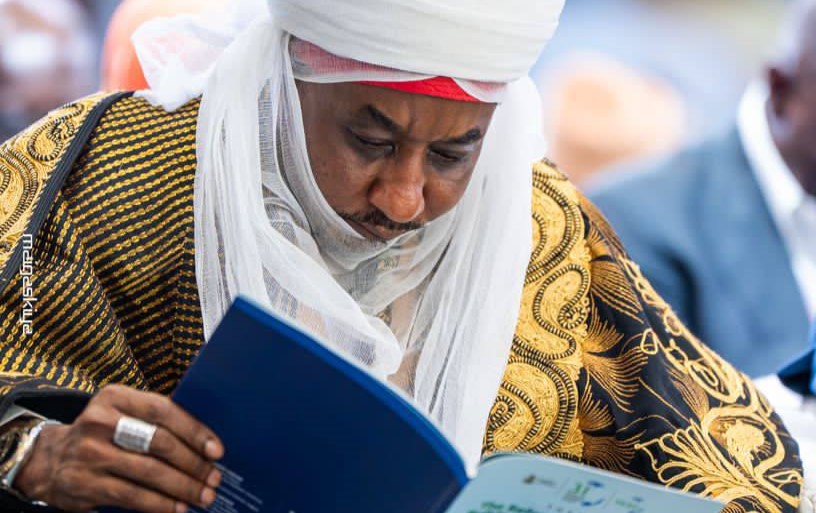
THE 16th Fulani Emir of Kano, Khalifa Muhammadu Sanusi II, has returned to the classroom after being granted a special admission into the Bachelor of Laws (LL.B) Common Law and Sharia programme at Northwest University, Kano.
The admission was formally approved in a letter dated January 12, 2026, obtained by News Point Nigeria and signed by the Head of the Directorate of Examinations, Admissions and Records, Jafaru Muhammad, on behalf of the Registrar of the institution.
The admission was confirmed on Thursday after the admission letter was shared on the social media platform X (formerly Twitter) by former presidential aide, Bashir Ahmad.


According to the letter, the Emir’s admission followed a formal application submitted to the university and was approved after he satisfied the institution’s requirements for special consideration.
The approval places the traditional ruler at Level 200 in the Faculty of Law, with effect from the 2024/2025 academic session.
“With reference to your application for special admission into this University, I write to convey the University approval of your admission into Northwest University, Kano after satisfying the University requirements for special consideration.
“Accordingly, you have been accepted for admission into LL.B. Common Law and Sharia degree programme in the Faculty of Law, Level 200, with effect from 2024/2025 Academic Session,” the letter read.
The university noted that the admission is subject to the Emir’s full compliance with the rules and regulations outlined in the Northwest University Student Handbook.
It also directed Dr. Sanusi to complete all necessary registration formalities by reporting to various units within the institution, including the Directorate of Examinations, Admissions and Records, ICT Unit, Bursary Department, Faculty and Departmental Offices, University Library, and the Student Affairs Division.

Dr. Sanusi, a former Governor of the Central Bank of Nigeria and a renowned economist and Islamic scholar, is widely regarded for his intellectual pursuits and advocacy for education, governance reform, and social justice.
His decision to pursue a law degree combining Common Law and Sharia has drawn public attention, with many observers describing it as a rare example of lifelong learning at the highest levels of traditional leadership.

