

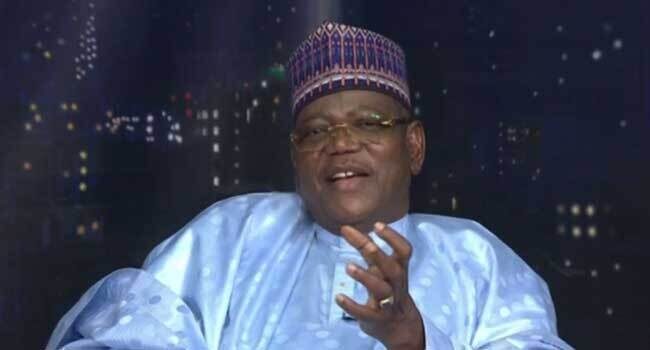
A FORMER Governor of Jigawa State and chieftain of the Peoples Democratic Party (PDP), Sule Lamido, has called for urgent reconciliation within the opposition party, including dialogue with the Minister of the Federal Capital Territory, Nyesom Wike, in what marks a significant shift from his earlier hardline position.
News Point Nigeria reports that speaking in an interview, Lamido acknowledged that while he had previously demanded disciplinary action against Wike, the current political realities facing the PDP now make reconciliation the only viable path for the party’s survival ahead of the 2027 general elections.
Lamido admitted he had been one of Wike’s most vocal critics during the height of the PDP crisis, even calling for his expulsion over alleged anti-party activities and threatening to boycott meetings of the party’s Board of Trustees.

“The shift is not about endorsing Wike’s actions but about confronting political reality,” he explained, noting that the PDP has been significantly weakened by internal divisions and high-profile defections.


The former governor painted a grim picture of the party’s current condition, describing it as being in a “comatose state” with weak structures and leadership challenges.
He pointed out that the PDP currently lacks a fully constituted national executive elected through a convention, while legal disputes and internal wrangling have further undermined its credibility.
Lamido also referenced developments involving the Independent National Electoral Commission (INEC), suggesting that internal disputes have created confusion over legitimate party leadership.
According to Lamido, the defection of several influential governors and party leaders to the ruling All Progressives Congress (APC) has dealt a severe blow to the PDP.
He argued that these defections have not only weakened the party structurally but also strengthened the administration of President Bola Ahmed Tinubu.

“Those who were accusing Wike are now the ones inside the APC,” he noted, adding that political survival instincts have driven many of the defections.
Lamido stressed that the PDP’s challenges go beyond individuals like Wike, describing the crisis as structural and existential.
He revealed that party stakeholders have resolved to prioritise reconciliation over litigation, including a decision not to pursue further legal battles following recent court rulings on party leadership.


As part of the rebuilding process, he proposed expanding the party’s caretaker committee to include all factions, including those aligned with Wike and other key stakeholders.
“If the committee is inclusive, we can sit together as one family and organise a proper convention to elect a legitimate leadership,” he said.
With the electoral timetable approaching, Lamido warned that time is running out for the PDP to put its house in order.
He emphasised that without a functional structure, the party would struggle to nominate candidates for key positions, including governorship, legislative seats, and the presidency.
“All of us are fatigued, Wike, Governor Seyi Makinde, Bala Mohammed, everybody,” he said. “The only realistic solution now is reconciliation.”
Despite advocating dialogue, Lamido maintained that Wike cannot dominate or redefine the party’s identity.
“The PDP is bigger than any individual,” he said, stressing the need for collective decision-making and respect for the party’s legacy.
On calls for former President Goodluck Jonathan to return as the PDP’s presidential candidate, Lamido said the idea is unrealistic under the current circumstances.
He argued that no individual, regardless of stature, can fix a divided party, insisting that unity must come first before any discussion about candidates.
Lamido confirmed that the PDP has already zoned its 2027 presidential ticket to the South, allowing any qualified candidate from the region to contest.
However, he warned that credible aspirants may be reluctant to join a party plagued by internal chaos.
“The purpose of contesting is to win. Without unity, you cannot win,” he said.
Dismissing claims that the PDP is no longer relevant, Lamido insisted the party remains a major force in Nigerian politics.
“If the PDP is truly dead, why are people still talking about it?” he asked, describing such claims as attempts to weaken the opposition.
Despite the challenges, Lamido expressed optimism that the PDP can recover if it embraces reconciliation and rebuilds its internal structures.
He urged members to avoid inflammatory rhetoric and focus on unity, warning that continued infighting could further damage the party’s chances in 2027.