

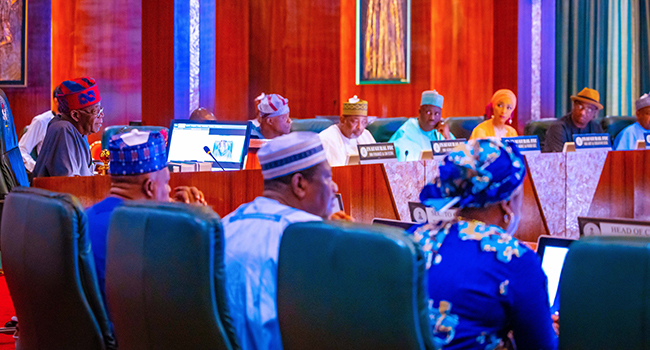
WITH barely 24 hours to the expiration of the deadline issued by Bola Ahmed Tinubu for political appointees seeking elective offices to resign, no serving minister has stepped down from the Federal Executive Council, raising questions over compliance and political calculations ahead of the 2027 general elections.
Checks by News Point Nigeria indicate that despite the clear directive, cabinet members and top aides are adopting a cautious approach, with many reportedly waiting for political assurances before making any decisive move.
However, in what appears to be the first concrete response to the directive, Nasir Bala Aminu, Senior Special Assistant to the President on Citizenship and Leadership, popularly known as Ja’oji, has resigned his position over the weekend to pursue his political ambition.


President Tinubu had directed all political appointees intending to contest in the 2027 elections to resign on or before March 31, 2026.
The directive, conveyed through the Office of the Secretary to the Government of the Federation, is anchored on Section 88(1) of the Electoral Act, 2026, as well as the timetable released by Independent National Electoral Commission (INEC) for party primaries.
The circular affects a wide range of officials, including ministers, ministers of state, special advisers, senior special assistants, heads of government agencies, and chief executives of parastatals.
According to the presidency, failure to comply with the directive may automatically disqualify affected appointees from participating in party primaries while retaining their current offices.
Investigations reveal that no fewer than 14 top appointees, including several ministers, are preparing to contest governorship elections in their respective states.
Among them are: Bosun Tijani (Ogun), Hakeem Muri-Okunola (Lagos), Saidu Alkali (Gombe), Abubakar Kyari (Borno), Yusuf Maitama Tuggar (Bauchi), Muhammad Ali Pate (Bauchi) and Adebayo Adelabu (Oyo)

Others include senior government officials heading key agencies such as the Federal Housing Authority, Nigerian Shippers Council, and the Petroleum Technology Development Fund.
Despite their ambitions, sources close to the appointees say most are reluctant to resign due to uncertainty surrounding their political futures.
Key among their concerns is the absence of what insiders describe as “clear signals” or assurances from the presidency and the ruling All Progressives Congress (APC) regarding ticket allocation.


Many of the aspirants are reportedly seeking guarantees that they will secure the party’s nomination before relinquishing their current positions.
“There is fear of taking a leap without assurance,” a source familiar with the situation disclosed. “Resigning without a guarantee could mean losing both the office and the ticket.”
Another source noted that some appointees are wary that resignation could be misinterpreted by the President as a sign of disloyalty or dissatisfaction.
“The directive didn’t come with encouragement. Any hasty move could be seen as being ungrateful or politically insensitive,” the source said.
Further findings by this newspaper indicate that some ministers are deliberately delaying their decisions to use the ongoing APC National Convention as an opportunity to gauge the mood within the presidency and party leadership.
Sources revealed that consultations are ongoing, with many aspirants engaging key stakeholders and political power brokers to secure backing before taking the final step.
The situation is further complicated by uncertainties at the state level, where some aspirants lack the support of incumbent governors and are instead relying on the presidency to influence outcomes.
The hesitation among appointees is also shaped by past political experiences.
During the administration of Goodluck Jonathan, several ministers resigned to contest elections, but only a few succeeded in securing party tickets.
For instance, Darius Ishaku successfully clinched the PDP governorship ticket after resigning, while Samuel Ortom failed to secure the PDP ticket and later defected to the APC to realise his ambition.
Similarly, Bala Mohammed reportedly declined to contest in 2015 after assessing the political climate, choosing instead to retain his ministerial position.
In contrast, during the era of Olusegun Obasanjo, political appointees were said to have clearer assurances of support, enabling smoother transitions into electoral contests.
Without explicit endorsement from the President or party leadership, aspirants risk political isolation, financial loss, and diminished influence.
“The stakes are extremely high,” a Professor of Political Science at Bauchi, Umar Katagum told News Point Nigeria. “You are not just resigning from a job; you are stepping into a very uncertain political battlefield.”
As the March 31 deadline draws closer, pressure is mounting on political appointees to make critical decisions that could shape their political careers.
While some may still comply at the last minute, others may opt to retain their positions and forfeit their ambitions, at least for now.