

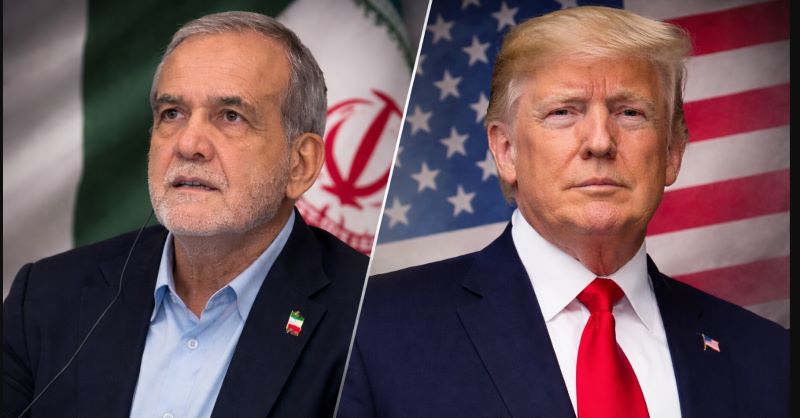
UNITED States President Donald Trump has called off a planned military attack on Iran just hours after threatening to strike key Iranian oil facilities, claiming that negotiations had reached a breakthrough and moved to the highest levels of Iran’s leadership.
The dramatic reversal was announced Thursday in a post on Truth Social, roughly five hours after Trump warned that the United States military would be “taking Kharg Island” and other Iranian oil infrastructure sites in the near future.

“Based on the fact that discussions with the Islamic Republic of Iran have been brought to the highest level of Iranian leadership and approved, I have, as President of the United States of America, cancelled the scheduled strikes and bombings against Iran this evening,” Trump wrote.


The US president further claimed that discussions and final points had been approved “in both concept and great detail” by all parties involved.
“Discussions and final points have been, in both concept and great detail, approved by all parties involved, including the United States, Israel, Saudi Arabia, UAE, Qatar, Turkey, Pakistan, Bahrain, Kuwait, Jordan, Egypt, and others,” he stated.
Trump added that while military action had been suspended, the US naval blockade of Iranian ports would remain in effect until a final agreement is formally concluded.
“The naval blockade will remain in full force and effect until this Transaction is finalized — Time and place of the signing to be announced shortly,” he said.
Speaking later to reporters in the Oval Office, Trump disclosed that the finalisation of documents could take place within days, with a possible signing ceremony expected somewhere in Europe.
He also indicated that the strategically important Strait of Hormuz would be reopened once the agreement is officially signed.

Despite Trump’s announcement, Iran has yet to formally confirm the claims.
Iranian Foreign Ministry spokesman Esmaeil Baghaei was quoted by the semi-official Tasnim news agency as saying that Tehran remained committed to its “red lines,” suggesting that important issues may still be unresolved.
Israel, which partnered with the United States in launching military operations against Iran, also appeared cautious about the reported breakthrough.


In a statement, Israeli Prime Minister Benjamin Netanyahu revealed that he had discussed the negotiations with Trump and expressed appreciation for Washington’s position on key demands.
According to Netanyahu, those demands included the removal of enriched uranium, the dismantling of Iran’s nuclear programme, restrictions on missile production and the cessation of support for groups Israel describes as terrorist proxies.
While Trump portrayed the negotiations as nearing completion, few concrete details of the proposed agreement have emerged, leaving uncertainty about the exact commitments made by either side.
Reporting from Qatar, Al Jazeera correspondent Osama Bin Javaid said several regional powers, including Qatar, Egypt, Türkiye and Pakistan, had been actively involved in efforts to secure a final agreement in recent days.
“Still, there is not enough clarity that the Iranian supreme leader has signed off on this, so we’ll have to wait and see until this becomes public and all sides are willing to share where exactly the compromise has been,” he said.
The announcement marked a sharp departure from Trump’s earlier rhetoric on Thursday when he signalled plans for a third wave of military strikes against Iran.
“At some point in the not too distant future, we will be taking Kharg Island, and other oil infrastructure points, and assume total control of their Oil and Gas Markets,” Trump had written earlier in the day.
He compared the proposed operation against Iran to an earlier US military intervention in Venezuela.
According to Trump, the United States launched military action against Venezuela on January 3, abducted then-president Nicolas Maduro and subsequently assumed control over the country’s oil exports.
Under US pressure, Maduro’s successor, Delcy Rodriguez, was said to have implemented reforms that opened Venezuela’s state-controlled oil industry to foreign investment.
Kharg Island remains one of Iran’s most strategically significant energy assets, processing approximately 90 percent of the country’s crude oil exports. The facility is often referred to as the “Forbidden Island” because of its heavy military protection and restricted access.
In a subsequent interview with Fox News on Thursday morning, Trump reiterated that taking control of Kharg Island had long been his preferred option.
“I don’t know that America has the stomach for it, to be honest,” he said.
The president, however, maintained that he remained reluctant to deploy American ground troops into Iran, signalling continued reservations about a broader military engagement despite his earlier threats.