

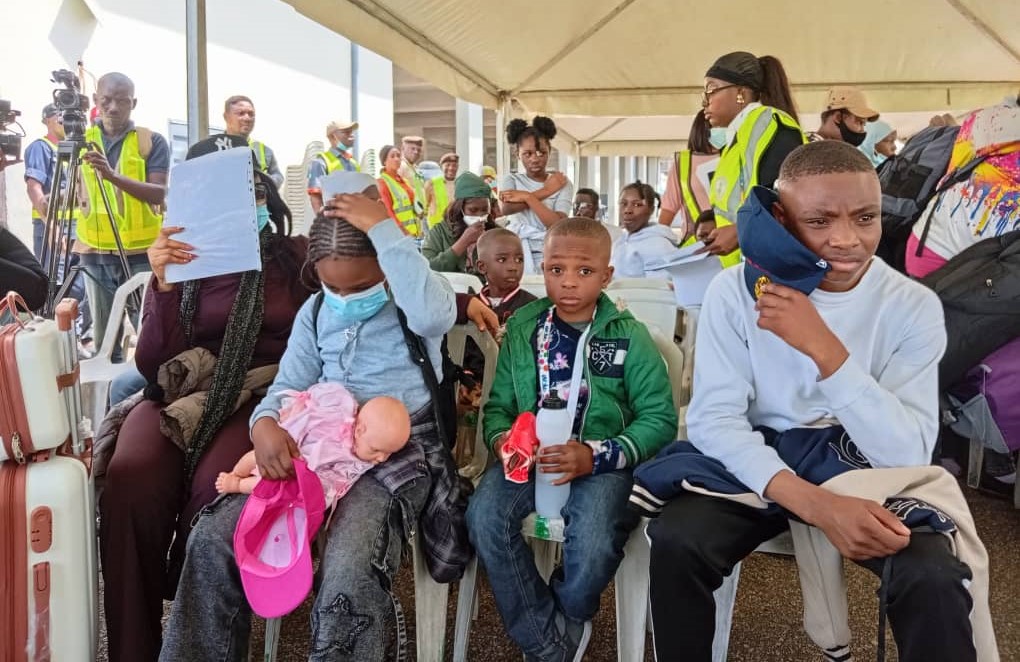
RETURNING Nigerians have narrated what they described as years of hardship, discrimination and neglect in South Africa, saying their experiences were worsened by a recent rise in xenophobic violence targeting foreign nationals.
News Point Nigeria reports that relief, gratitude and joy filled the atmosphere at the Murtala Muhammed International Airport in Lagos on Thursday morning as the first batch of repatriated Nigerians arrived home.
Heaves of relief, sighs of gratitude and bursts of laughter erupted among the returnees as they touched down on Nigerian soil after years of living abroad under increasingly difficult circumstances.


At least 258 Nigerians made up the first batch of citizens repatriated from South Africa.
Many of them spoke of prolonged struggles with documentation, discrimination in public institutions, hostility from locals and growing insecurity linked to anti-immigrant sentiments.
One of the returnees, Milly Abu, told journalists that she had lived in South Africa for 23 years but was unable to secure proper documentation due to what she described as a difficult and cumbersome system.
According to Abu, who worked as a tutor in Pretoria, obtaining legal documents in South Africa involved lengthy and challenging procedures.
She explained that she was eventually forced to close down her spa studio after authorities intensified crackdowns on undocumented migrants.
Abu said she largely stayed at home as a parent during that period, while her children regularly returned from school with stories of discrimination and prejudice.

“Most teachers, they criticise kids that are from outside. They don’t regard them the same way that they regard other kids that are in South Africa,” Abu said.
“They treat them different, they talk badly about Nigerian nationals, just to make other kids to feel supreme or to feel more bigger than other kids.
“It actually took a toll on my kids. The kids would always come back from school and also inform me that, ‘oh, mommy, this is what I went through at school.


“The teacher was criticizing’, or ‘the teacher would make a comment that, ‘oh, be careful of Nigerians, they’re kidnappers’, or there are some certain things, very bad words.”
Abu further alleged that discrimination extended beyond schools and affected other sectors of society, including healthcare services, where foreign nationals often faced unequal treatment.
Another returnee, Emilia Godwin, 45, described the experiences of many Nigerians in South Africa as deeply painful, alleging that foreigners were often treated as second-class citizens.
Speaking with journalists after her arrival, Godwin said many Nigerians endured mistreatment but felt powerless to challenge it because they were foreigners.
“I’m not happy with them. I am still saying it. Now I’m in my country. I have my mouth to speak. They are wicked, they don’t like us,” Godwin said.
“If you enter a taxi, they make jest of you, they pull you. They beat you. We’re just like a slave there; we don’t have mouth to talk. If we talk too much, they will start hitting, speaking their language.”
She said her experiences had left such a lasting impression that she had no intention of ever returning to South Africa.
“I will never go to South Africa anymore. Even if my child is born there, she will never go to South Africa anymore,” she added.
Godwin also alleged that some South African women deliberately targeted Nigerian men in relationships to gain access to their property and belongings.
Referring to the death of her husband, she said, “the way they killed my husband,” adding that the incident reinforced her determination never to return to the country.
Having lived in South Africa since 2014, Godwin said she had noticed signs of growing xenophobia over the years but lacked the opportunity to leave earlier.
Recent anti-immigrant protests in South Africa have often been justified by demonstrators on the grounds that undocumented migrants pose security concerns and place pressure on public resources.
However, another returnee identified simply as Henry insisted that even migrants with valid legal documents were not spared from harassment and discrimination.
“I went through a lot because when they come to you, they will ask you (for) your papers, even when you show your valid papers, they still find something to hold on (to),” Henry said.
“Because of that they will try to do one or two things to you, and you will not be happy about that.”
Despite the difficulties he faced, Henry said he was grateful to have returned home safely.
“I’m home, this is my country.
“Nobody will ask me, ‘where is your passport? Where is your document?’ I’m very happy.
“My parents, my brother, siblings, everybody will welcome me. At least I came back alive. They will see me alive.”
For many of the returnees, the homecoming marked the end of years of uncertainty, fear and hardship, as they expressed hope for a fresh start in Nigeria after enduring what they described as persistent discrimination and hostility in South Africa.