

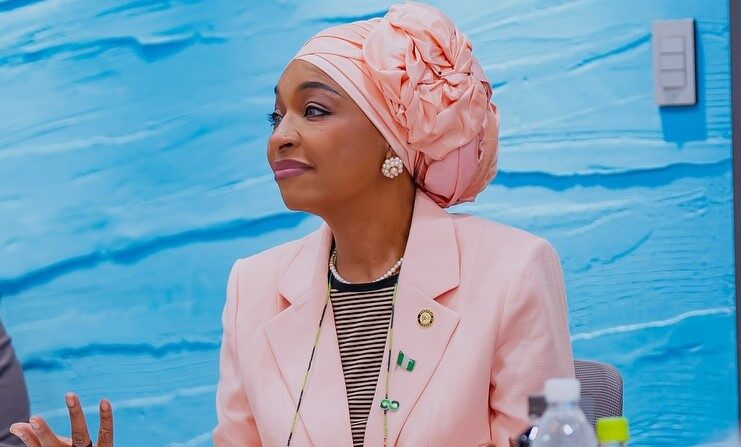
MINISTER of Art, Culture, Tourism and Creative Economy, Barrister Hannatu Musa Musawa, has paid an emotional tribute to the heroes and martyrs of Nigeria’s democratic struggle, urging citizens to uphold the values of unity, sacrifice and active participation that gave birth to the nation’s democracy.
News Point Nigeria reports that in a specially written Democracy Day spoken-word piece titled “Honouring the Heroes of June 12th,” Musawa reflected on the sacrifices of prominent figures who paid dearly for the restoration of democratic governance in Nigeria, including Alhaja Kudirat Abiola, General Shehu Musa Yar’Adua, Chief Alfred Rewane and numerous other pro-democracy activists.
The minister described June 12 as one of the most defining moments in Nigeria’s political history, noting that it demonstrated the capacity of Nigerians to rise above ethnic, religious and regional divisions in pursuit of a common national purpose.

According to her, the sacrifices made by democracy advocates continue to serve as a reminder that the responsibility of sustaining democracy rests with every citizen.


Below is the full text of the spoken-word tribute:
HONOURING THE HEROES OF JUNE 12TH
By Barrister Hannatu Musa Musawa
Minister of Art, Culture, Tourism and Creative Economy
…On a Tuesday, 4th of June, 1996, around 3:05 pm something unbelievable happened that shook the core of the struggle for democracy in Nigeria.
Kudirat Abiola was gunned down as her car slowed down around 7-Up Depot/Bus Stop in Ikeja, Lagos State. She was instantly killed along with her chauffeur and assistant.
Many people who knew her opined that her death brought a beautiful, brilliant and bold life, which she was generally believed to have lived, to an untimely end.

With her death, a new chapter was opened in Nigeria’s political history, as the deceased became one of the prominent martyrs in the struggle for a truly democratic nation.
The outspoken wife of Chief M.K.O. Abiola gave her life for this country and, even in death, she remains a symbol of Nigeria’s struggle for democracy.
She is one of several Nigerians who paid the supreme price in their quest for a better, freer and democratic Nigeria.


Another of such martyrs was General Shehu Musa Yar’Adua.
After serving in the military and as the Third Republic beckoned, Yar’Adua and his group formed the People’s Front of Nigeria.
Its members included current President Bola Tinubu, Babagana Kingibe, Atiku Abubakar, Magaji Abdullahi, Ango Abdullahi, Ahmadu Rufa’i, Rabiu Musa Kwankwaso, Tony Anenih, Chuba Okadigbo and many other great Nigerians.
The People’s Front later merged to form the Social Democratic Party (SDP).
About two years after the 1993 elections, he, alongside Olusegun Obasanjo, Lawan Gwadabe and others, was arrested on allegations of plotting a coup against the military regime.
He was sentenced to death by a military tribunal after calling on the military government and the Provisional Ruling Council to restore civilian rule.
Although the sentence was later commuted to life imprisonment, Yar’Adua died in captivity on December 8, 1997.
Just five days after Nigeria celebrated her independence anniversary on October 1, 1995, another prominent pro-democracy activist and businessman was murdered at his residence in Ikeja, Lagos State.
He was Chief Alfred Rewane.
A major financier of the National Democratic Coalition (NADECO) and a close associate of Chief Obafemi Awolowo, Rewane’s residence served as a meeting point for political leaders whose consultations eventually led to the formation of NADECO.
The organisation became one of the most vocal opponents of military rule in Nigeria.
He was among the courageous pro-democracy advocates who stood firmly against military dictatorship.
Sadly, he paid the ultimate price.
Chief Alfred Rewane remains one of the great Nigerians who truly “gave their yesterday for the liberty that is ours today.”
Democracy Day, crystallised and officially recognised as June 12 by former President Muhammadu Buhari in 2018, remains permanently etched in our national consciousness.
It is a day set aside to honour the heroes who championed the democratic struggle and made extraordinary sacrifices to enthrone democratic governance in Nigeria.
History reminds us that on June 12, 1993, an estimated 14 million Nigerians put aside ethnic, religious, class and regional differences to elect a president, hoping to bring an end to years of military rule.
At the time, Nigeria’s Third Republic featured only two political parties — the Social Democratic Party (SDP) and the National Republican Convention (NRC).
The candidates were two patriotic Nigerians: Chief M.K.O. Abiola of the SDP and Alhaji Bashir Tofa of the NRC.
At the conclusion of the election, Chief Abiola was widely believed to have secured the majority of votes, including in Kano State, the home state of his opponent.
However, before the final declaration of results, the election was annulled.
The decision shattered the hopes of millions of Nigerians and fractured the trust that had emerged from a rare national consensus.
Like the title of Fela Anikulapo-Kuti’s 1977 album, June 12 and its triumphs came with “Sorrow, Tears, and Blood.”
Something was lost on that day.
Something greater than ethnic or religious identity.
Something that transcended sectional interests and celebrated national unity.
June 12 remains one of the most significant moments in Nigeria’s democratic history because it rose above the divisions that often define political discourse.
Nigerians from different regions, religions and cultures overwhelmingly supported Chief Moshood Abiola, not because of where he came from, but because they believed in his leadership, vision and promise.
June 12 offered a glimpse of a united Nigeria where competence, hope and shared aspirations mattered more than tribe, ethnicity or religion.
Although the election was annulled, its legacy continues to remind us that Nigerians possess the capacity to reject division, embrace inclusiveness and strengthen democracy through a common purpose.
June 12 brought together the democratic aspirations of Nigerians from every part of the country and demonstrated the power of collective civic action free from ethnic, religious and tribal considerations.
In light of the examples set by the heroes of democracy, every Nigerian has a role to play in advancing democratic governance.
Our Constitution guarantees every citizen the right to participate.
Democracy thrives only when citizens actively engage in shaping the future of their country.
While our individual sacrifices may not mirror those made by the heroes who gave their lives for democracy, participation itself remains essential.
Democracy is not about party affiliation alone.
It is about recognising that every citizen possesses both a voice and a vote.
The future of our democracy depends on our willingness to use them.
The right to participate in democracy is not merely a privilege; it is a responsibility that empowers each of us to influence the direction of our nation.
We must rise above ethnic, religious and regional divisions.
We must recognise that our shared identity as Nigerians is greater than the differences that seek to divide us.
The sacrifices of our democratic heroes have shown us this truth.
The future of Nigeria is not something that simply happens to us.
It is something we build together, one responsible citizen at a time.
That is precisely what the heroes of democracy did.
Through courage, resilience, sacrifice and an unwavering commitment to Nigeria, they fought for a nation where every citizen’s voice matters.
Our democracy will continue to flourish when we honour and embrace the values exemplified by Kudirat Abiola, Mallam Aminu Kano, Alex Ekwueme, Solomon Lar, Chuba Okadigbo, Shehu Musa Yar’Adua, Prof. Wole Soyinka, Chief Ayo Adebanjo, Frank Kokori, Dr Beko Ransome-Kuti, Chief Gani Fawehinmi and many other great heroes of democracy.
These men and women remained vigilant, responsible and willing to sacrifice personal comfort for the progress of Nigeria.
On that Tuesday, June 4, 1996, at about 3:05 pm, Nigeria lost a remarkable heroine as she fought for the spirit of June 12.
May the sacrifice of Kudirat Abiola continue to remind Nigerians of the need to strengthen and improve our democracy.
Despite our challenges, we can build a better democratic society by honouring her legacy not only with words, but through actions that place the common good above personal, ethnic and partisan interests.
That is the enduring lesson left behind by the heroes of June 12 and the champions of democracy in Nigeria.