

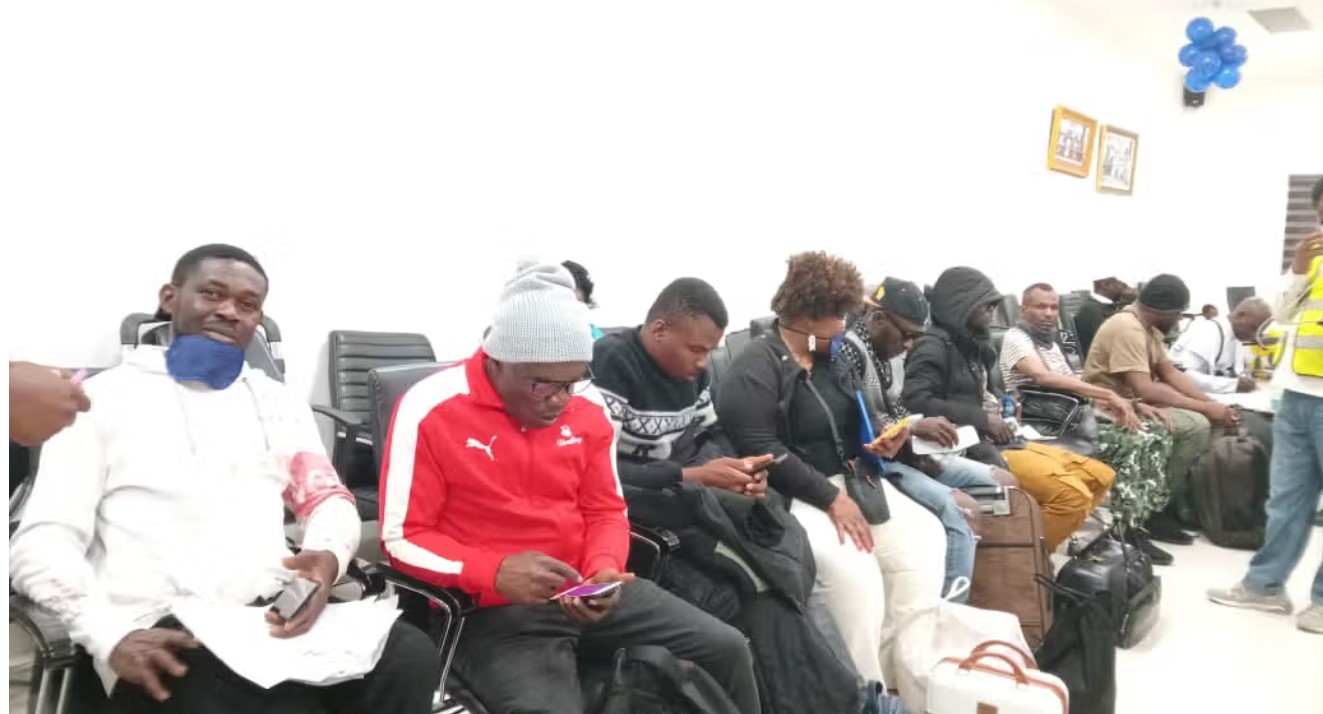
A FRESH batch of 83 Nigerians repatriated from South Africa has arrived in Lagos, as the Federal Government renewed its call on the South African authorities to take urgent and concrete measures to end xenophobic and Afrophobic attacks against African nationals in the country.
The returnees arrived aboard a South African Airways flight from Johannesburg and landed at the Murtala Muhammed International Airport on Wednesday evening.
News Point Nigeria reports that Kimiebi Ebienfa, spokesperson for the Federal Ministry of Foreign Affairs, said in a statement that the returnees were accompanied by two officials from the Consulate-General of Nigeria in Johannesburg.

“The Ministry wishes to reiterate the fact that the repatriation exercise of this batch of returnees was facilitated through the procurement of flight tickets by good-spirited private individuals, whose generous support enabled their safe return to Nigeria,” the statement read.


The returnees were received in Lagos by Haruna Ali-Gombe, the Director of African Affairs Department at the Ministry of Foreign Affairs.
Ebienfa said Ali-Gombe welcomed them on behalf of the Federal Government and thereafter handed the returnees over to the relevant government agencies for necessary documentation and profiling ahead of their reunification with their families.
“The Federal Government remains committed to the welfare and safe return of all Nigerian citizens abroad and expresses profound appreciation to the Nigerian Mission in South Africa, the private individuals who sponsored the exercise, and all agencies involved in ensuring a smooth reception and reintegration process,” he added.
The latest repatriation of 83 Nigerians is in addition to the 1,490 Nigerians who were earlier repatriated in seven batches from South Africa.
However, following the repatriation exercise, the Nigerian High Commission in South Africa opened an online portal for citizens seeking to participate in another repatriation exercise.

The Federal Government has urged other corporate organisations, state governments and individuals to emulate the “worthy examples” of the private individuals who sponsored the latest repatriation.
The latest return of Nigerians comes as the Federal Government called on South Africa to take urgent and concrete measures to end xenophobic and Afrophobic attacks against African nationals in the country.
The government also urged stronger migration governance, responsible political leadership and deeper people-to-people relations across the continent to prevent further violence against migrants.


The Minister of State for Foreign Affairs, Amb. Sola Enikanolaiye, made the call on Tuesday at a virtual roundtable on “South Africa’s Xenophobia in Comparative Perspective,” convened by the Nigerian Institute of International Affairs.
According to a statement issued on Wednesday by his Special Adviser, Digital Media and Public Diplomacy, Raphael Oni, the minister stressed that Nigeria viewed the situation as a challenge that must be addressed without either denial or exaggeration, arguing that the term Afrophobia more accurately captured the nature of the attacks.
He described the violence as having “a particularly African, post-colonial and post-apartheid character.”
The minister expressed concern over the irony of citizens from countries that supported South Africa during its anti-apartheid struggle now being treated as “unwanted outsiders.”
To preserve the historical record of Nigeria’s role in South Africa’s liberation struggle, Enikanolaiye said the Ministry of Foreign Affairs had directed the NIIA to undertake a comprehensive study documenting the country’s support for the struggle.
He said Nigeria’s financial commitment to the liberation struggle was estimated at more than $60bn, in addition to the nationalisation of British Petroleum, provision of scholarships and hospitality extended to South African leaders in Nigeria.
“The relationship between Nigeria and South Africa is not reducible to trade statistics or diplomatic communiqués. There is history in that relationship. There is blood, sacrifice and solidarity in that history,” the minister said.
Enikanolaiye said Nigeria was particularly concerned about the loss of lives resulting from Afrophobic violence, disclosing that about 90 Nigerians had been killed in such attacks since June 2022.
He added that fresh attacks and displacement had been recorded in 2026.
According to him, the continued violence threatens South Africa’s international reputation, investor confidence and regional integration, while also diminishing the moral authority the country earned through its liberation struggle.
To address the problem, the minister called on South African authorities to strengthen transparent and humane migration systems and ensure that enforcement of immigration laws remained the sole responsibility of the state.
He warned against vigilantism and urged political leaders to exercise restraint in their rhetoric, noting that descriptions of migrants as “criminals” or “job thieves” could create an environment conducive to violence.