

NO fewer than 146 candidates currently in the race for the 2027 presidential and governorship elections could collectively spend up to N571bn under the campaign expenditure limits prescribed by the Electoral Act 2026.
The figure comprises 19 presidential candidates, each with a campaign spending ceiling of N10bn, and 127 governorship candidates, each allowed to spend a maximum of N3bn under Section 92 of the new Electoral Act.

News Point Nigeria reports that the 19 presidential candidates alone have a combined spending ceiling of N190bn, while the 127 governorship candidates could collectively spend up to N381bn.

The combined ceiling for the two categories therefore stands at N571bn, although the amount represents the maximum permissible expenditure and not money guaranteed to, or actually received by, the candidates.


The development comes as the Independent National Electoral Commission published the personal particulars and credentials of the 19 presidential candidates and their running mates ahead of the 2027 poll, paving the way for the commencement of the presidential campaign on Wednesday, August 19, 2026.
According to the election tracker NGelections.com, 127 candidates across 28 states will be running for governor in 2027. Of the number, 122 have been nominated, four have declared, and one is still being monitored.
A check on the INEC website showed that the commission had yet to publish the total number of 2027 governorship candidates, with its official 2027 election page stating under the list of candidates that, “This will be available soon.”
INEC has confirmed that governorship elections will be held in 28 states in 2027, with Anambra, Bayelsa, Edo, Ekiti, Imo, Kogi, Ondo and Osun excluded because they are on the off-cycle schedule.
The commission had fixed January 16, 2027, for the presidential and National Assembly elections, while the governorship and State House of Assembly elections are scheduled for February 6, 2027.

Section 92 of the Electoral Act 2026 substantially raises the amount candidates are permitted to spend on election campaigns compared with the previous statutory limits.
Under the new law, a presidential candidate may spend up to N10bn, while a governorship candidate is limited to N3bn.
For the National Assembly, the ceiling is N500m for a senatorial candidate and N250m for a House of Representatives candidate.


A candidate seeking election to a State House of Assembly may spend up to N100m, the same ceiling prescribed for an Area Council chairmanship candidate, while the maximum campaign expenditure for an Area Council councillorship election is N10m.
The law also places a ceiling on individual contributions to candidates, providing that no individual donor may contribute more than N500m to a single candidate.
Section 92 further provides sanctions for candidates who knowingly exceed the prescribed limits.
Such a candidate faces a fine equivalent to one per cent of the permitted expenditure limit, or imprisonment for up to 12 months, or both.
The provision makes compliance with the new spending thresholds a statutory obligation rather than a voluntary guideline.
The PUNCH could not confirm if INEC has successfully prosecuted and secured a conviction against a Nigerian politician specifically for exceeding the statutory election or campaign spending limit.
Also, there is no reported case of a politician or party being prosecuted for exceeding campaign-spending limits.
When asked how INEC would enforce the spending limits, the INEC National Commissioner and Chairman, Information/Voter Education Committee, Mohammed Haruna, simply stated, “It’s the Commission’s statutory responsibility to monitor the campaign finance of all political parties.”
The anti-graft agencies are expected to collaborate with INEC in monitoring and enforcing the spending limits.
The restriction on individual donations means that while a presidential candidate can spend as much as N10bn, a single donor cannot contribute more than N500m.
Similarly, a governorship candidate’s N3bn spending ceiling is six times the maximum individual donation.
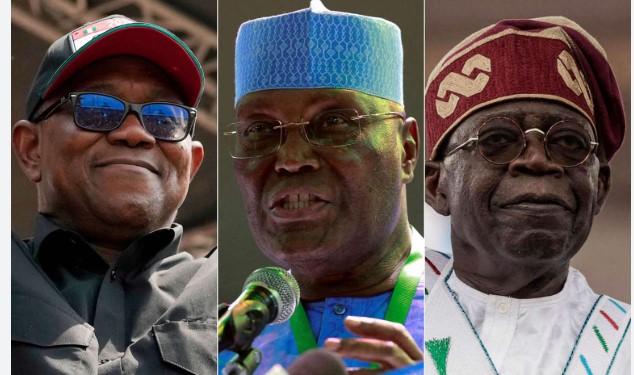
The presidential race features incumbent President Bola Tinubu of the All Progressives Congress; former Vice-President Atiku Abubakar of the African Democratic Congress; and former Anambra State Governor Peter Obi of the Nigeria Democratic Congress, among 16 other candidates.
INEC’s published list includes 19 presidential candidates and their running mates, with the commission making their personal information and credentials available for public scrutiny in accordance with the Electoral Act.
The field also includes PDP candidate Sandy Onor, African Action Congress candidate Omoyele Sowore, Peoples Redemption Party candidate Donald Duke, Social Democratic Party candidate Adewole Adebayo and Allied Peoples Movement candidate Seyi Makinde.
Other candidates are from the National Democratic Party, Young Progressives Party, Action Alliance, Boot Party, Democratic Liberty Alliance, Zenith Labour Party, Labour Party, National Rescue Movement, Action Democratic Party, New Nigeria Peoples Party and Action Peoples Party.
With each presidential candidate permitted to spend up to N10bn, the 19-man field represents a theoretical campaign expenditure ceiling of N190bn.
At the state level, the number of candidates is considerably higher. The latest election data currently tracks 127 governorship candidates from 18 political parties across the 28 states scheduled to hold governorship elections in 2027.
The APC and PDP have the largest number of candidates, with 28 each, followed by the ADC with 21, Labour Party with 16 and NDC with nine.
The SDP has six candidates, while APM, PRP and Accord have three each. Other parties have a smaller number of candidates.
At N3bn per candidate, the 127 governorship candidates have a collective statutory spending ceiling of N381bn.
When added to the N190bn available to the 19 presidential candidates, the potential maximum expenditure rises to N571bn.
The figure should not, however, be interpreted as an indication that N571bn will actually be spent during the campaigns.
It represents the aggregate amount that the candidates could lawfully spend if each candidate reached the maximum permitted under Section 92.