

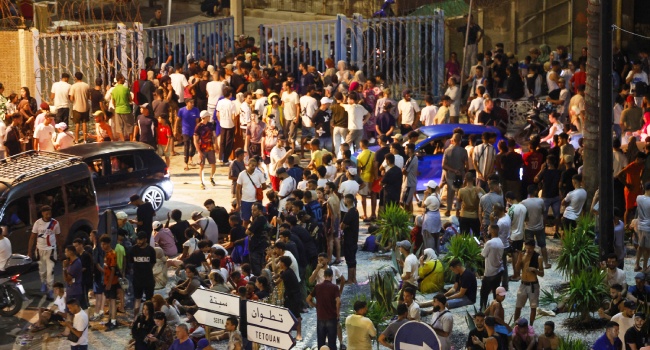
BETWEEN 3,000 and 5,000 migrants remain in the Spanish territory of Ceuta following the arrival of many times that number of people last week, the north African exclave’s leader has said.
Juan Jesús Vivas told the European Parliament of his “profound sorrow” over the “irreparable tragedy” of 100 deaths that had occurred after roughly 78,000 migrants from neighbouring Morocco arrived by sea in a matter of hours.

His comments come as new calls for mass crossings circulate on social media, according to Moroccan media.

The crisis has created tensions among EU nations who share open borders and has sparked criticism of the Spanish government.


However the EU Commission has commended Spain’s “swift response” to the crisis, which has included deploying armed forces to Ceuta and its other territory on the north African coast, Melilla.
Vivas, a conservative, was critical of the national government’s response while addressing the European Parliament on Thursday, saying that he had personally told Socialist Prime Minister Pedro Sánchez that it had been late and insufficient.
“The fact that we don’t have numbers on how many are still in Ceuta shows how few resources we have to deal with this situation,” Ceuta’s mayor-president said. Previous warnings by local officials of an increase in migrant crossings by sea had been ignored, he said.
Vivas said that while the return of nearly 75,000 migrants to Morocco had “considerably alleviated” the situation, Ceuta had not yet returned to normal.
There was still a humanitarian emergency and disturbances to public order in the territory, he said, while it was “basically impossible” to return the minors who had crossed because this required their consent.

Spain’s interior minister has said the government had allocated €25m (£21.4m; $28.8m) to assist minors in Ceuta.
However, Spanish newspaper El Mundo reports that 4,860 migrant children have been registered by volunteer groups in Ceuta – double official estimates.
“Neighbours are taking them into their homes, but the situation is unsustainable,” a volunteer told the paper.


So far no migrant children have been moved to mainland Spain, with right-wing local authorities reluctant to take them in, according to El País.
While some on the right have pointed to an agreement with Morocco stipulating co-operation on returning migrant children to their families, Melilla’s conservative leader has called for a “gesture of solidarity” from his mainland colleagues.