

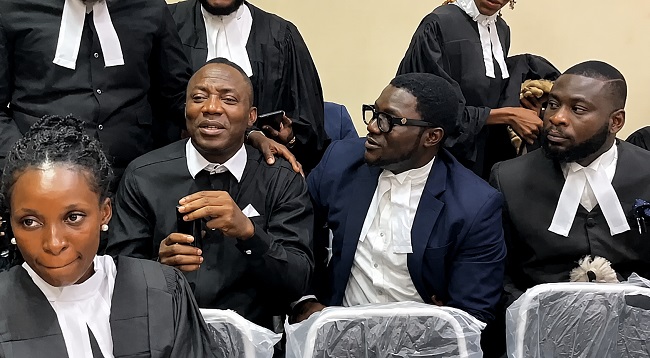
TEMPERS flared at the Federal High Court in Abuja on Monday after counsel to Omoyele Sowore, Adeyinka Olumide-Fusika (SAN), engaged in a heated exchange with prosecuting counsel, Akinlolu Kehinde (SAN), describing him as a “persecutor” rather than a prosecutor during the continuation of the activist’s criminal trial.
News Point Nigeria reports that the courtroom drama erupted after the defence sought another adjournment, blaming the court registry for its inability to obtain a Certified True Copy (CTC) of documents it said were crucial to the continuation of its case.

Addressing Justice Muhammed Umar, Fusika explained that although the defence had been “reliably informed” that a witness from the Department of State Services (DSS) was present in court in compliance with a subpoena issued to the agency’s Director-General, Oluwatosin Ajayi, it could not proceed because it had yet to receive the certified court records.

According to the senior advocate, the defence applied for the Certified True Copy on July 22, 2026, but was repeatedly informed by officials of the court registry that the trial judge had not approved the request.


He, however, disclosed that the defence later discovered Justice Umar had actually approved the application on July 27.
“Obviously, the fault is not from Your Lordship’s end. It is a registry issue. The document is prefatory to the continuation of the defence,” Fusika submitted.
Opposing the application for adjournment, prosecuting counsel Kehinde accused the defence of deliberately frustrating the trial and unnecessarily prolonging the case.
He reminded the court that at the previous sitting, both parties had agreed that a nominated DSS officer would appear to testify for the defence, noting that the prosecution had fulfilled its own part of the agreement.
“That part of the agreement was kept by the prosecution,” he said, adding that the witness was in court to testify in relation to Exhibit DWD.

Kehinde argued that it was the responsibility of the defence, having applied for the document, to diligently pursue the request at the registry instead of waiting until the hearing date.
He therefore urged the court to foreclose the defence’s case, maintaining that several opportunities had already been granted without any meaningful progress.
“We further submit that it is a discretionary case management procedure, and it is not a breach of the constitutional right to fair hearing. Section 36(4) and (6) of the 1999 Constitution guarantees only the opportunity to be heard, not an unlimited right to delay the matter, as in the instant case,” he argued.


Responding, Fusika maintained that the prosecution had failed to address the facts placed before the court and had instead chosen to blame the defence for circumstances beyond its control.
He insisted that the defence had not engaged in any dilatory tactics, adding that it could easily have insisted on the personal attendance of the subpoenaed DSS Director-General if its intention was merely to delay proceedings.
The senior advocate further argued that the defence had no way of determining when the judge approved its application and could only rely on the information supplied by officials of the court registry.
Relying on Sections 4 to 13 of the Evidence Act, Fusika argued that the documents being sought were material to the defence’s intended line of questioning.
He also dismissed claims that the defence was deliberately delaying the proceedings, describing such allegations as “insulting,” particularly considering the expense and effort involved in attending court sessions.
Justice Umar observed that since the prosecution closed its case, the defence had called only one witness and that the matter had already been adjourned about four times at the instance of the defence.
Fusika then presented a detailed chronology of events beginning from June 22, 2026, when he took over the conduct of the case, in an effort to demonstrate that the defence had acted diligently throughout the proceedings.
Proceedings, however, took a dramatic turn when Kehinde rose to make further submissions and Fusika interrupted him, remarking that the prosecuting counsel was behaving like a “persecutor” rather than a prosecutor.
The comment immediately drew a rebuke from Justice Umar, who warned the senior advocate against making any further outbursts in court.
The judge cautioned that any recurrence of such conduct would result in his referral to the “appropriate disciplinary bodies.”
Justice Umar subsequently adjourned the matter until September 20, 2026, for the continuation of the defence, stating that he could not proceed further with the hearing.
At the previous sitting, the defence withdrew its subpoena seeking to compel the Director-General of the DSS to testify after the prosecution argued that the evidence sought through the witness had already been admitted twice during the course of the trial.
The Federal Government is prosecuting Sowore on a two-count charge of cyberbullying, accusing him of referring to President Bola Tinubu as a “criminal” on his official social media platforms, X and Facebook. Sowore has, however, pleaded not guilty to the charges.