

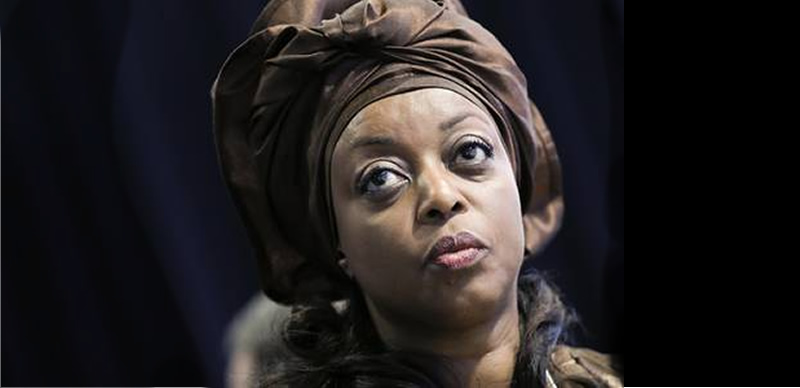
THE Economic and Financial Crimes Commission (EFCC) has urged the Federal High Court in Abuja to disregard evidence of former Petroleum Minister Diezani Alison-Madueke’s acquittal by a United Kingdom court in a suit challenging the forfeiture of her assets.
The commission made the request in a further counter-affidavit filed in opposition to Diezani’s application seeking to introduce evidence of her acquittal by the Southwark Crown Court in London as a subsequent development in the case.

Diezani was acquitted on June 17, 2026, of criminal allegations of bribery brought against her in the UK.

In the suit before the Federal High Court, the former minister is challenging, among other things, an EFCC public notice for the auction and sale of properties and personal effects which she contends affect her proprietary rights.


She had asked the court to allow her to introduce the UK acquittal as a material development relevant to the determination of her case.
However, in the counter-affidavit filed on October 5, Oyakhilome Ekienabor, a litigation officer in the law firm of Mofesomo Oyetibo, counsel to the EFCC, argued that the acquittal was irrelevant to the issues before the Nigerian court.
News Point Nigeria reports that Ekienabor maintained that the proceedings before the Southwark Crown Court were separate from the Nigerian case and had no bearing on the substantive suit.
“The proceedings before the Southwark Crown Court, London, United Kingdom, and the purported acquittal of the applicant therein, are in respect of a proceeding that is not being prosecuted before any Nigerian court and have nothing to do with the substantive suit before this honourable court,” the affidavit reads.
The EFCC counsel further argued that the forfeiture order in question related exclusively to jewellery and did not extend to other assets or properties belonging to Diezani.

“The order for forfeiture relates exclusively to items of jewellery and does not extend to any other category of assets or properties,” he said.
The commission also contended that Diezani’s supplementary affidavit introduced irrelevant facts and was an attempt to divert the attention of the court from the substantive issues raised in the suit.
The EFCC consequently urged the court to discountenance the supplementary affidavit to the extent that it seeks to introduce evidence relating to Diezani’s UK acquittal.


However, Diezani had argued that the acquittal constituted a material development which occurred after she filed her earlier court processes and should therefore be considered by the Nigerian court.
Her counsel, Mike Ozekhome, said the development was relevant to issues including the absence of a conviction, fair hearing, due process and the propriety of depriving his client of her property.
Ozekhome also maintained that Diezani was not asking the Federal High Court to sit on appeal over the UK decision or regard the acquittal as automatically conclusive of the Nigerian proceedings.
Rather, he argued that the acquittal should be considered as a subsequent material fact in determining the issues before the court.
At Tuesday’s proceedings, Queen-Ubokutom Uwe, who appeared for Diezani, informed the court that the EFCC had served her legal team with the further counter-affidavit shortly before the hearing.
Counsel for the EFCC, Paul Mgbeoma, told the court that the commission was ready to proceed with the matter.