

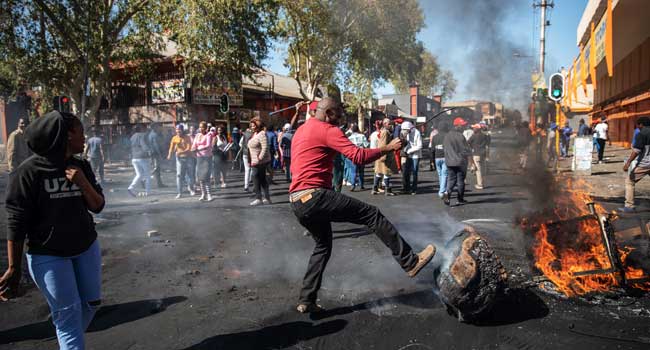
THE first batch of Nigerian nationals being evacuated from South Africa following rising xenophobic attacks is expected to arrive in the country on Thursday, as the Federal Government begins the repatriation of affected citizens.
In a statement sent to News Point Nigeria on Wednesday, the spokesperson for the Ministry of Foreign Affairs, Kimiebi Ebienfa, disclosed that the evacuees would depart South Africa on Wednesday night and arrive in Lagos early Thursday morning.

“The Ministry of Foreign Affairs wishes to inform that the first batch of Nigerian nationals that will be evacuated from the Republic of South Africa due to Xenophobic attacks will depart the Oliver Thambo International Airport in Johannesburg on Wednesday night, and the expected time of arrival at the Murtala Mohammed International Airport in Lagos is 5.00 am on Thursday morning,” the statement read in part.

According to the ministry, the evacuation operation will be carried out by Air Peace, with the Federal Government bearing the full cost of the exercise.


“The evacuation operation will be undertaken by Air Peace Airlines. The Federal Government of Nigeria has fully funded the evacuation exercise; consequently, all affected Nigerians will be repatriated at no cost to them,” the statement added.
Ebienfa assured Nigerians that the government, through relevant Ministries, Departments and Agencies (MDAs), had made adequate arrangements to receive and support the returnees upon arrival.
“Upon arrival, the evacuees will undergo documentation and profiling procedures and will receive the appropriate assistance and support before being reunited with their families,” he stated.
The evacuation follows growing tensions in South Africa after a citizen-led group opposed to irregular migration last month ordered all undocumented foreign nationals to leave the country by June 30.
While countries such as Ghana and Mozambique have already repatriated hundreds of their citizens, Nigeria and Malawi also announced plans to evacuate affected nationals.

Last week, Nigeria disclosed plans to repatriate more than 1,000 of its citizens from South Africa.
“Total figure not out yet,” Ebienfa said. “We are expecting over a 1,000 persons.”
In a related development, Nigeria’s High Commission in Pretoria revealed that it had negotiated waivers with South African authorities to enable Nigerians with immigration-related offences to leave the country through the repatriation programme rather than face detention.


According to the mission, the arrangement would ensure that affected Nigerians are allowed to board evacuation flights and return home safely.
The evacuation comes amid growing diplomatic concern over reports of hostility directed at Nigerians and other black African migrants in South Africa.
On Monday, the Minister of Foreign Affairs, Bianca Odumegwu-Ojukwu, disclosed that Nigeria was considering possible retaliatory measures in response to the attacks.
When asked whether the Federal Government was contemplating sanctions or other retaliatory actions, the minister said the option remained under consideration.
“Well, that is a situation that we are considering. This is up to our legislature,” she said.
“This is a decision that has to be taken at the highest level of government, but it’s not off the table.”
South Africa, which is grappling with an unemployment rate of more than 30 percent, has witnessed recurring waves of xenophobic protests over the years, with renewed violence reported in recent weeks.
The latest tensions have reignited debate across Africa over migration, xenophobia and the widening gap between pan-African ideals and the realities faced by migrants on the continent.
An ultimatum issued by a citizen-led group demanding that undocumented migrants leave South Africa by June 30 has heightened fears of fresh violence, recalling previous anti-immigrant unrest that claimed dozens of lives.
Last month, Ghana repatriated about 300 of its nationals, the first batch of what authorities projected could rise to approximately 800 citizens returning home.
The South African government has maintained that it is intensifying efforts to enforce immigration laws against undocumented migrants but has repeatedly urged citizens not to take the law into their own hands.
According to South Africa’s national statistics agency, more than three million foreign nationals currently reside in the country, representing about 5.1 percent of the population.
The agency further noted that over 63 percent of the foreign population originates from countries within the 16-member Southern African Development Community.
As evacuation efforts begin, Nigerian authorities say they remain committed to ensuring the safe return and reintegration of all affected citizens while continuing diplomatic engagements over the treatment of Nigerians and other African migrants in South Africa.