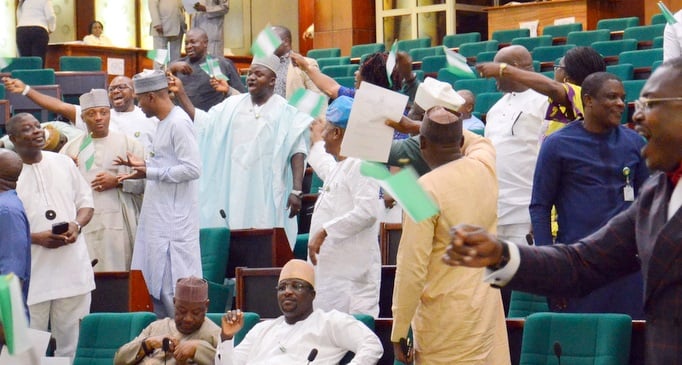
PROCEEINGS at the House of Representatives on Wednesday descended into a heated confrontation after lawmakers disagreed over a motion seeking to invite President Bola Ahmed Tinubu to explain alleged delays in the implementation of the 2025 Appropriation Act.
News Point Nigeria reports that the disagreement broke out during plenary when the member representing Okpe/Sapele/Uvwie Federal Constituency of Delta State, Benedict Etanabene, raised a point of privilege concerning a circular issued by the Accountant-General of the Federation, Shamseldeen Ogunjimi.

Read also: Reps Summon DMO, TCN Over Irregular N54.57tn Borrowing, N446.7bn Debt

Etanabene drew the attention of lawmakers to the June 29 directive, which ordered all federal Ministries, Departments and Agencies (MDAs) to immediately suspend the processing of payments for constituency and Zonal Intervention Projects (ZIPs) unless such projects had been formally reviewed and cleared by the Federal Ministry of Special Duties and Intergovernmental Affairs.


The lawmaker expressed concern that the directive could slow down the implementation of projects already captured in the 2025 budget and frustrate lawmakers’ efforts to deliver development projects to their constituents.
He argued that the circular introduced an additional administrative requirement that was not contained in the Appropriation Act, warning that it could further delay the execution of the national budget.
Etanabene subsequently called on the House to invite President Tinubu to provide explanations on the slow pace of budget implementation and the reason behind the new directive, stressing that the executive owed both Nigerians and the National Assembly accountability on the matter.

Read also: 2027: Tompolo Donates 25 Vehicles To Tinubu’s Re-Election Campaign In Kogi
However, the proposal immediately triggered opposing reactions among lawmakers, with some members rejecting the idea of summoning the President while others backed the move.

The disagreement escalated into a heated exchange, with lawmakers shouting across the chamber and briefly disrupting legislative proceedings over whether the President should be invited to address the House.
The controversy was linked to the June 29 circular issued by the Accountant-General of the Federation, directing MDAs to stop processing payments for constituency and zonal intervention projects until approval was obtained from the Ministry of Special Duties and Intergovernmental Affairs.
The directive was introduced as part of efforts to strengthen oversight and ensure proper monitoring of constituency and intervention projects funded through the federal budget.


Read also: Makinde Reveals How Tinubu Picked Adelabu As Power Minster Over His Nominee
However, critics of the move argued that the additional clearance process could slow down the release of funds and negatively affect the timely execution of projects already approved under the 2025 Appropriation Act.
The lawmakers are expected to continue deliberations on the matter as concerns grow over the impact of the directive on budget implementation and constituency projects nationwide.