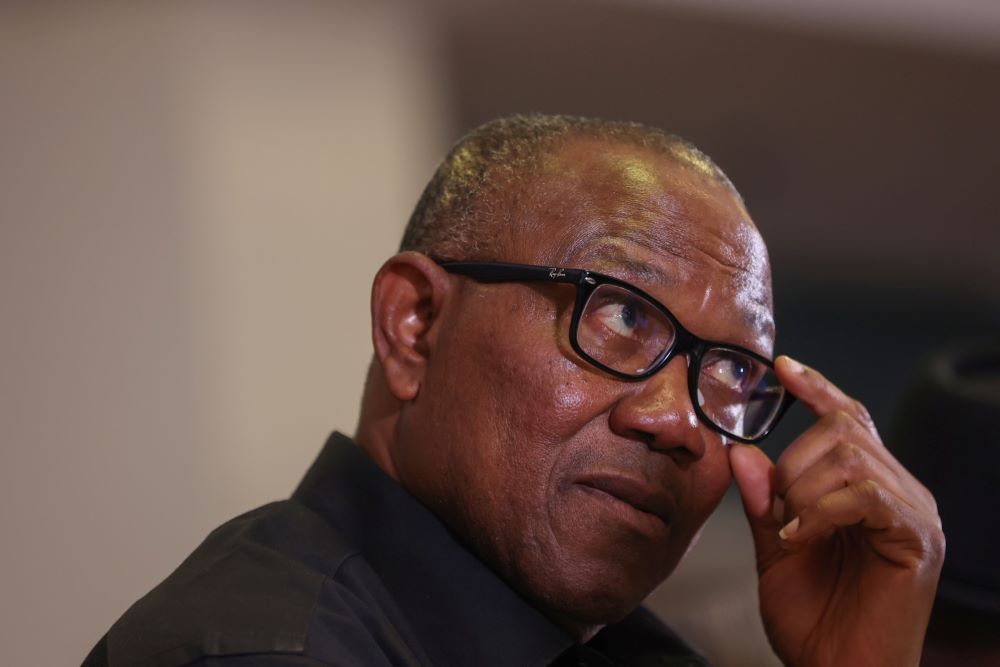
THE presidency has criticised Peter Obi, presidential candidate of the Nigeria Democratic Congress (NDC), over his call for President Bola Tinubu to resign following Keir Starmer’s announcement that he would step down as British prime minister.
News Point Nigeria reports that Starmer announced on Monday that he would step down amid public dissatisfaction over economic challenges and unmet campaign promises.

Read also: Makinde Reveals How Tinubu Picked Adelabu As Power Minster Over His Nominee

Obi said he was inspired to reflect on political accountability after listening to Starmer’s resignation speech, arguing that Nigerian leaders should also be held accountable for governance failures.


Reacting in a statement, Bayo Onanuga, special adviser to the president on information and strategy, described Obi’s position as “misplaced” and based on a flawed comparison between the political systems of the United Kingdom (UK) and Nigeria.
“Peter Obi’s latest comments calling for President Bola Tinubu’s resignation, based on a comparison with the British Prime Minister’s voluntary exit, are not only misplaced but also reflect a selective and distorted view of Nigeria’s realities since 2023,” the statement reads.
He added that Obi “forgets our country does not run a parliamentary system of government like the UK,” stressing that Nigeria operates a presidential system with a fixed four-year electoral mandate for the president.
Onanuga said recent election victories recorded by the All Progressives Congress (APC) in Ekiti and some senatorial districts reflected continued public support for Tinubu and his administration.
He argued that Obi should wait until the 2027 presidential election to test public opinion on Tinubu’s performance rather than calling for resignation at this stage.

“Obi should wait until the presidential election to know what the people think of Tinubu’s government. Moving to use X to harangue the President out of office is off the mark and anti-democratic,” he said.
The presidential spokesperson also defended Tinubu’s handling of security challenges, noting that the administration inherited longstanding insecurity issues but had recorded successes through military operations and the rescue of kidnapped victims.
“It is important to note that President Tinubu did not inherit a country in perfect shape. The security challenges we face today are longstanding and deeply rooted,” he said.


He further criticised Obi personally, stating that it was “laughable” for the former Anambra governor to attack the president on security matters.
Read also: Tinubu Welcomes World Bank Report, Says Economic Reforms Are Delivering Results
“It is laughable that Obi, who, as governor, was a colossal failure, unable to secure lives and property in his small state of Anambra, is now the one calling for President Tinubu’s resignation over security breaches in some parts of the country,” Onanuga added.
Onanuga also rejected Obi’s claim that Nigeria is in its worst condition, citing positive quarterly gross domestic product (GDP) growth, rising foreign reserves, increased oil production, and improved government revenues since Tinubu assumed office in May 2023.
According to him, Tinubu inherited a struggling economy and has implemented reforms that previous administrations avoided.
“When he came on board in May 2023, President Tinubu introduced bold, courageous policies that his predecessors had shied away from,” he said, adding that Nigeria’s economy had recorded positive GDP growth every quarter, surpassing the global average.
The presidency also faulted Obi’s criticism of the administration’s performance in the power sector, insisting that Tinubu never promised 24-hour electricity supply for all Nigerians.
Onanuga accused Obi and his supporters of misrepresenting Tinubu’s campaign remarks during the 2023 election period.
According to him, what the president said was: “Whichever way, by all means necessary, you will have electricity, and you will not pay for estimated bills anymore. A promise made will be a promise kept. If I don’t keep the promise and I come for a second term, don’t vote for me — unless I give you adequate reasons why I couldn’t deliver.”
He added that the administration had since signed the Electricity Act, expanded prepaid metering, and increased investments in off-grid power projects, while efforts continued to address transmission constraints and attract further investment into the sector.
While acknowledging Nigeria’s high cost of living, Onanuga attributed the situation partly to global economic disruptions and geopolitical tensions, including those in the Middle East.
He described Obi’s call for Tinubu’s resignation as politically motivated rather than a genuine push for accountability.
Read also: APC Slams Atiku For Addressing Tinubu As ‘Bola’, Says 2027 Campaign Will Focus On Achievements
“Peter Obi’s call for President Tinubu’s resignation is childish and hollow. It is not a call to hold the leader accountable. It is merely a political grandstanding and an unworthy distraction,” he said.
Onanuga insisted that President Tinubu remains focused on reforms, economic stabilisation, improved security operations, and laying the groundwork for long-term national prosperity.